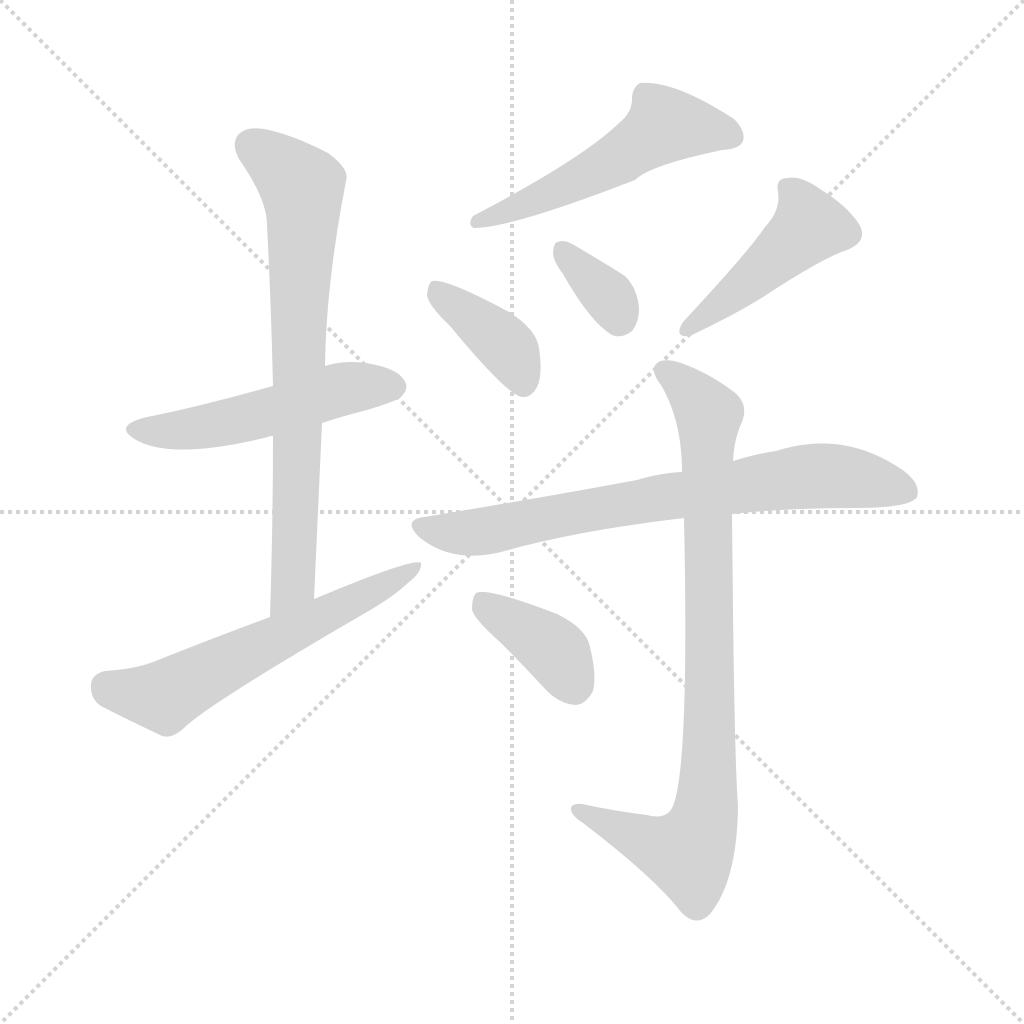
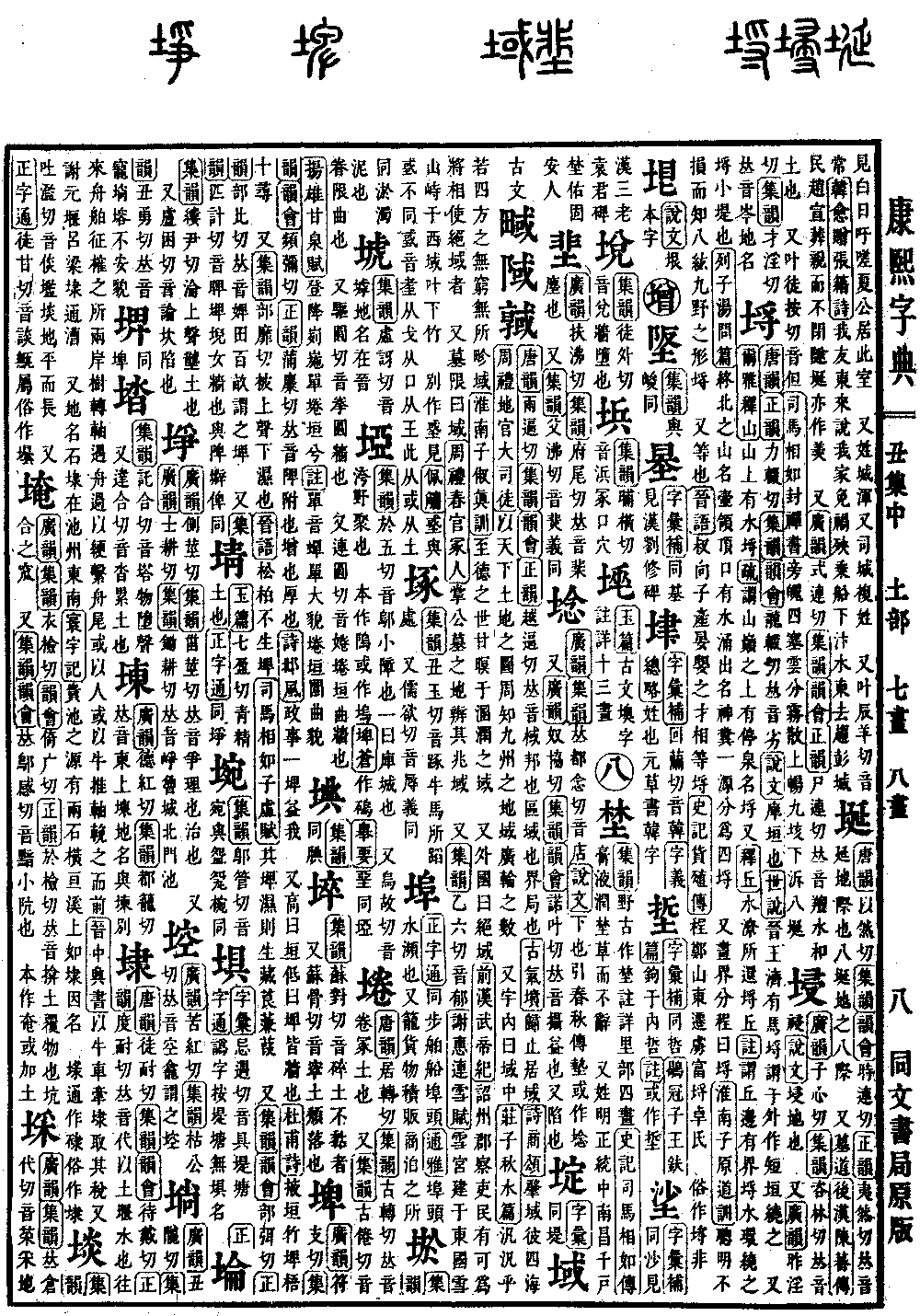
Chou Collection, Middle Volume. Radical: Earth (tǔ). Kangxi stroke count: 10. Page 230, Entry 12.
Pronounced lie. In the Shuo Wen Jie Zi (Shuowen), it refers to a low wall. In the A New Account of Tales of the World (Shishuo), it is noted that Wang Ji of the Jin dynasty had a horse enclosure, meaning a low wall was built to surround it.
Also, in the Er Ya (Erya), it is noted that water on top of a mountain is called lie. The commentary explains this as accumulated spring water atop a mountain peak.
In the section regarding mounds, it is noted that a place where rainwater flows and circles is called a lie hill. The commentary explains that this refers to a small ridge forming a boundary at the edge of an earth mound, where water flows around it; lie is a small embankment. In the Liezi (Liezi), it is mentioned that the northernmost mountain is called Huling, and from a vent on its peak flows water called the divine excrement, which divides into four channels known as lie.
It also refers to marking boundaries or distinguishing scopes. In the Huainanzi (Huainanzi), it states that intelligence is not diminished, allowing one to know the configurations and boundaries of the eight directions and nine fields.
It also means to be equal or equivalent. In the Discourses of the States (Jin Yu), it is stated that the talents of Shuxiang, Zichan, and Yanying were equivalent. In the Records of the Grand Historian (Shiji), it is noted that Cheng Zheng was a captive moved from east of the mountains, and his wealth was equivalent to that of the Zhuo family. The common variant form (lie) is incorrect.