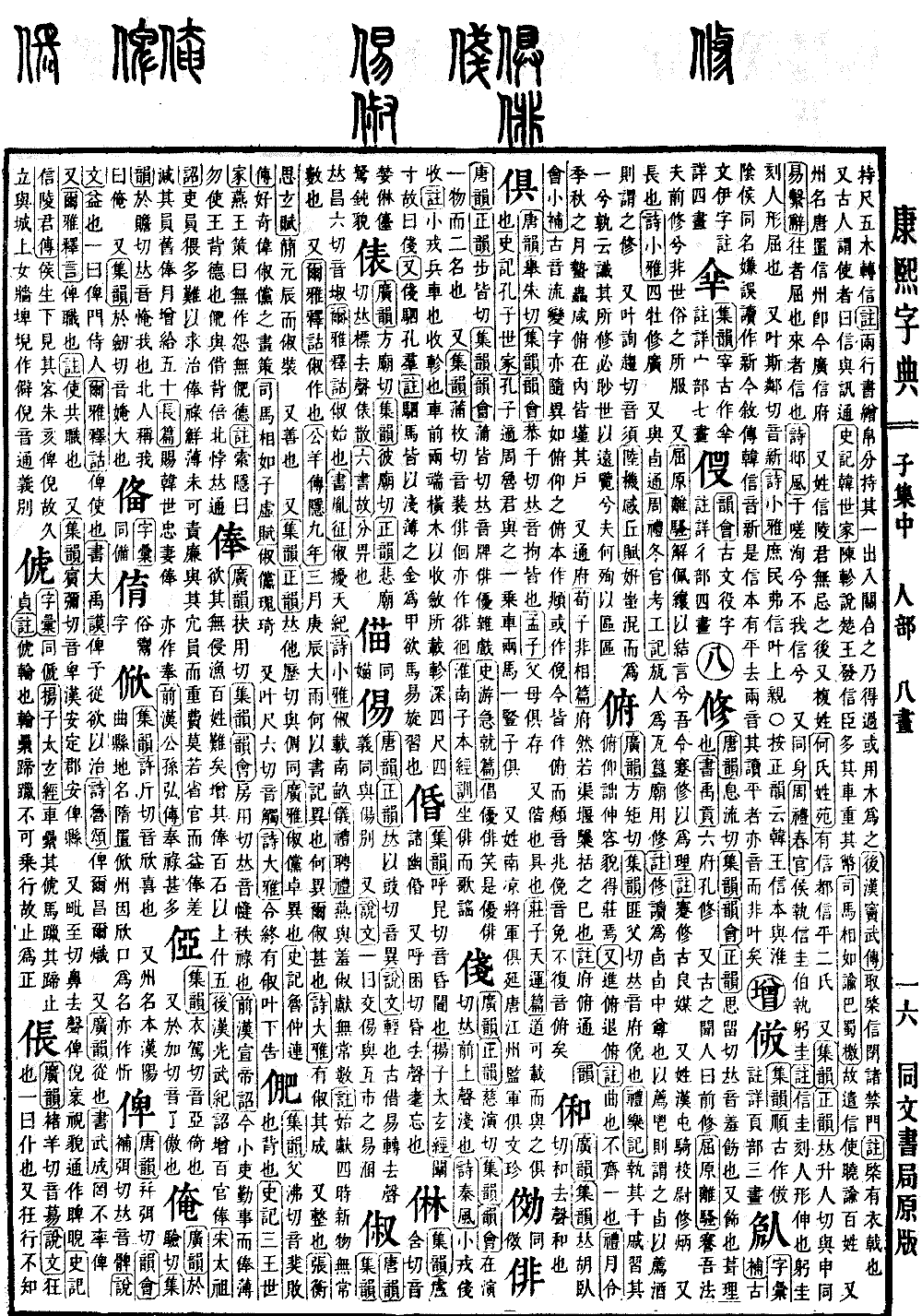
Zi Collection, Middle Volume
Radical: Person (rén)
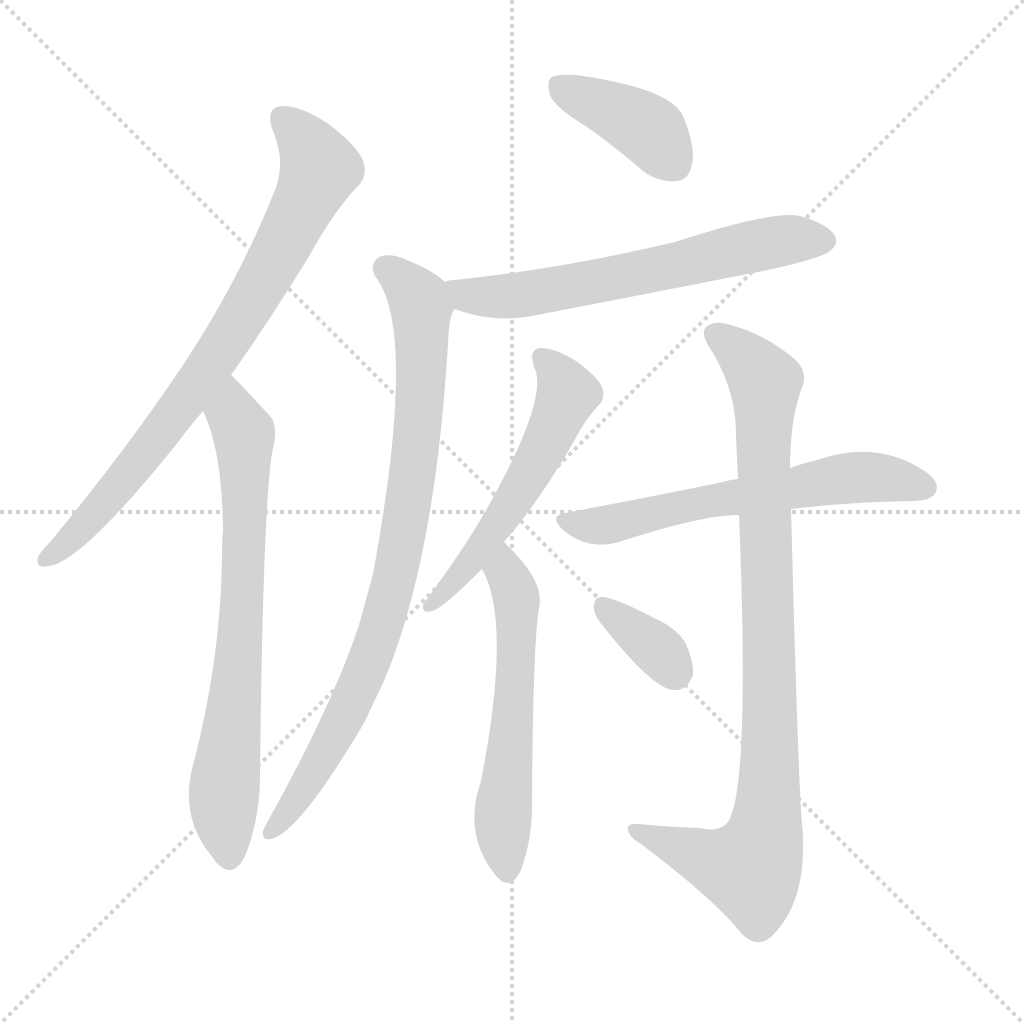
俯
Kangxi strokes: 10
Page 106, Entry 06
Pronounced fǔ
Pronounced fǔ
The term fu means to lower the head.
Book of Rites (Liji), Record of Music: With hands holding shields and axes, practicing movements of lowering the head, lifting the head, bending, and stretching, one's appearance will become solemn.
Also: To bend forward when advancing, to bend forward when retreating.
Commentary: Fu means to bend, referring to movements that are not uniform.
Book of Rites (Liji), Monthly Ordinances: In the final month of autumn, hibernating insects all retreat into hiding, and people seal the crevices of doors and windows with mud indoors.
Also interchangeable with fu (government office).
Xunzi, Against Physiognomy: Restraining oneself just as an embankment restrains the flow of water or as a tool for straightening wood corrects timber.
Commentary: Fu and fu are interchangeable.
Rhyme Collection Minor Supplement (Yunhui xiaobu): As ancient pronunciations have evolved over time, the shapes of characters have changed accordingly. For example, the fu in the compound fu-yang (looking down and looking up) was originally written as tiao or as mian, but now it is written as fu. The characters tiao and mian are now pronounced tiao and mian, respectively, and are no longer pronounced as fu.
Textual Research: Xunzi, Against Physiognomy: Fu ran ruo qu yan yin kuo zhi yi ye. Note: The original text adds the character yu before the character yi.