Si Collection, Lower Volume
Radical: Cow (niú)
Kangxi strokes: 10
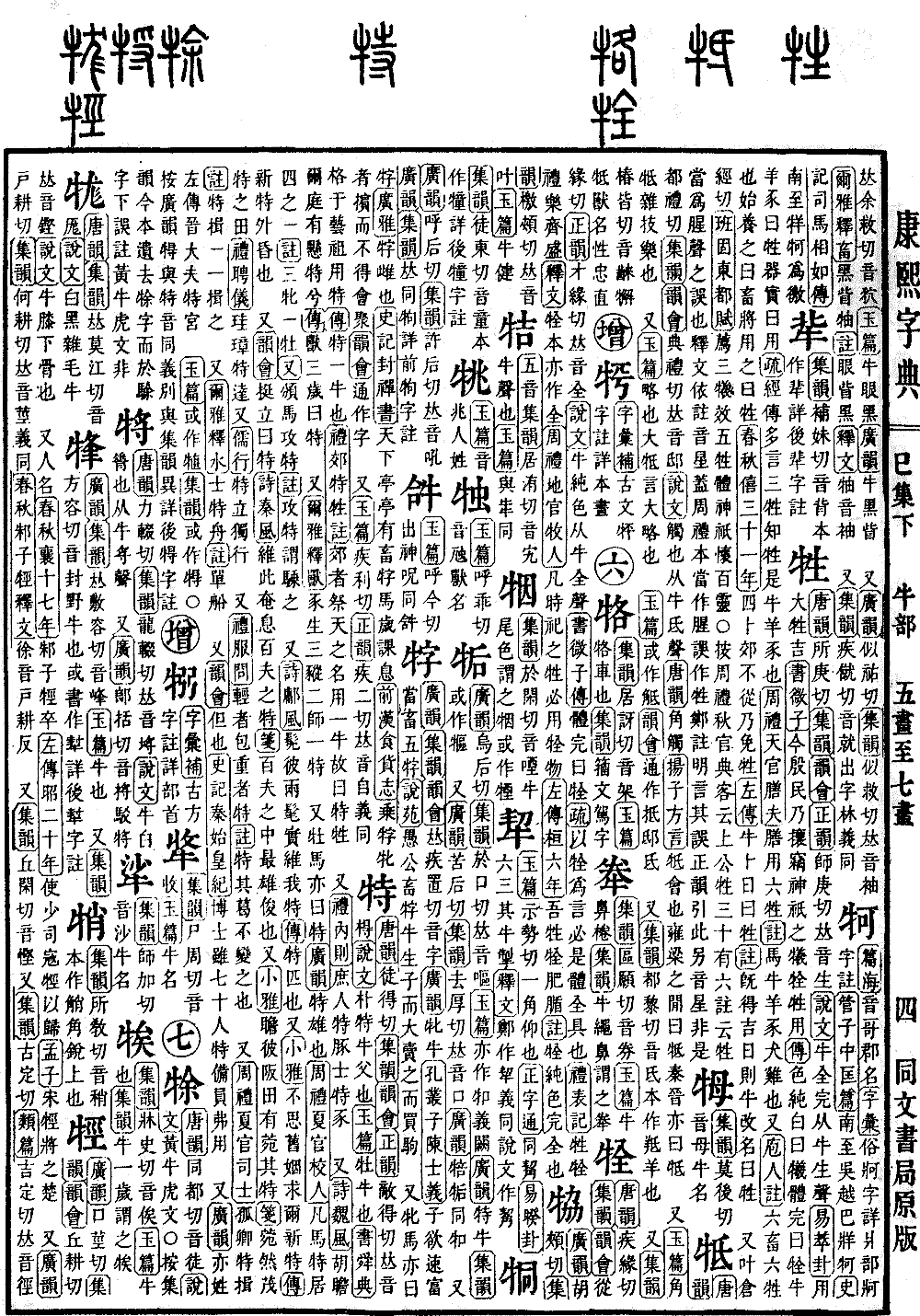
Page 700, Entry 20
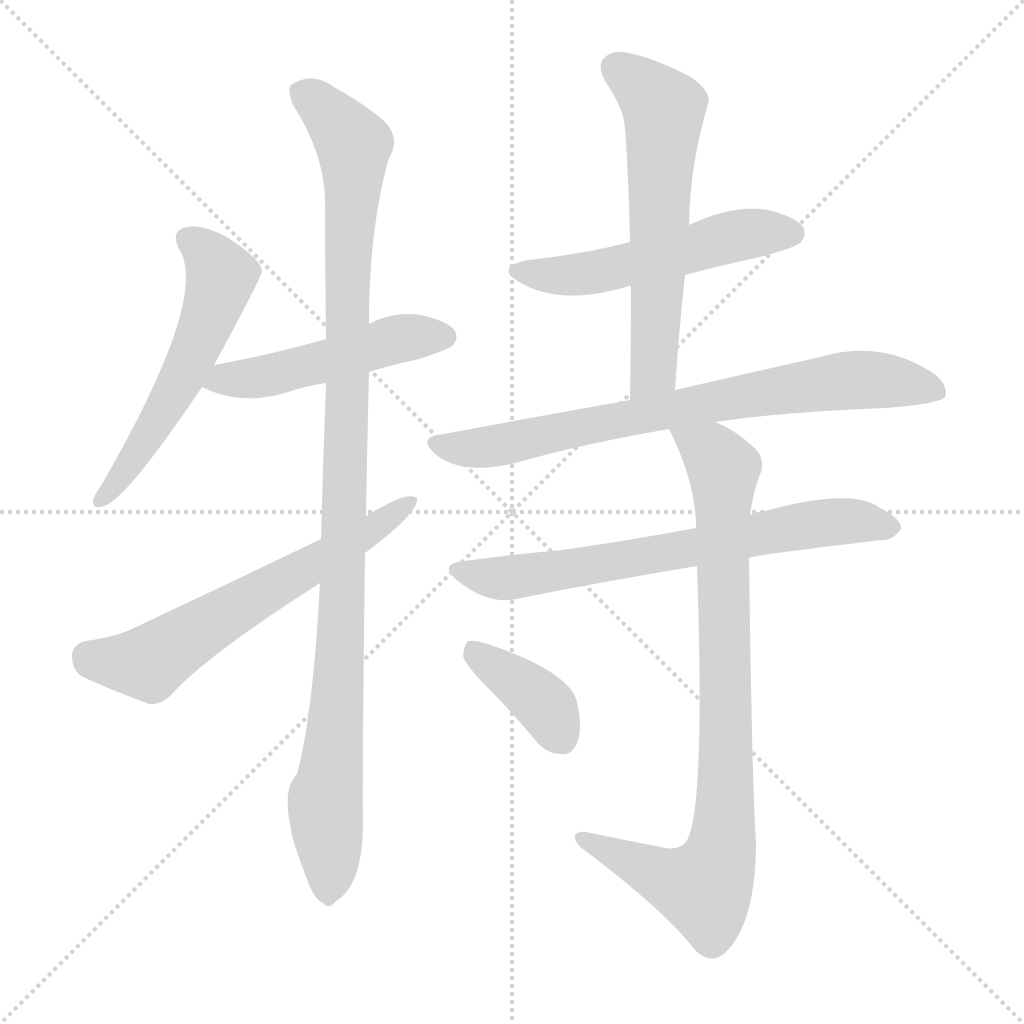
Pronounced de.
Shuowen Jiezi (Explanation of Writing and Analysis of Characters): Pu-te, refers to a bull.
Yupian (Jade Chapters): A bull.
Book of Documents (Shujing): Approaching the ancestral temple, using a bull. Commentary: Te means a single cow.
Book of Rites (Liji), Commentary on the suburban sacrifice: The suburb is the name for the sacrifice to Heaven. Using one cow, therefore it is called a single sacrificial animal.
Also, Book of Rites (Liji): Commoners use a single piglet, scholars use a single pig.
Also, Book of Odes (Shijing): Why do I see a suspended animal in your courtyard? Commentary: A beast three years of age is called te.
Also, Erya (Approaching Elegance), Explaining Beasts: When a pig gives birth, three are called zong, two are called shi, and one is called te.
Also, a male horse is also called te.
Guangyun (Broad Rhymes): Te means male.
Rites of Zhou (Zhouli): Regarding all horses, one male is kept for every four. Commentary: Three females to one male.
Also, distributing horses to castrate the males. Commentary: Attacking the male refers to castrating it.
Also, Book of Odes (Shijing): Hanging down are those two locks of hair, they are truly my match. Commentary: Te means a mate or peer.
Also, Book of Odes (Shijing): You do not think of old ties, but seek your new match. Commentary: New match refers to a marriage with an outsider.
Also, Yunhui (Collection of Rhymes): Standing tall is called te.
Also, Book of Odes (Shijing): This is Yan Xi, a hero among a hundred men. Commentary: The most heroic and outstanding among a hundred men.
Also, Book of Odes (Shijing): Look at those fields on the slope, with its luxuriant growth standing alone. Commentary: Luxuriant and flourishing sprouts.
Rites of Zhou (Zhouli): Gui and Zhang jade implements are presented singly.
Also, Book of Rites (Liji): Standing alone and acting independently.
Also, Book of Rites (Liji): Light mourning clothes are wrapped, heavy ones are single. Commentary: Te means that the kudzu fabric remains unchanged.
Also, Rites of Zhou (Zhouli): Officials and ministers are bowed to individually. Commentary: Individual bowing means bowing to each one separately.
Also, Erya (Approaching Elegance), Explaining Waters: Scholars use a single boat. Commentary: A solitary boat.
Also, Yunhui (Collection of Rhymes): Also means only or merely. Records of the Grand Historian (Shiji): Although there were seventy erudites, they were merely filler and not employed.
Also, Guangyun (Broad Rhymes): Also a surname. Zuo Commentary (Zuozhuan): The Jin state official Te Gong.
Yupian (Jade Chapters): Sometimes written as a variant form.
Jiyun (Collection of Rhymes): Sometimes written as a variant form.
Note: According to Guangyun, it is homophonous with te but different in meaning, and differs from Jiyun. Details are in the entry for the later character.
Textual Research: Book of Odes (Shijing): Look at those fields on the slope, with its luxuriant growth standing alone. Commentary: Luxuriant and flourishing sprouts. In accordance with the original text, sprout has been corrected from field.