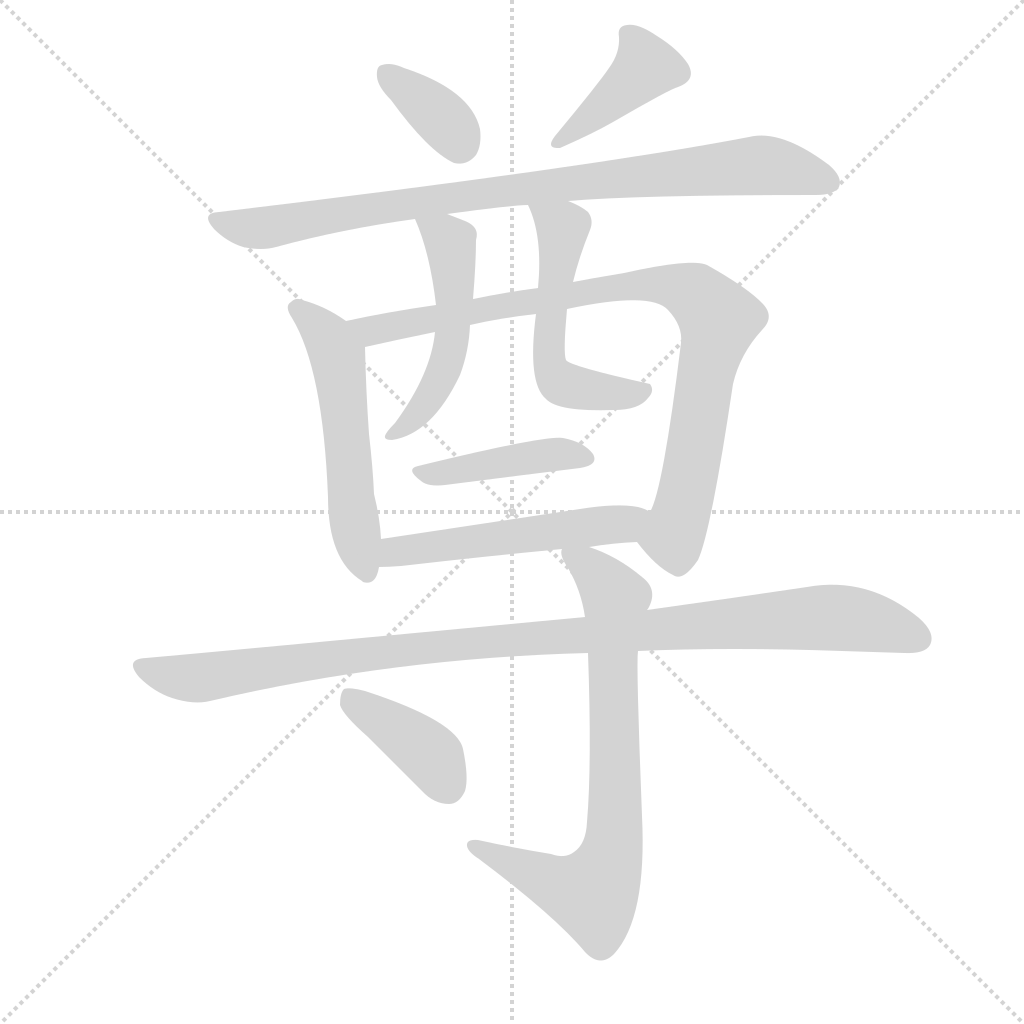
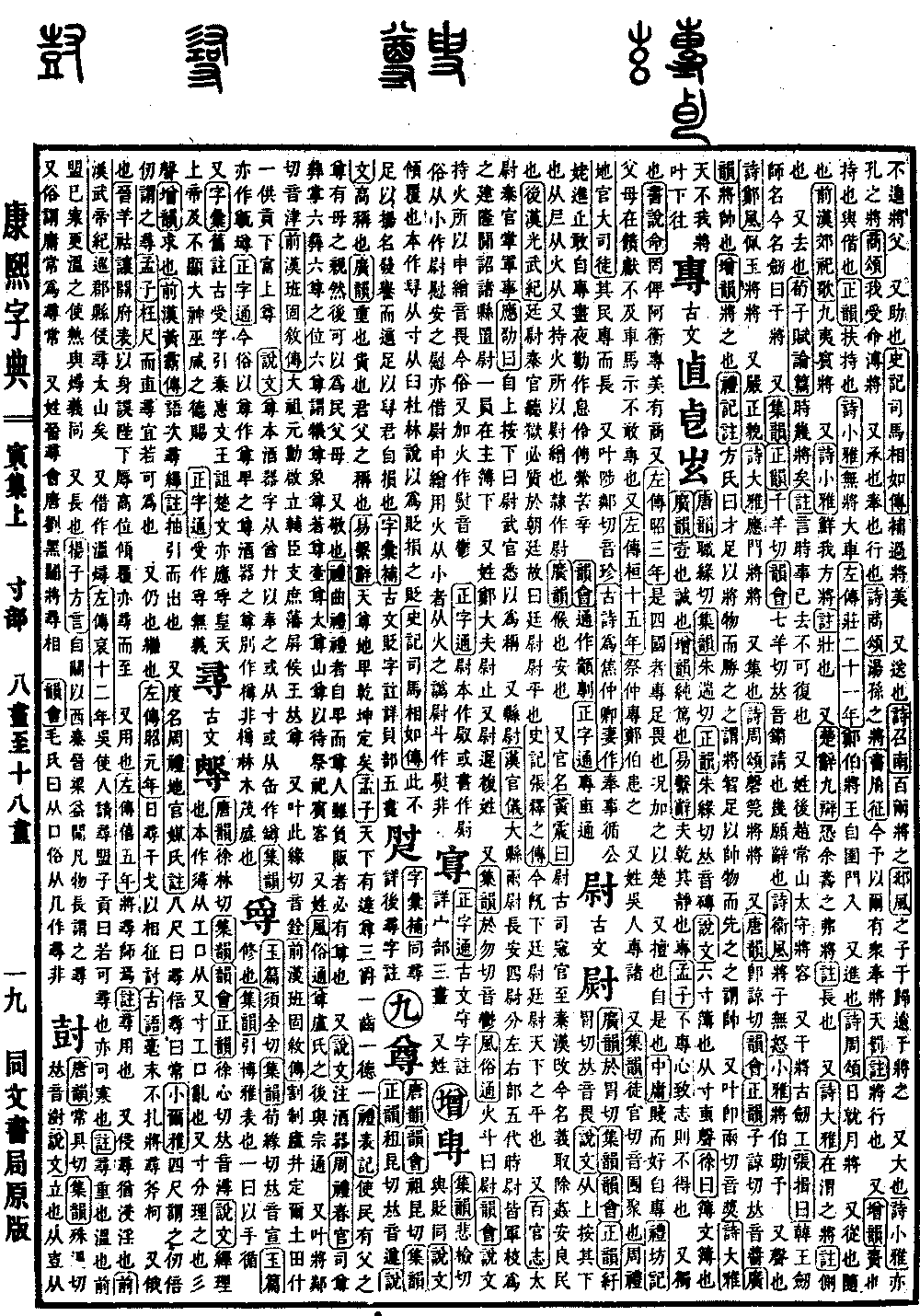
Yin Collection, Upper Volume
Radical: Inch (cùn)
Kangxi stroke count: 12
Page 295, Entry 10
Pronounced zūn.
According to the Explanation of Scripts and Picture Symbols (Shuowen Jiezi), it refers to a high status.
According to the Broad Rhymes (Guangyun), it means heavy, noble, or a title for a sovereign or father.
Book of Changes (Yijing), Commentary on the Appended Statements: Heaven is high and noble, earth is low and humble; thus Heaven and Earth are established.
Mencius (Mengzi): In the world there are three things universally considered noble: rank, age, and virtue.
Book of Rites (Liji), Record of Expressions: Cause the people to have the sense of respect for their fathers and closeness to their mothers, and only then can one be the parent of the people.
Also means to respect.
Book of Rites (Liji), Summary of the Rules of Propriety: Propriety consists of humbling oneself and respecting others. Even those who carry goods for sale must have a sense of respect.
Also, according to the Explanation of Scripts and Picture Symbols (Shuowen Jiezi), it refers to a wine vessel.
Book of Rites (Zhouli), Offices of Spring: The Master of Ceremonies for Sacrificial Vessels manages the positions of the six ceremonial vessels and the six ritual containers. The six ceremonial vessels refer to the ox-shaped vessel, the elephant-shaped vessel, the sacrificial vessel with painted decorations, the pot-shaped vessel, the great vessel, and the mountain-shaped vessel, used for offerings to spirits and guests.
Also a surname.
Customs of the World (Fengsu Tong): Descendants of the Zunlu clan. This is used interchangeably with the character for clan (zōng).
Also pronounced jīn.
History of the Former Han Dynasty (Qian Hanshu), Biographical Sketches by Ban Gu: The great ancestors and their original meritorious officials established the supporting ministers. The collateral branches served as screens, with lords and kings sharing equal respect.
Also pronounced quán.
History of the Former Han Dynasty (Qian Hanshu), Biographical Sketches by Ban Gu: Dividing and organizing the land into well-field systems to determine your fields. By supplying one-tenth as tribute, the common people become wealthy and the superiors become noble.
The Explanation of Scripts and Picture Symbols (Shuowen Jiezi) states that the character was originally a wine vessel, composed of the radical for distilled spirits (yóu) and the radical for two hands (gǒng) to offer it. It is sometimes written with the radical for inch (cùn). It is also written with the radical for earthenware jar (fǒu) as the variant form (zūn). According to the Collection of Rhymes (Jiyun), it is also written as (zūn). According to the Guide to Correct Characters (Zhengzitong), nowadays the character is commonly used for the distinction between noble and humble, while the character for the wine vessel is written separately as (zūn), which is incorrect. The character (zūn) actually refers to dense forest trees.
Editorial Note: In the Book of Rites (Liji), Record of Expressions, the phrase to be read as and only then can one be the parent of the people is corrected from the original text. In the Book of Rites (Zhouli), Offices of Spring, the sequence of the six ritual containers and six ceremonial vessels is corrected to match the original text.