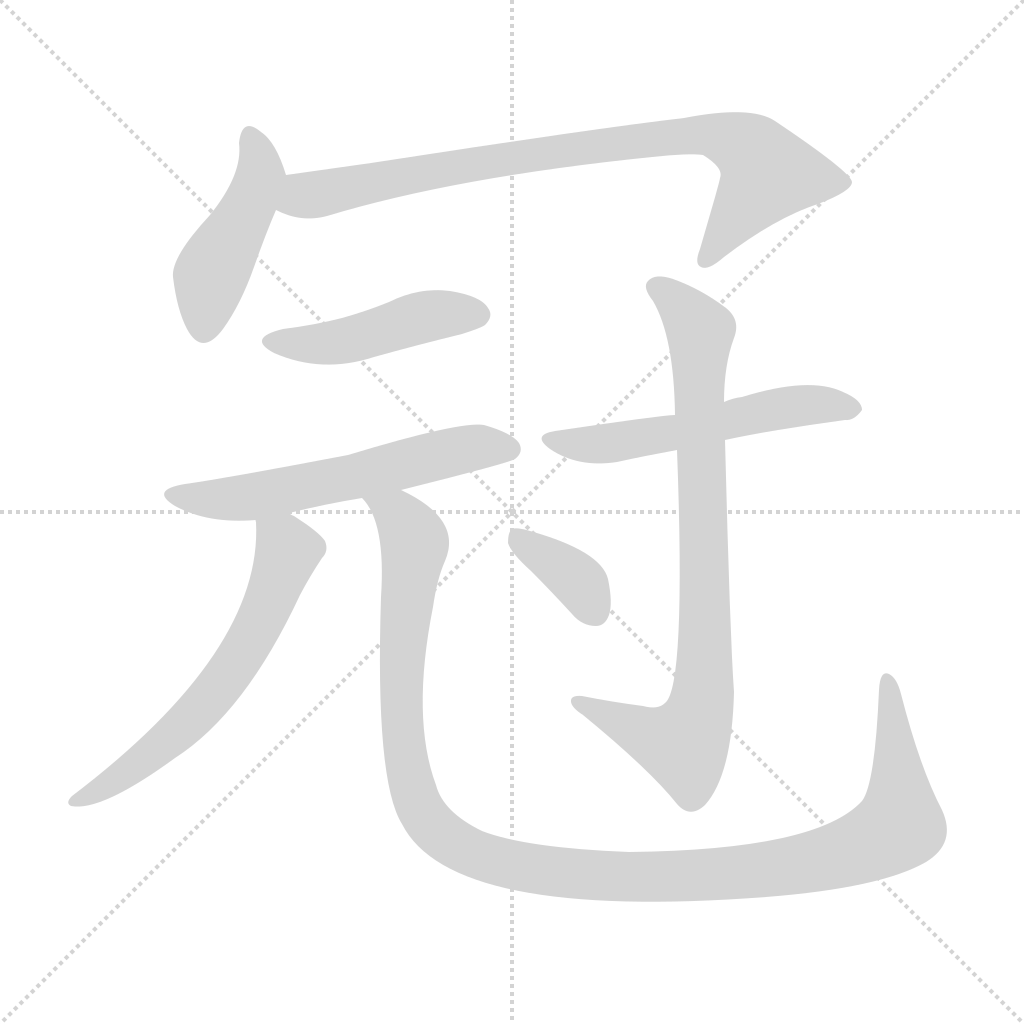
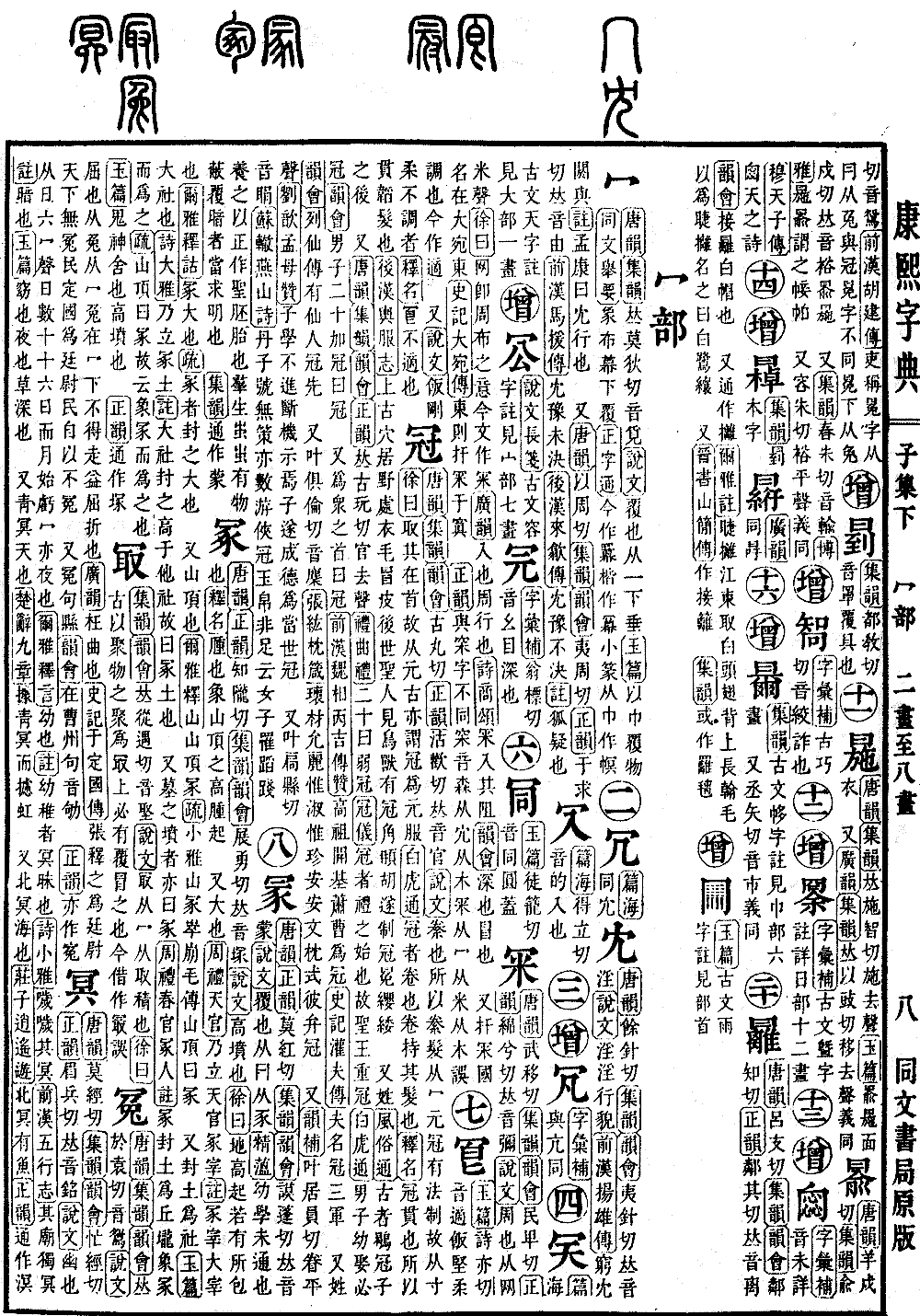
Zi Collection, Page Position: Lower. Radical: Cover (mì). Kangxi Strokes: 9. Page: 130, entry 23.
Pronounced guan. According to the Shuowen Jiezi (Shuowen), it means to bind; it is what is used to bind the hair. It is composed of the radical cover (mì) and the character for head (yuán). The cap has a regulated form, hence the inclusion of the radical inch (cùn). Xu Shen says that because it is placed upon the head, the character for head is included. In ancient times, it was also referred to as the head covering (yuánfú). According to the White Tiger Hall Discussions (Baihu Tong), to cap means to roll; it is to roll up and hold the hair in place. According to the Explaining Names (Shiming), a cap is a piercing; it is what pierces and covers the hair. According to the Book of the Later Han (Hou Hanshu), treatise on carriages and clothing, in high antiquity people lived in caves and wild places, wearing skins and furs. Later, the sages saw that birds and beasts had crests or horns, and subsequently created caps, coronets, tassels, and ribbons. It is also a surname. According to the Comprehensive Customs (Fengsu Tong), it refers to the descendants of the ancient scholar Heguantzi.
Pronounced guan (falling tone). According to the Book of Rites (Liji), at the age of twenty one is called "weak cap." In the Rites of Capping, it states that capping is the beginning of ritual. Therefore, the sage kings valued the capping ceremony. According to the White Tiger Hall Discussions (Baihu Tong), men are young, and upon marrying, they must be capped. According to the Dictionary of Rhymes (Yunhui), when a man reaches twenty, he is capped, which is called guan. It also denotes the head of a group, referred to as guan. According to the Book of the Former Han (Qian Hanshu), biography of Wei Xiang and Bing Ji, when the High Ancestor established his foundation, Xiao He and Cao Shen were the foremost. According to the Records of the Grand Historian (Shiji), biography of Guan Fu, his name was foremost among the three armies. It is also a surname. According to the Dictionary of Rhymes (Yunhui), the Biographies of the Immortals (Liexian Zhuan) mentions the immortal Guan Xian.
Also pronounced jun. In the Pillow Admonition by Zhang Hong: Rare materials are indeed beautiful, only refined, only precious. Peaceful is the literary pillow, following the cap.
Also pronounced juan (even tone). In the Eulogy for Mother Meng by Liu Xin: The son’s studies did not progress, so she cut the loom to show him. The son then attained virtue and became the foremost of his generation.
Also pronounced juan (falling tone). In a poem about Yanshan by Su Zhe: The Dan child claimed to have no strategy, and also counted the chivalrous as the foremost. Jade and silk are not enough to speak of; the woman suffered the stepping and trampling.