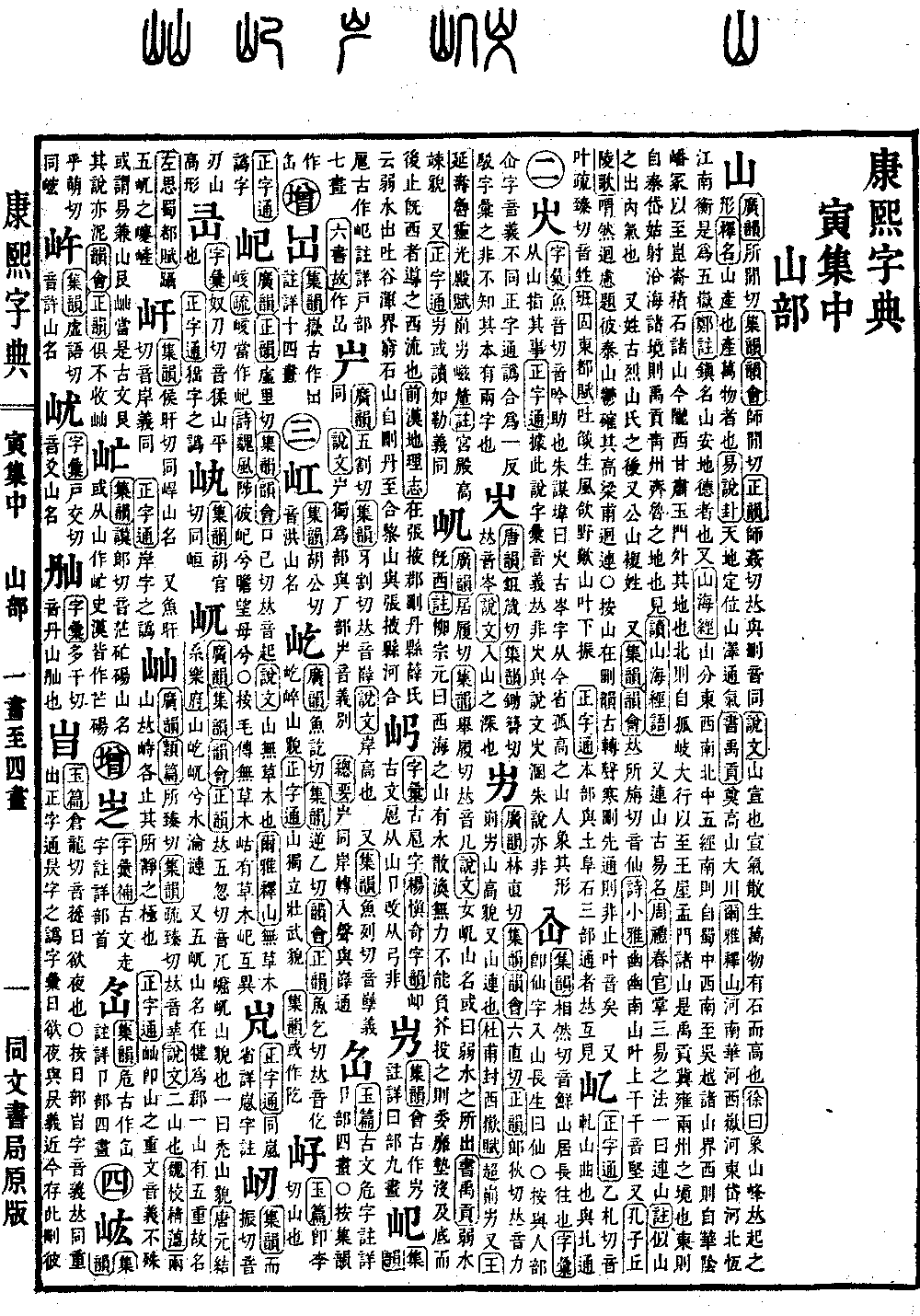
Yin Collection, Middle Volume
Radical: Mountain (shān)
Page 307, Entry 01
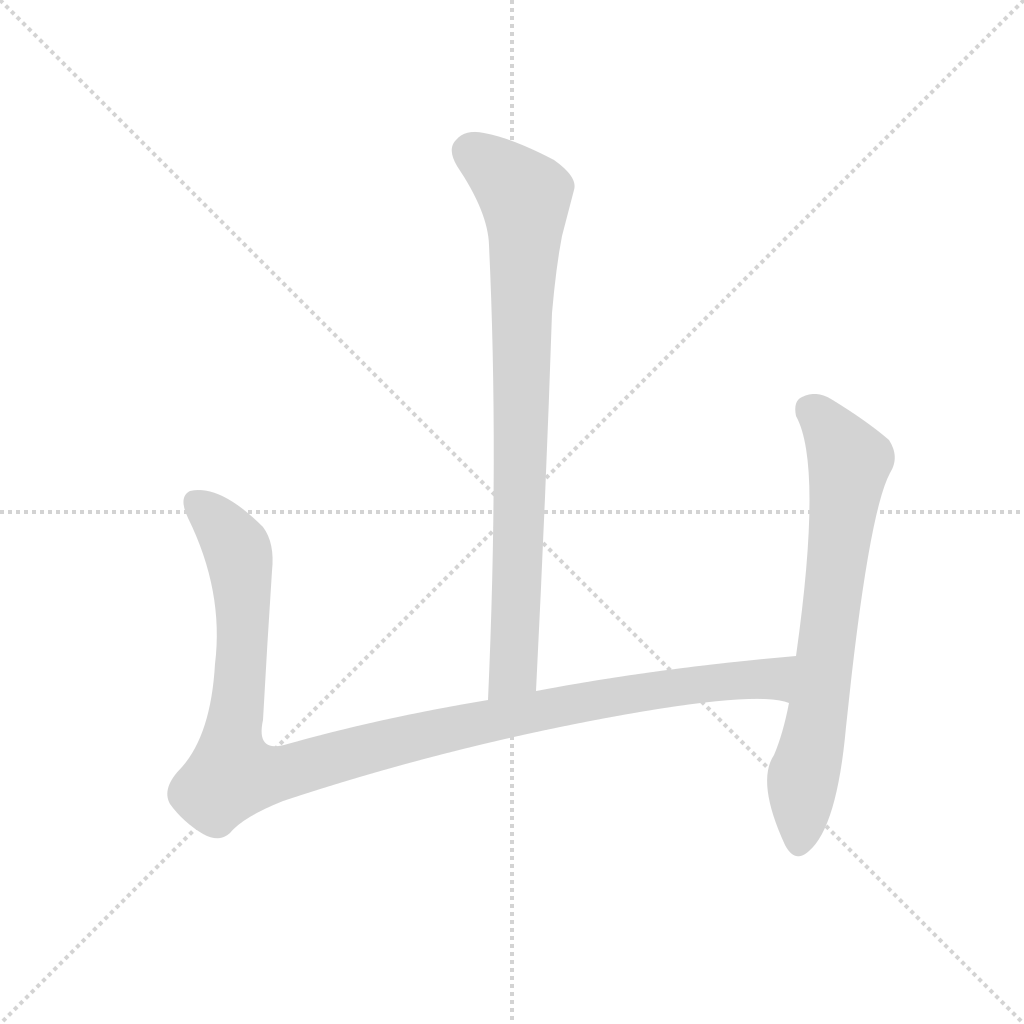
Pronounced shan. According to the Broad Rhymes (Guangyun), the Collected Rhymes (Jiyun), and the Rhyme Compilation (Yunhui), the pronunciation is identical to that of the character for delete (shan). According to the Orthographic Rhymes (Zhengyun), it is also pronounced the same. In the Discussion of Writing (Shuowen), it is defined as the dispersal of energy; the energy disperses to bring forth the myriad things, characterized by being rocky and high. Xu stated that the character represents the shape of mountain peaks rising. In the Explanations of Names (Shiming), it is said that mountain means to produce, as it produces the myriad things. In the Book of Changes (Yijing), in the Explanation of Trigrams, it is stated that Heaven and Earth fix their positions, and mountains and marshes exchange their breath. In the Book of Documents (Shujing), in the Tribute of Yu (Yu Gong), it mentions establishing high mountains and great rivers. In the Erya, in the Explanation of Mountains, it notes: South of the Yellow River is Mount Hua; west of the Yellow River is Mount Yue; east of the Yellow River is Mount Dai; north of the Yellow River is Mount Heng; south of the Yangtze River is Mount Heng. The Rites of Zhou (Zhouli) refers to these as the guardians. The Zheng commentary explains that the guardians are the great mountains that settle the virtues of the earth. Furthermore, in the Classic of Mountains and Seas (Shanhaijing), the mountains are divided into five classics: east, west, south, north, and center. The south extends from Shu in the southwest to the borders of the mountains in Wu and Yue. The west extends from Mount Hua and Mount Bozhong to the various mountains of Kunlun and Jishi, which is the region now outside the Jade Gate in Gansu, Longxi. The north extends from Mount Huqi and Mount Daxing to the mountains of Wangwu and Mengmen, which are the borders of the Ji and Yong provinces mentioned in the Tribute of Yu. The east extends from Mount Dai and Mount Guye along the coastal regions, which are the lands of Qi and Lu in Qing province as mentioned in the Tribute of Yu. This is found in the Discussion on Reading the Classic of Mountains and Seas. Also, Lianshan is the name of an ancient Book of Changes. The Rites of Zhou, in the Office of Spring, notes: Control the methods of the three changes. The first is called Lianshan. The commentary states that it resembles the way mountains emit and absorb breath. It is also a surname, descended from the ancient Lie Shan clan. It is also a double surname, Gongshan. Also, according to the Collected Rhymes and the Rhyme Compilation, it is pronounced xian. In the Book of Odes (Shijing), in the Minor Odes (Xiao Ya), it says: Dim and distant is the southern mountain. It rhymes with the character for trunk (gan), which is pronounced jian. Furthermore, in the Song of Hills and Mounds by Confucius, it says: Sighing, I turn my thoughts to the top of Mount Tai. Grand and lofty it stands, connected to Mount Liangfu. According to the analysis, since the character for mountain is in the shan rhyme group, and in ancient times the sounds of the han, shan, and xian rhyme groups were interchangeable, this is not merely a rhyming effect. It is also pronounced shen. In Ban Gu’s Rhapsody on the Eastern Capital (Dongdu Fu), it says: It spits out flames and generates wind, engulfing the plains and spraying the mountains. It rhymes with the character for shake (zhen). According to the Comprehensive Dictionary of Characters (Zhengzitong), the entries that overlap with the Radical: Earth (tu), Radical: Mound (fu), and Radical: Stone (shi) are cross-referenced.
Textual research: The Erya, in the Explanation of Mountains, states: South of the Yellow River is Mount Hua, west of the Yellow River is Mount Yue, east of the Yellow River is Mount Dai, north of the Yellow River is Mount Heng, south of the Yangtze River is Mount Heng, which are the five sacred mountains. The Zheng commentary says: The guardians are the great mountains that settle the virtues of the earth. We respectfully note that the phrase which are the five sacred mountains is not in the original text of the Erya. The phrase the guardians are the great mountains that settle the virtues of the earth is from the commentary on the Rites of Zhou, not the commentary on the Erya. We have therefore amended which are the five sacred mountains to read the Rites of Zhou refers to these as the guardians, to better introduce the following commentary.