Appendix
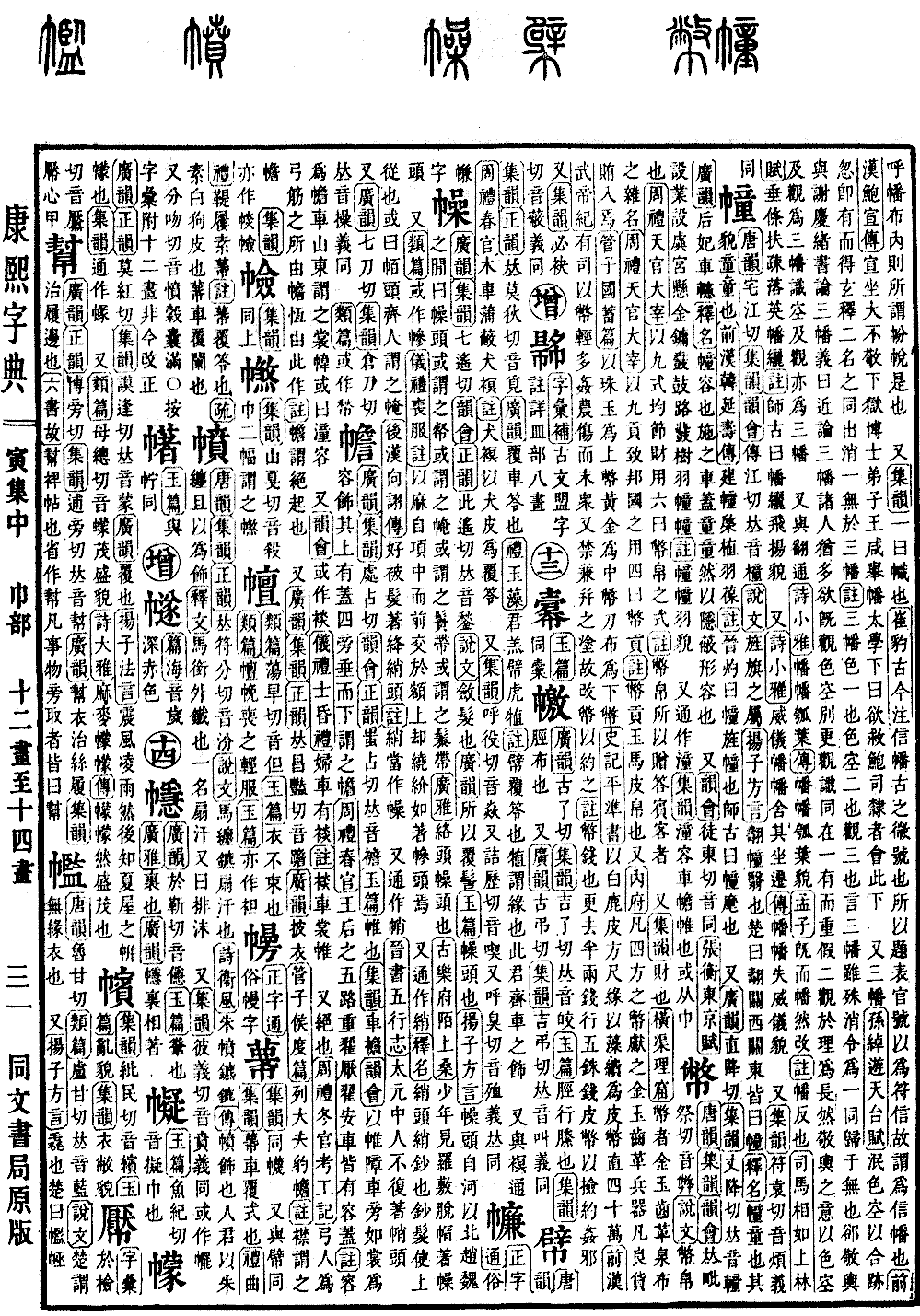
Yin Collection, Middle Volume
Radical: Turban (jīn)
Bi
Kangxi strokes: 15
Page 337, Entry 01
Longkan
The same as seal.
Bi
Tangyun, Jiyun, Yunhui: Pronounced bi (falling tone).
Shuowen: Silk fabrics used for gifts.
Book of Rites (Zhouli), Celestial Offices, Grand Administrator: Used to equalize and regulate financial expenditures through nine formulas; the sixth is the formula for silk fabrics.
Commentary: Silk fabrics are used to present rewards to guests.
Also Jiyun: Wealth.
Hengqu Liku: A collective term for gold, jade, ivory, leather, coins, and cloth.
Book of Rites (Zhouli), Celestial Offices, Grand Administrator: Used to bring in the resources of the states through nine tributes; the fourth is the tribute of silk fabrics.
Commentary: The tribute of silk fabrics includes jade, horses, skins, and textiles.
Also Neifu: All silk fabrics presented from the four corners, including gold, jade, ivory, leather, weaponry, and all fine goods and bribes are stored therein.
Guanzi, National Storage Chapter: Pearl and jade are considered high-tier currency, gold is medium-tier currency, and knife-coins and cloth are low-tier currency.
Records of the Grand Historian (Shiji), Treatise on the Balancing of Goods: White deerskin one foot square, bordered with embroidered designs, was used as leather currency, valued at 400,000.
History of the Former Han (Qianhan), Annals of Emperor Wu: Because currency was light and fraud was prevalent, while farmers suffered and merchants flourished, and to forbid the path of monopolization, the currency was changed to regulate it.
Commentary: Currency means money. Half-liang coins were abolished and five-zhu coins were implemented, along with leather currency, to restrain fraud and vice.
Also Jiyun: Pronounced bi (falling tone). The meaning is the same.
Textual research: Book of Rites (Zhouli), Celestial Offices, Grand Administrator, Commentary: Silk fabrics are used to present rewards to guests. According to the original text, change reward to acknowledge.