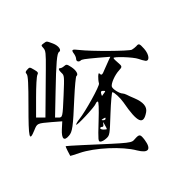
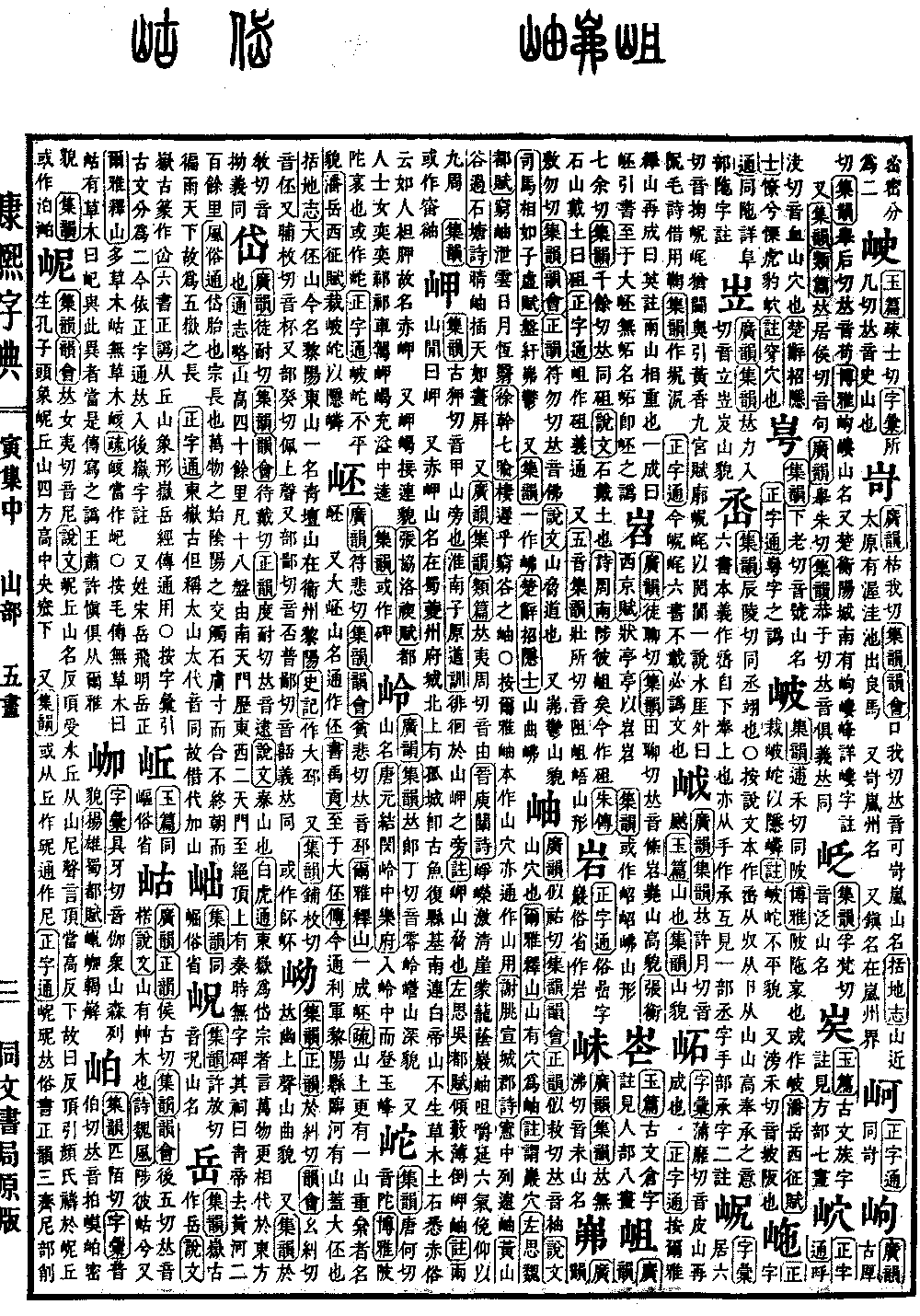
Yin Collection, Middle Volume. Radical: Mountain (shān). Character: Pi. Kangxi stroke count: 8. Page 309, Entry 26.
According to the Broad Rhymes (Guangyun), it is pronounced pi. According to the Collected Rhymes (Jiyun) and the Rhyme Compilation (Yunhui), it is also pronounced pi.
In the Erya (Erya), section on mountains, it states that a single mountain layer is called a pi. The commentary explains that when a mountain has another layer or hill stacked upon it, it is called pi. It is also used in the name Great Pi, a mountain name. It is commonly written in the variant form pi.
In the Classic of History (Shujing), specifically the Tribute of Yu (Yugong), it mentions reaching Great Pi. The commentary notes that in the present day, in the Tongli military region of Liyang County, there is a mountain overlooking the river, which is identified as Great Pi. The Comprehensive Geography (Kuodizhi) states that Great Pi Mountain, presently known as the East Mountain of Liyang, and also called Green Altar Mountain (Qingtan Shan), is located in Wei Prefecture, Liyang. The Records of the Grand Historian (Shiji) writes it as pi.
According to the Collected Rhymes (Jiyun), it is also pronounced pi. It is also pronounced bei. It is also pronounced pei (rising tone). It is also pronounced fou. It is also pronounced pi. The meanings are the same. It is sometimes written as a variant form consisting of mountain and not.