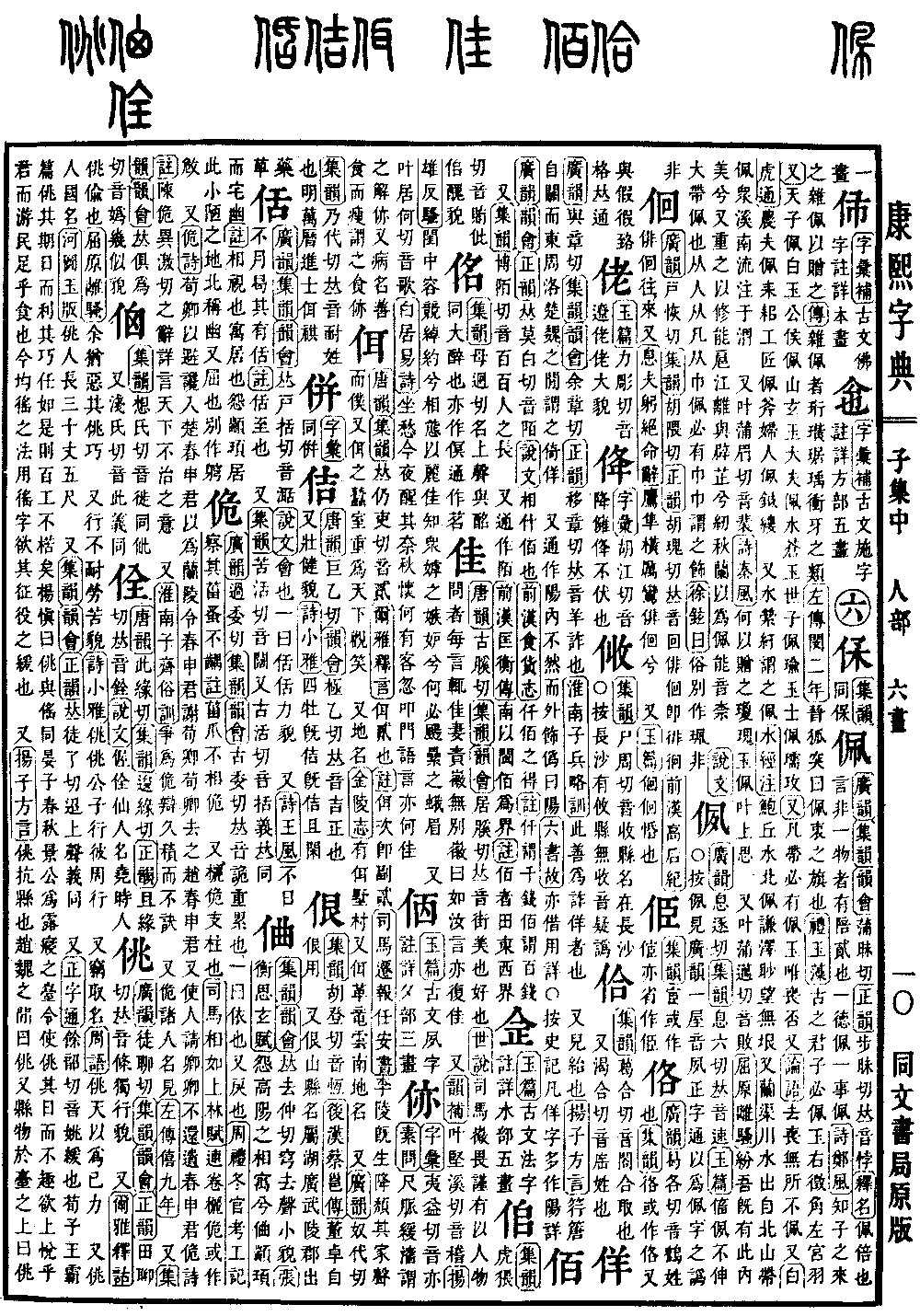
Zi Collection, Middle Volume
Radical: Person (rén)
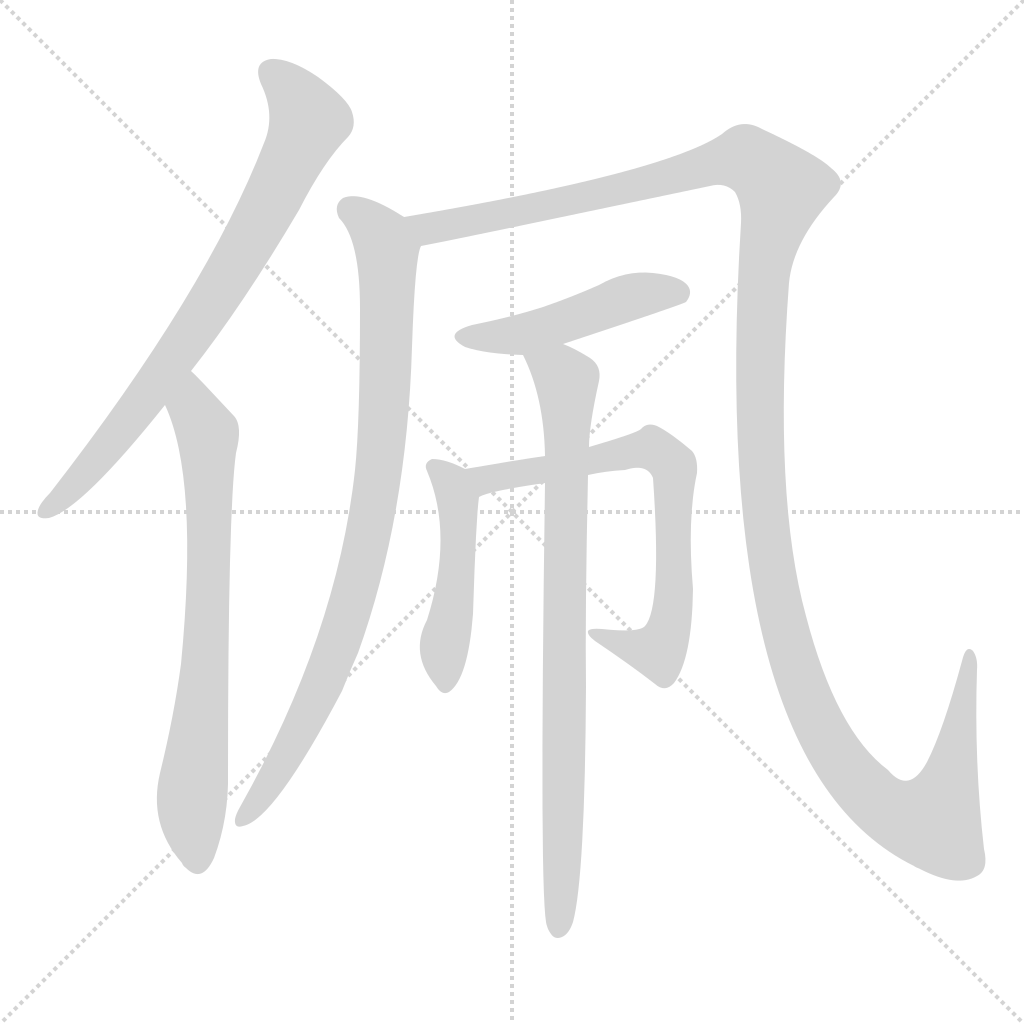
Pei
Kangxi strokes: 8
Page 100, Number 04
Guangyun, Jiyun, Yunhui: pú-mèi pronunciation. Zhengyun: bù-mèi pronunciation. Sounded as bèi.
Explaining Names (Shiming): Ornament (pèi) means accompaniment (bèi). This implies it is not a single object, but has secondary items that accompany it. Some wear virtue as an ornament, while others wear physical objects as ornaments.
"Knowing you were coming, I presented you with a set of jade pendants" — Book of Odes (Shijing). The Commentary (Zhuan) states: A set of pendants refers to jade ornaments such as the héng, huáng, jū, yǔ, and chōngyá.
Hu Tu of the State of Jin said: "Ornaments are the outward signs of inner emotions" — Zuo Commentary (Zuozhuan).
"In ancient times, a gentleman always wore jade ornaments. Those on the right emitted the notes of zhǐ and jué, while those on the left emitted the notes of gōng and yǔ" — Book of Rites (Liji).
Furthermore: "The Son of Heaven wears white jade, dukes and marquises wear mountain-dark jade, high officials wear water-azure jade, the heir apparent wears yú jade, and scholars wear ruǎn-méi jade."
Furthermore: "Whenever a belt is worn, jade pendants must be attached, except during periods of mourning."
Also: "After the mourning period is over, there is nothing that cannot be worn" — Analects (Lunyu).
Also: "Farmers carry plows and shares, craftsmen carry axes, and women carry needles and thread" — Comprehensive Discussions in the White Tiger Hall (Baihu Tong).
Also, water that flows in a swirling and winding manner is called pèi. "The Baoqiu River flows north and encircles the Qian Marsh, stretching boundlessly as far as the eye can see" — Commentary on the Water Classic (Shuijing Zhu).
Also, the Lanqu River originates in the northern mountains, gathering numerous streams like the pendants of a sash and flowing south into the Wei River.
Also used as a rhyming word pronounced péi. "What did I present to him? Fine gems and jade pendants" — Book of Odes. Here it rhymes with the word sī.
Also used as a rhyming word pronounced bài. "I possessed such inner beauty and added to it outstanding talents. I draped myself in river-ligusticum and secluded angelica, and wove autumn orchids to serve as my ornament" — On Encountering Sorrow (Li Sao) by Qu Yuan. The character néng is pronounced nài.
"It is an ornament worn on a large sash. The character is composed of the elements for person (rén), all (fán), and cloth (jīn). An ornament must involve cloth, and the cloth is called a decoration" — Explaining Graphs and Analyzing Characters (Shuowen Jiezi). Xu Xuan states: The popular form written as pèi with the jade radical is incorrect.
Textual Research: Explaining Names (Shiming) states: Ornament (pèi) means accompaniment (bèi). It states it is not a single object, but has secondary items that accompany it. Following the original text, the phrase "referring to it not being a single thing" has been corrected to "stating it is not a single object."