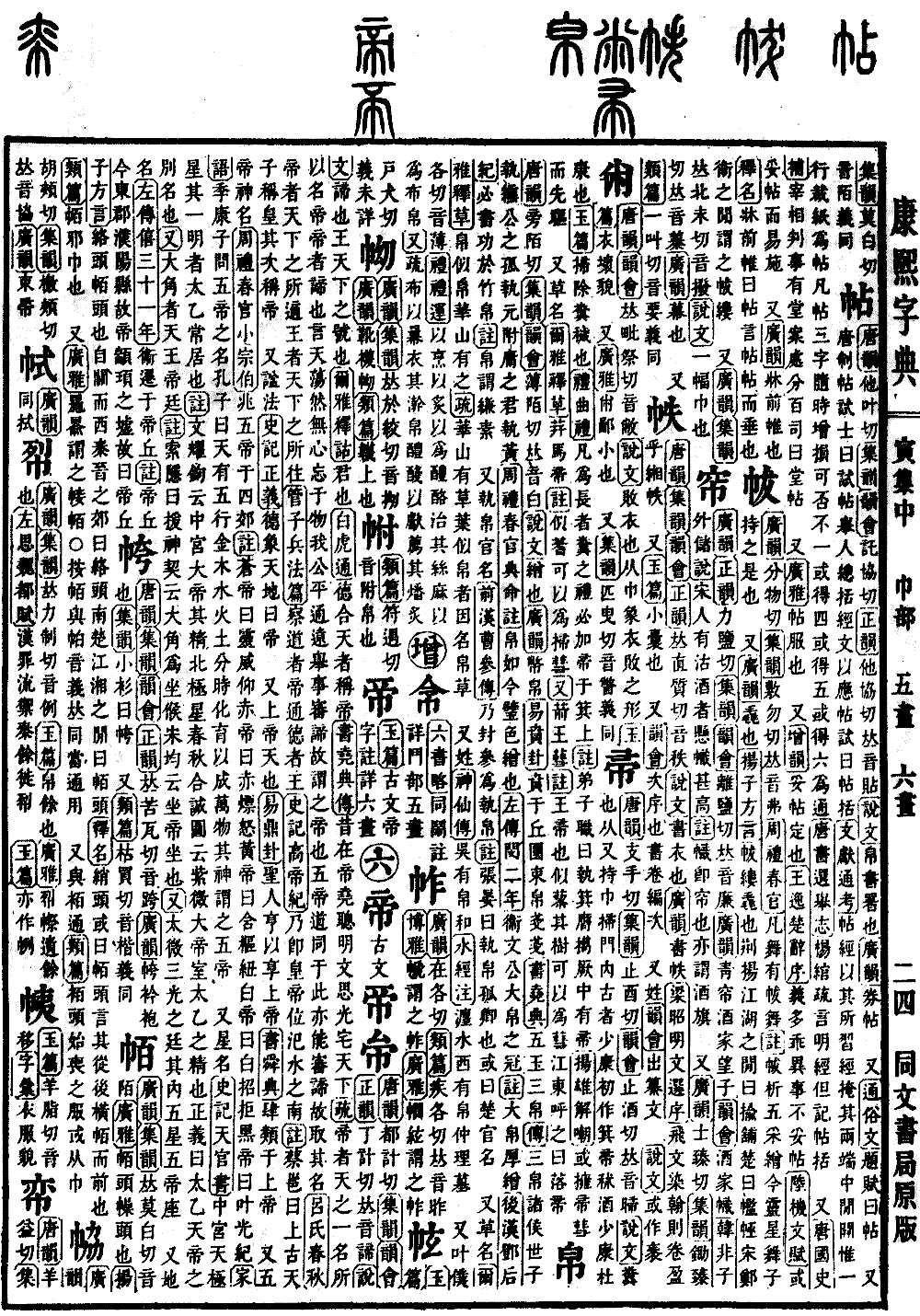
Yin Collection, Middle Volume
Radical: Napkin (jīn)
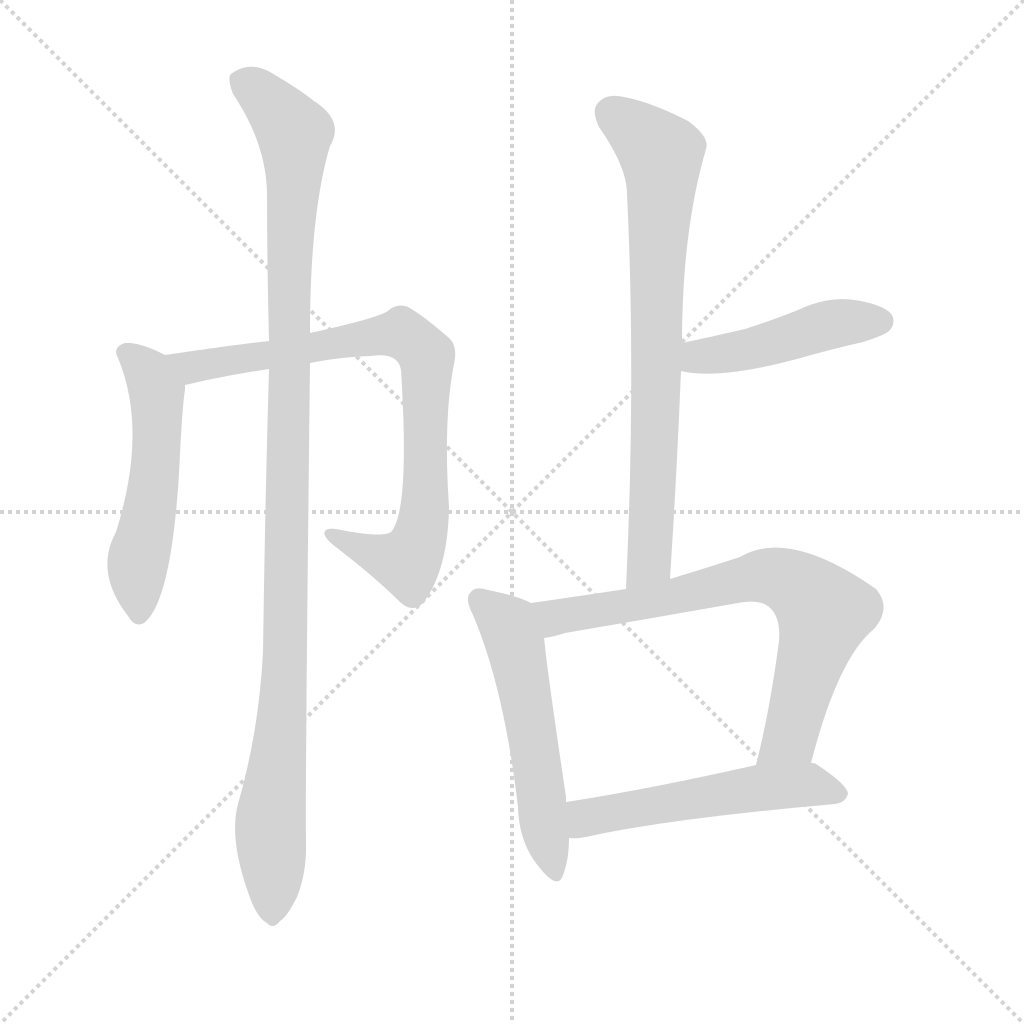
帖
Kangxi strokes: 8
Page 330, Entry 01
Pronounced tie (entering tone).
According to the Explaining Graphs and Analyzing Characters (Shuowen Jiezi), it refers to a written label on silk.
According to the Guangyun, it refers to a deed or document.
According to the Common Records (Tongsuwen), an inscribed poem is called a tie.
In the Tang Dynasty system, testing scholars by means of fragments was called tie shi. Candidates would summarize the classic texts to prepare for these examinations, which was called tie kuo.
According to the Comprehensive Examination of Literature (Wenxian Tongkao), tie jing involved taking a practiced classic, covering both ends, and opening only one line in the middle, cutting the paper to create a strip. Every strip consisted of three characters, with additions and subtractions made according to the circumstances; whether it was considered passing varied, with some obtaining four, five, or six points.
According to the History of the Tang Dynasty (Tangshu), the Election Records, Yang Wan submitted a memorial suggesting that for the classics examinations, only the memorization of summaries should be required.
According to the Tang Dynasty National History Supplement (Tang Guoshi Bu), when a chancellor presided over administrative matters, the official directives issued to the various government offices were called tang tie.
According to the Guangya, tie means to submit or to be satisfied.
According to the Expanded Rhymes (Zengyun), tuo tie means to be settled or stable.
In Wang Yi’s Preface to the Songs of Chu (Chuci Xu), it is noted that the interpretations were often contradictory, and the matters were not settled (tuo tie).
In Lu Ji’s Essay on Literature (Wen Fu), it is said that some are settled (tuo tie) and easy to implement.
According to the Guangyun, it also refers to a curtain hanging in front of a bed.
According to the Explaining Names (Shiming), a curtain in front of a bed is called a tie, meaning it hangs in a smooth and stable (tie tie) fashion.