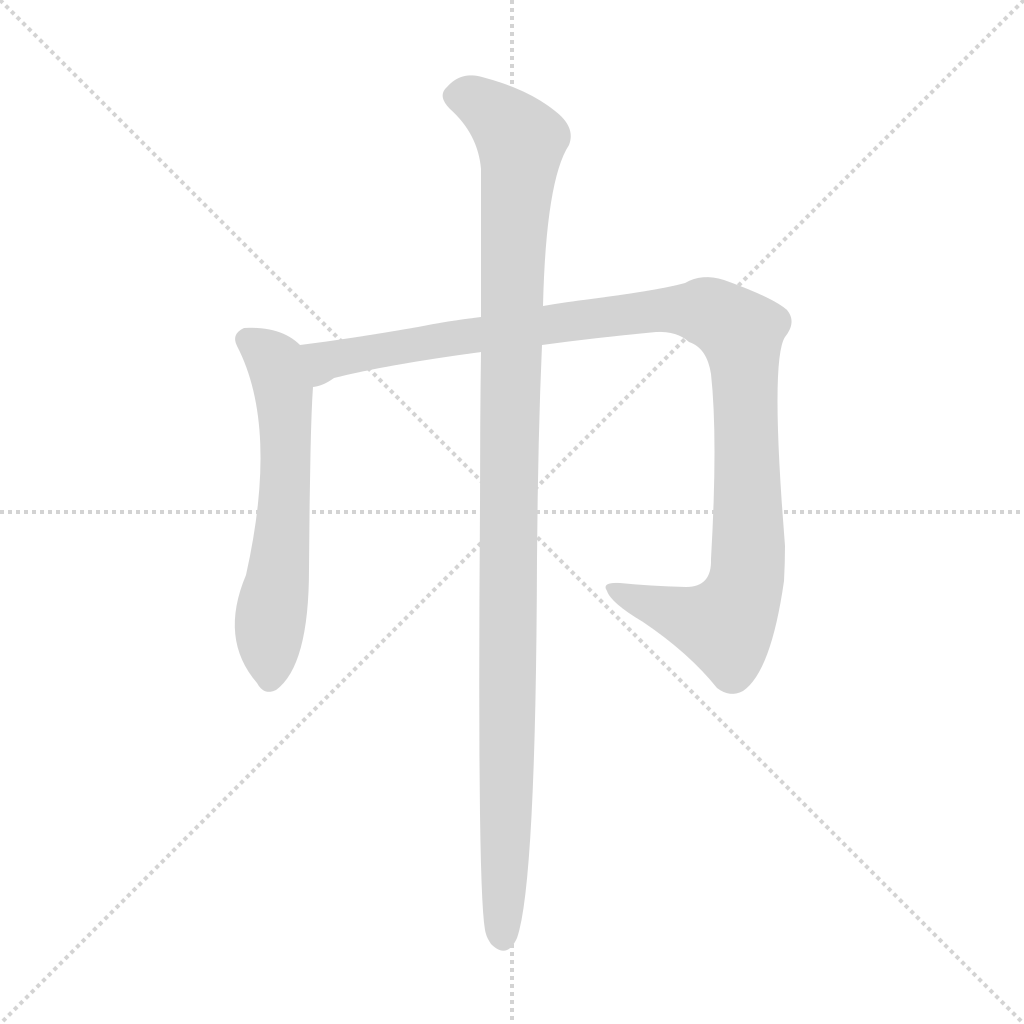
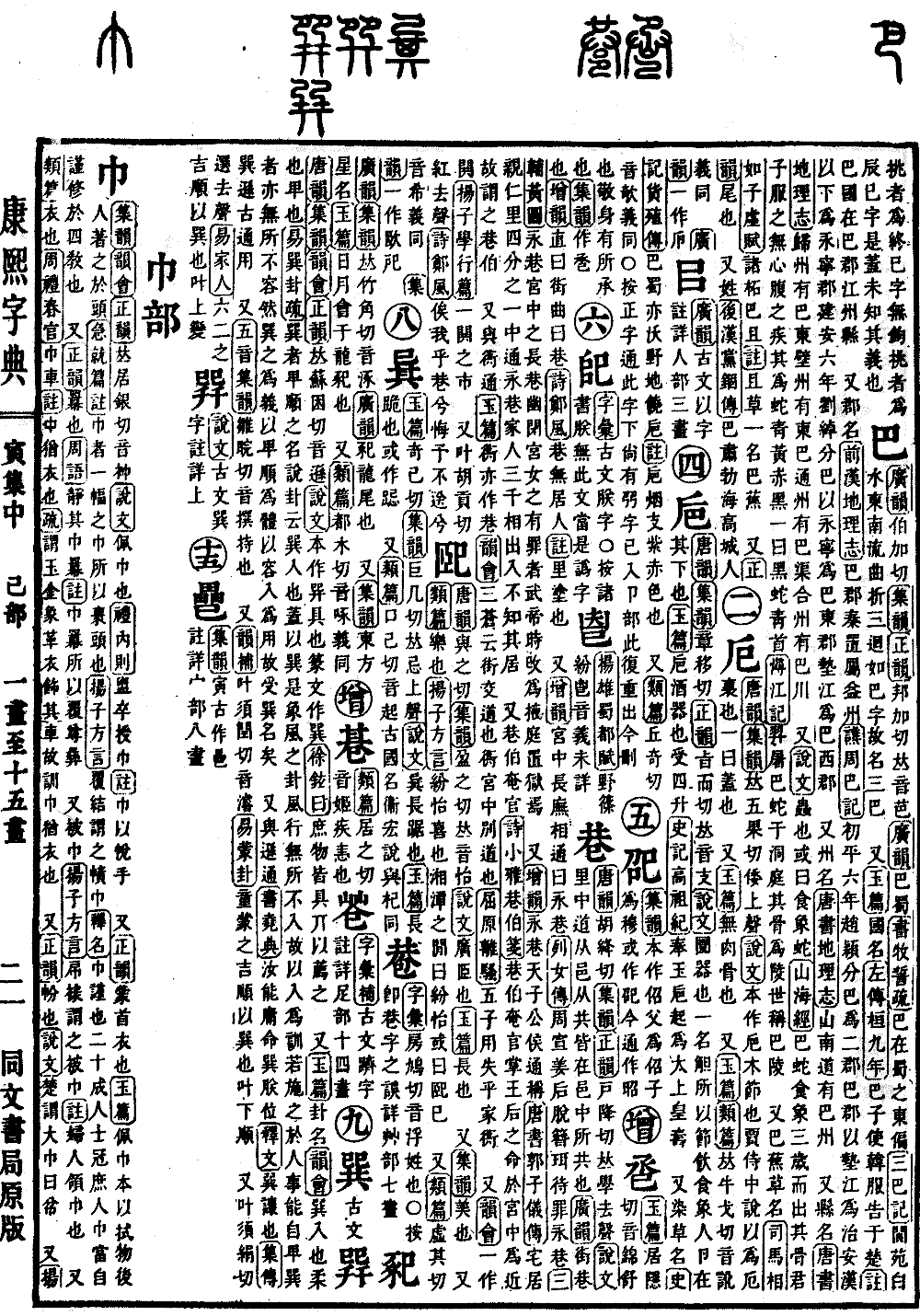
Yin Collection, Middle Volume
Radical: Cloth (bù)
Page 327, Entry 20
Pronounced jin.
Shuowen Jiezi (Dictionary of Explaining Graphs and Analyzing Characters): A cloth worn at the waist.
Book of Rites (Liji), Inner Rules: When finished washing, one is handed a towel. Commentary: The towel is used for drying hands.
Zheng Yun (Correct Rhymes): Also refers to a head covering.
Yupian (Jade Chapters): A waist cloth; originally used for wiping objects, later used to cover the head.
Jijiupian Zhu (Commentary on the Emergency Relief Text): A jin is a piece of cloth used for wrapping the head.
Yangzi Fangyan (Regional Dialects): That which covers the hair bun is called a ze-jin.
Shiming (Explanation of Names): Jin means to be cautious. At twenty, a man reaches adulthood; scholars wear caps, while commoners wear towels, signifying that one should henceforth cautiously cultivate the four virtues of women (morality, speech, appearance, and work).
Zheng Yun (Correct Rhymes): Also refers to a cloth used for covering objects.
Discourses of Zhou (Guoyu): To settle its jin and mi. Commentary: Jin and mi are coverings used for sacrificial vessels like the zun and yi.
Also refers to a shoulder cloth. Yangzi Fangyan (Regional Dialects): A hu-biao is called a bei-jin. Commentary: Refers to a woman’s collar cloth.
Leipian (Classified Chapters): Refers to clothing ornaments.
Rites of Zhou (Zhouli), Spring Officials: The jin-che (towel chariot official). Commentary: Jin acts like an ornament. Commentary Explication: This means decorating chariots with jade, gold, ivory, and leather, thus explaining why jin is like an ornament.
Zheng Yun (Correct Rhymes): Refers to a wiping cloth. Shuowen Jiezi: In the Chu region, a large towel is called a jin.
Yangzi Fangyan (Regional Dialects): Knee pads, known as ju-jin in the regions of Wei, Song, and Southern Chu.
Jijiupian Zhu (Commentary on the Emergency Relief Text): According to one source, it refers to a foot wrapping, similar to modern foot-binding cloths.
Also, jin-che is an official title. Rites of Zhou (Zhouli), Spring Officials, Commentary: The jin-che is the head of the chariot office.
Wuyin Jiyun (Collection of Rhymes in Five Tones): Pronounced jin, meaning to decorate.
Jiyun (Collection of Rhymes) and Leipian (Classified Chapters): Pronounced xin. The meaning is the same.