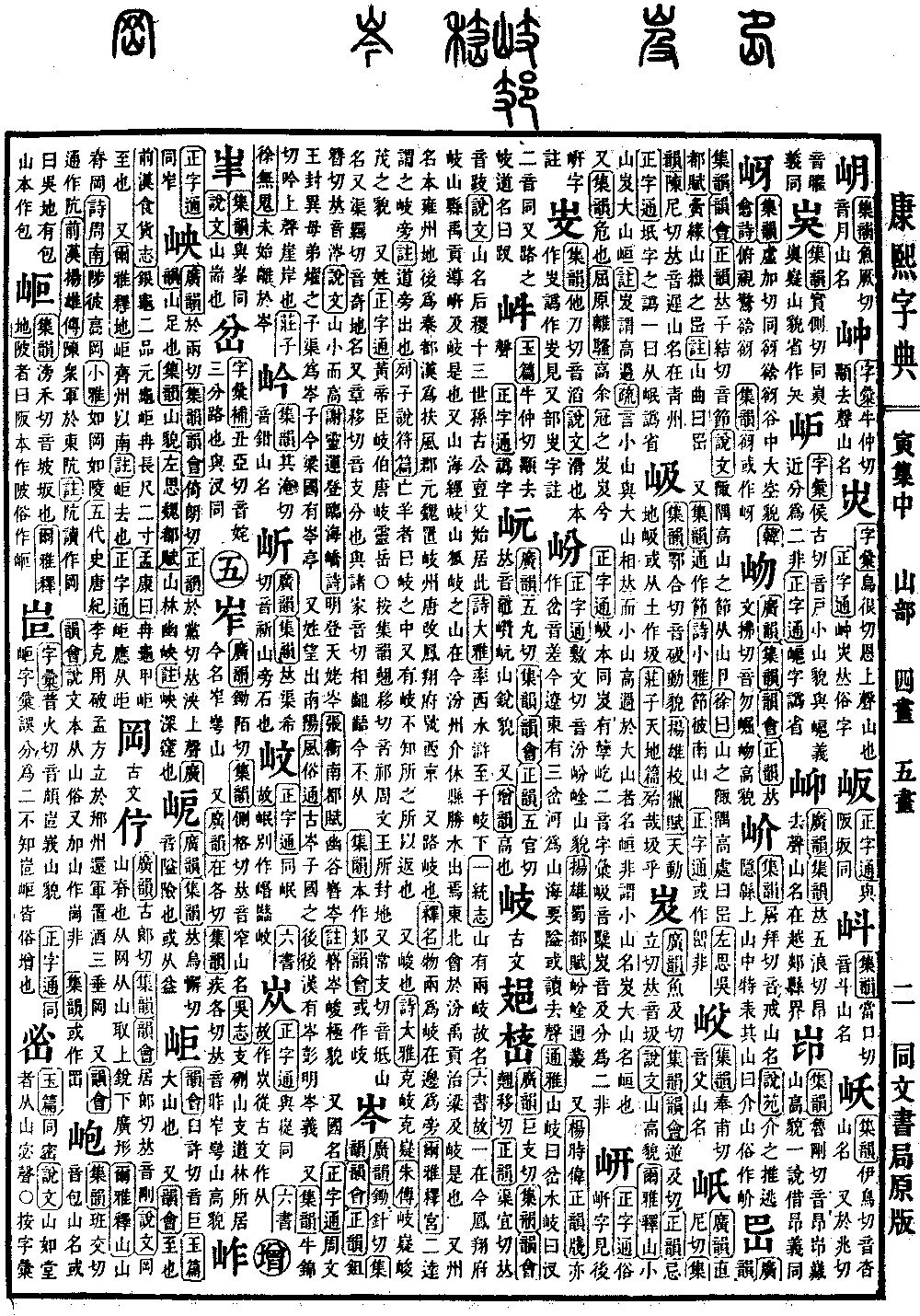
Yin Collection, Middle Volume
Radical: Mountain (shān)
Gang (Ridge)
Kangxi stroke count: 8
Page 308, Entry 39
Ancient form.
According to the Expanded Dictionary of Sounds (Guangyun), pronounced gang.
According to the Collected Dictionary of Sounds (Jiyun) and the Compendium of Phonology (Yunhui), pronounced gang.
According to the Analytical Dictionary of Characters (Shuowen), gang means a mountain ridge. It is composed of the radical for net and the radical for mountain, representing a shape that is sharp at the top and wide at the bottom.
According to the Literary Expositor (Erya), in the section on mountains, a mountain ridge is called a gang.
Book of Odes (Shijing), Zhou Nan section: Climbing that high ridge.
Book of Odes (Shijing), Lesser Odes (Xiaoya) section: Like a ridge, like a mound.
History of the Five Dynasties (Wudaishi), Tang Annals: Li Keyong defeated Meng Fangli at Xing Prefecture; upon returning his army, he hosted a banquet at the Triple Ridge (Sanchui Gang).
Also, according to the Compendium of Phonology (Yunhui), it is used interchangeably with the character pronounced keng.
History of the Former Han (Qianhan), Biography of Yang Xiong: The gathered armies at the eastern pit (keng).
Commentary: The character pit (keng) is to be read as gang (ridge).
According to the Compendium of Phonology (Yunhui), the Analytical Dictionary of Characters (Shuowen) originally included the mountain radical; popular usage adds another mountain radical to form a variant, which is incorrect.
According to the Collected Dictionary of Sounds (Jiyun), it is sometimes written in a variant form.