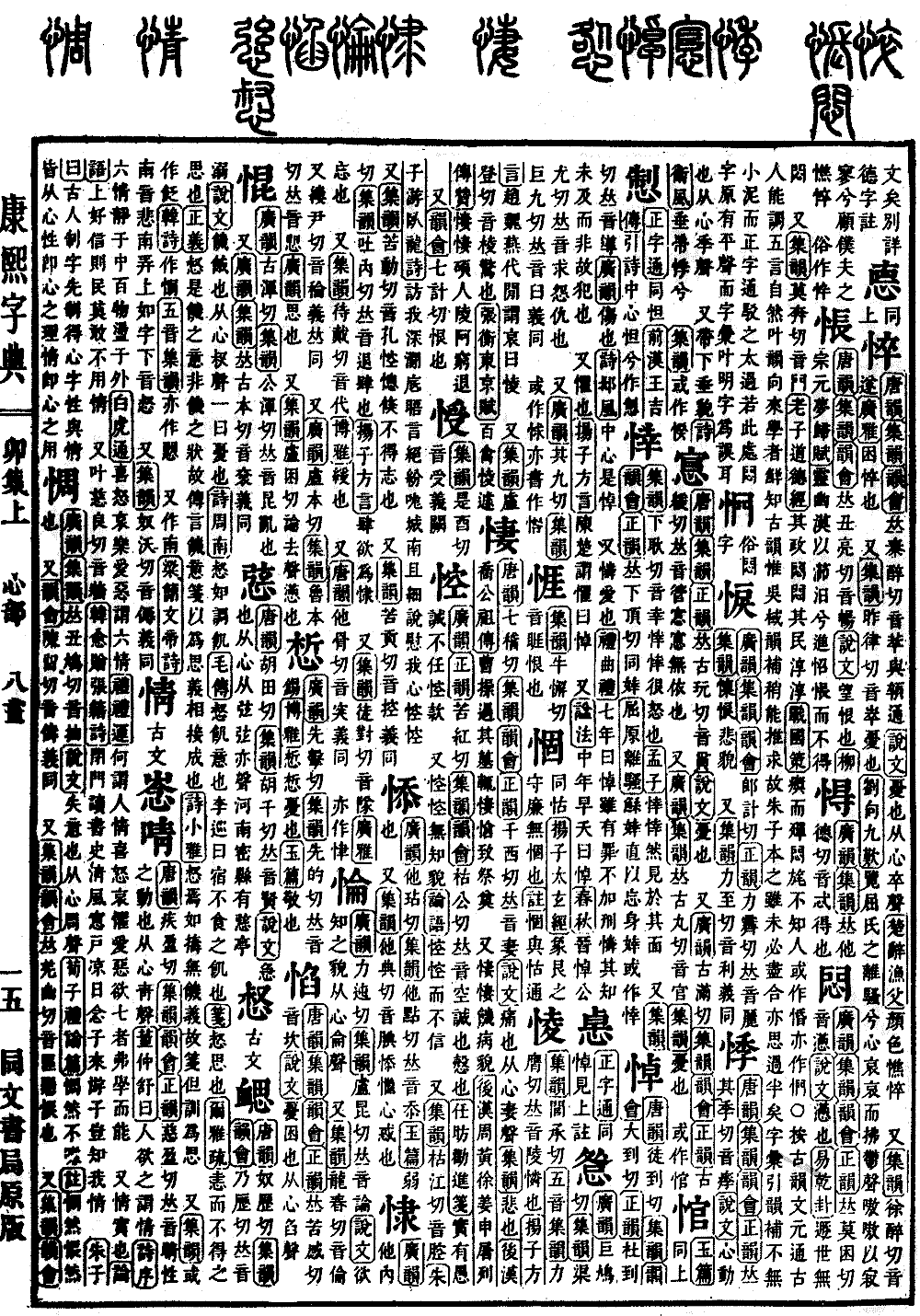
Mao Collection, Upper Volume
Radical: Heart (xīn)
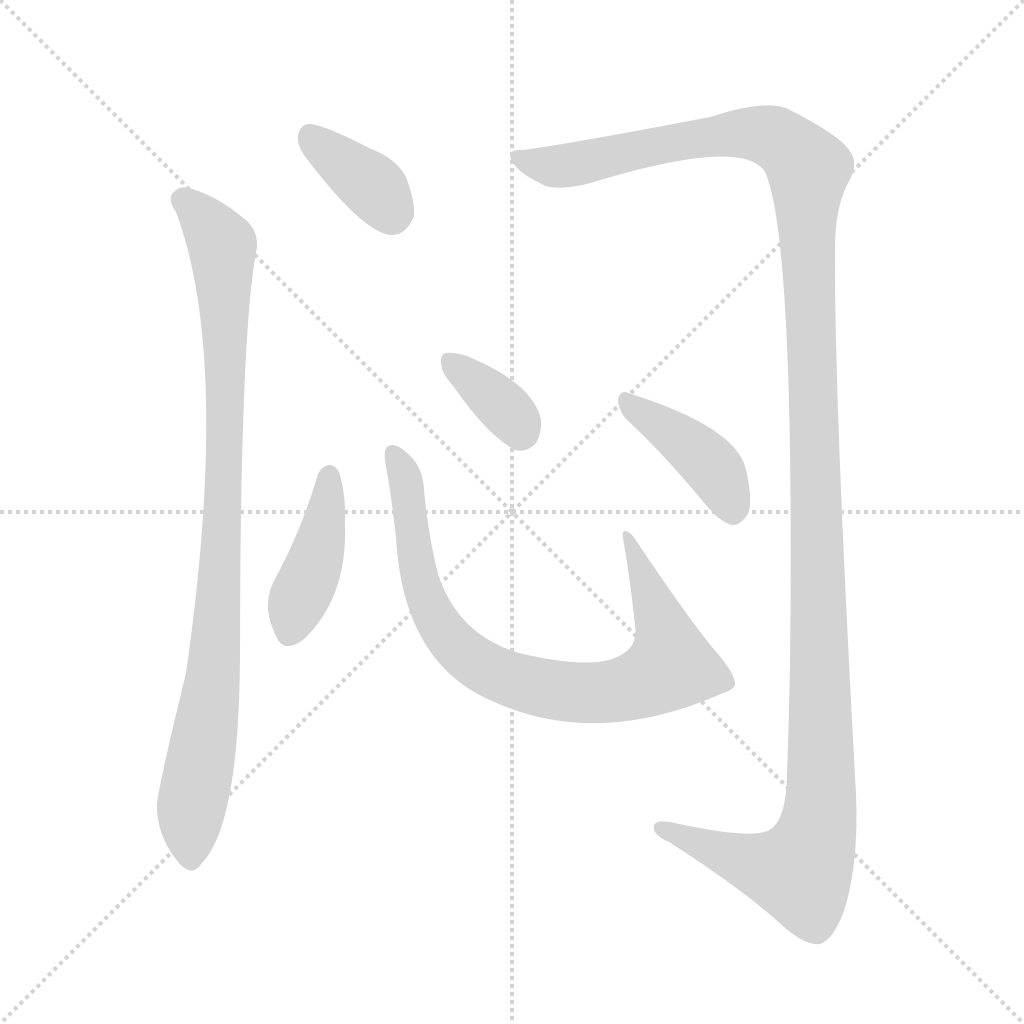
闷
Kangxi Strokes: 12
Page 389, Entry 06
Broad Rhymes (Guangyun), Collected Rhymes (Jiyun), Rhyme Meetings (Yunhui), Correct Rhymes (Zhengyun): Pronounced men (falling tone).
Explanation from the Explaining Graphs and Analyzing Characters (Shuowen): Means feeling stifled.
Book of Changes (Yi Jing), Hexagram Qian: To retreat from the world without feeling stifled.
Also, Collected Rhymes (Jiyun): Pronounced men.
Laozi, Tao Te Ching: If the administration is stifling and dull, the people will be simple and honest.
Strategies of the Warring States (Zhanguoce): To be delirious and exhausted, fainting to the point of losing consciousness of others.
Sometimes written in a variant form (hun). Also written in other variant forms.
Note: In ancient rhymes, the categories wen and yuan are interchangeable. Ancient people were able to harmonize five-character lines and naturally created rhyming patterns. Past scholars rarely understood ancient rhyme, only Wu Yu in his Supplement to Rhymes (Yunbu) was somewhat able to deduce and investigate it. Therefore, Master Zhu relied upon it; although not necessarily entirely accurate, it is more than half correct. The Dictionary of Characters (Zihui) quotes the Supplement to Rhymes but is somewhat pedantic, and the Correctness of Characters (Zhengzitong) refutes it too harshly. If the character men here originally possessed a level tone, then the Dictionary of Characters matching it with the character ming is a mistake.