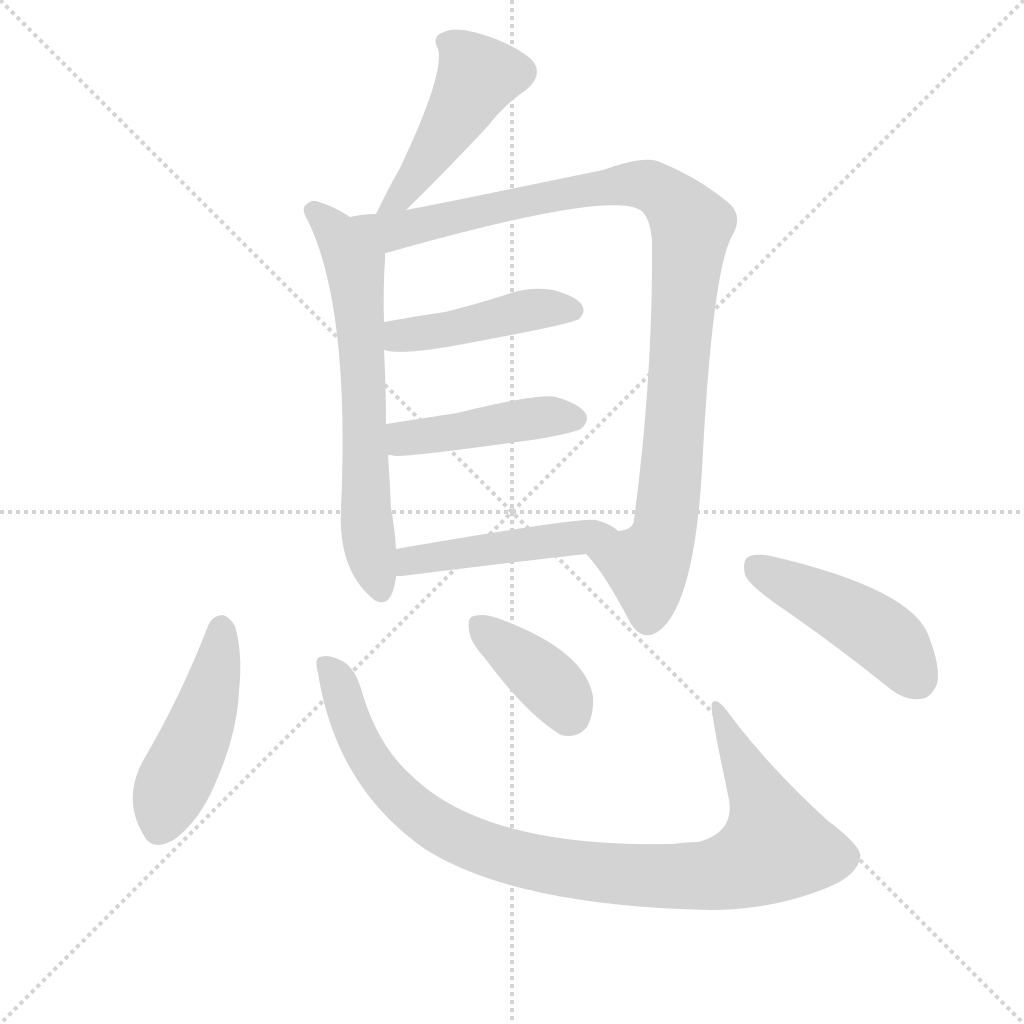
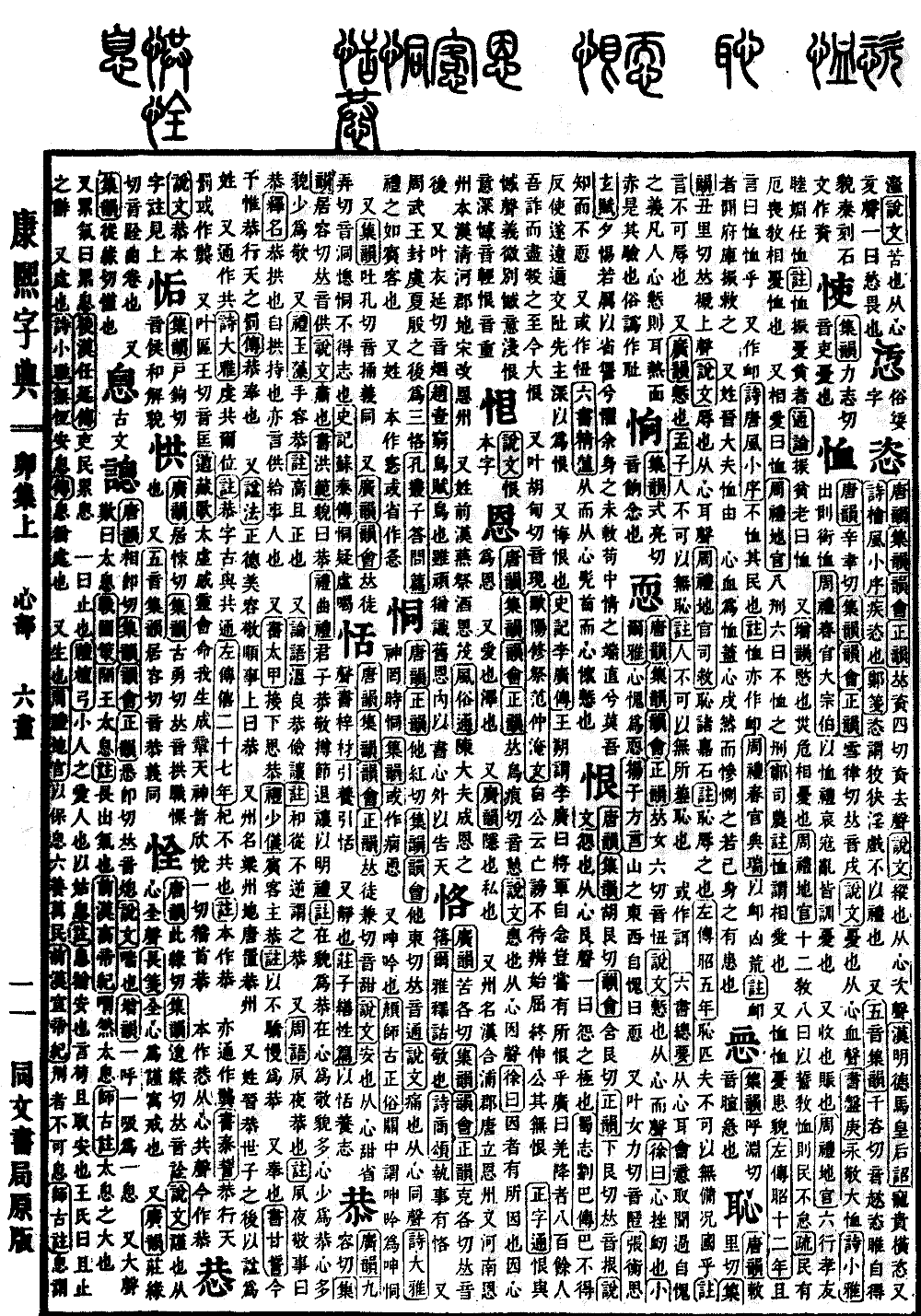
Mao Collection, Upper Volume. Radical: Heart (xīn). Kangxi Dictionary strokes: 10. Page 385, Entry 20.
Ancient character. According to Tang Rhymes (Tangyun), pronounced xi. According to Collected Rhymes (Jiyun), Rhyme Compilation (Yunhui), and Orthodox Rhymes (Zhengyun), pronounced xi, with a sound identical to extinguished. Shuo Wen Jie Zi (Shuo Wen Jie Zi) defines it as gasping. Zeng Yun (Zeng Yun) states that one exhalation and one inhalation are called one breath (xi). Furthermore, a loud sigh is called a deep sigh (tai xi). Records of the Warring States (Zhanguo Ce): King Min heaved a deep sigh. Commentary: To exhale air at length. History of the Former Han (Qian Hanshu), Annals of Emperor Gao: He sighed deeply with a gasp. Commentary by Shigu: Deep sigh means a loud sigh. Also, to hold one's breath due to fear is called lei xi. History of the Later Han (Hou Hanshu), Biography of Ren Yan: The officials and the common people were all holding their breath in fear. Another interpretation is to stop. Book of Rites (Liji), Tan Gong: The love of a person of shallow insight for others is one of indulgence (gu xi). Commentary: Xi is like being at peace. It means to seek ease temporarily. Mr. Wang says: It means to stop for the time being. Also defined as to dwell. Book of Odes (Shijing), Lesser Odes: Do not always covet comfort. Commentary: Xi is like a place to dwell. Also defined as to grow. Rites of Zhou (Zhouli), Earth Officer: To protect and allow growth (xi) for the six types of nourishment to care for the masses. History of the Former Han (Qian Hanshu), Annals of Emperor Xuan: Those who have undergone corporal punishment cannot grow (xi) again. Commentary by Shigu: Xi refers to growth. It means those who have had their noses cut off or feet severed cannot grow again. Also, Commentary on the Monthly Ordinances (Yueling Zhu) of the Book of Rites (Liji): The growth of Yang energy is called xi. Also, a son is called xi. Records of the Eastern Han (Dongguan Hanji): This is likely my child (zi xi). Records of the Warring States (Zhanguo Ce): My humble son (jian xi) Shuqi is the youngest. Also, Master Shi (Shizi): Abandon the teachings of the elderly and adopt the language of women and children. Commentary: Gu refers to women; xi refers to children. Also, lending money to collect interest is also called xi. Rites of Zhou (Zhouli), Earth Officer, Spring Treasury: All commoners who borrow shall pay interest (xi) according to the tax rates established by the state. Also defined as to comfort. Book of Etiquette and Ceremonial (Yili), Village Drinking Ritual: Then comfort (xi) the Minister of Justice. Commentary: Xi means to comfort. Explanation of Sounds (Shiwen): Lao is pronounced as li plus bao in reverse. Also defined as to rest. Rites of Zhou (Zhouli), Spring Officer, Flute Master: To allow the decaying myriad things to find rest (xi). Commentary: It means to let them rest. Also, Winter Officer, Record of Trades (Kaogong Ji), The Artisan: Set up a beast target, then the monarch uses it to rest and feast. Commentary: Xi means to let the farmers rest and let the decaying myriad things recover. Also, Explanation of Names (Shiming): Xi means to block or to fill. Also, the name of a state. There is also Xinxi County, originally the former land of the Xi State, which moved to the east, hence the addition of the character new. Zuo Tradition (Zuo Zhuan), 11th Year of Duke Yin: The Marquis of Xi attacked the Zheng State. Commentary: The Xi State was in Xinxi County, Runan Commandery. Explanation of Sounds (Shiwen): Some versions write it as He. There is also Anxi, a state of the Rong tribes, ten thousand six hundred li away from Chang'an. Customs and Practices (Fengsu Tong): There are six types of Rong tribes, and the fifth type is called the Nasal Breath (bi xi). Also, soil that can grow infinitely by itself is called breathing soil (xi rang). Classic of Mountains and Seas (Shanhai Jing): Gun stole the breathing soil (xi rang) from the Heavenly Emperor to block the great flood. Also a surname. Surname Garden (Xingyuan): There is this surname in Xiangyang now. Also, Xifu is a compound surname. Also, the leaf-rhyme is pronounced xie, with a sound identical to the character for scraps (xie). Su Shi, Poem on Visiting Xiangji Temple: Enjoyment eventually leads to nothing, cast aside with a long sigh. Deep exploration is difficult to sustain, recording the years on a wooden board. The character form consists of heart and self, with self also acting as a phonetic element. Xu Kai says: Self refers to the nose. Breath comes out of the nose. It is a compound ideograph. Note on textual research: In Book of Rites (Liji), Tan Gong, the phrase regarding a person of small character has been corrected from the original text to read person of fine character.