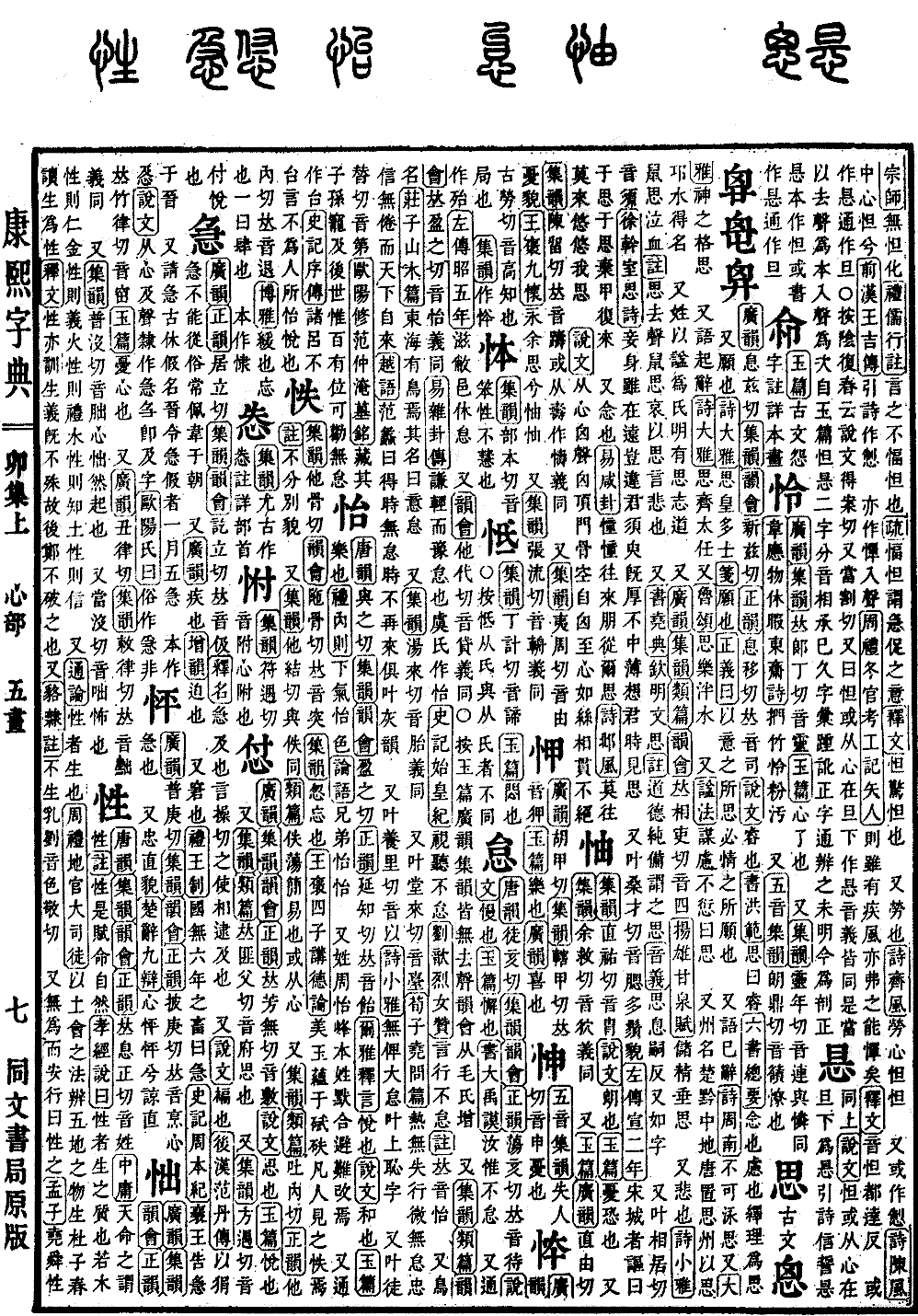
Mao Collection, Upper Volume
Radical: Heart (xīn)
急
Kangxi strokes: 9
Page 381, Entry 21
Pronounced ji (falling tone).
Explanation of names: Urgent, meaning to urge or press so that one may catch up with another.
According to the Shuo Wen Jiezi (Shuowen), it also means narrow-minded.
In the Biography of Fan Dan in the History of the Later Han (Hou Hanshu), it is noted that because his temperament was impatient and irritable, unable to conform to common customs, he often wore leather belts at court to caution himself.
According to the Guang Yun (Guangyun), it means rapid.
According to the Zeng Yun (Zengyun), it means pressing. It also means distressed or in a difficult situation.
In the Book of Rites (Liji), in the section regarding Royal Regulations, it is stated that a state without six years of reserves is considered to be in an urgent situation.
In the Records of the Grand Historian (Shiji), in the Annals of Zhou, it is recorded that King Xiang of Zhou reported an emergency to the state of Jin to seek aid.
Requesting an urgent leave refers to an ancient term for taking time off. The statutes of the Jin dynasty stipulated urgent leave, allowing for five such instances per month.
Originally written as the character composed of the heart radical and the sound component ji. In the clerical script it is written as the current form, where the lower portion is the character ji.
Ouyang stated that the common variant form is incorrect.