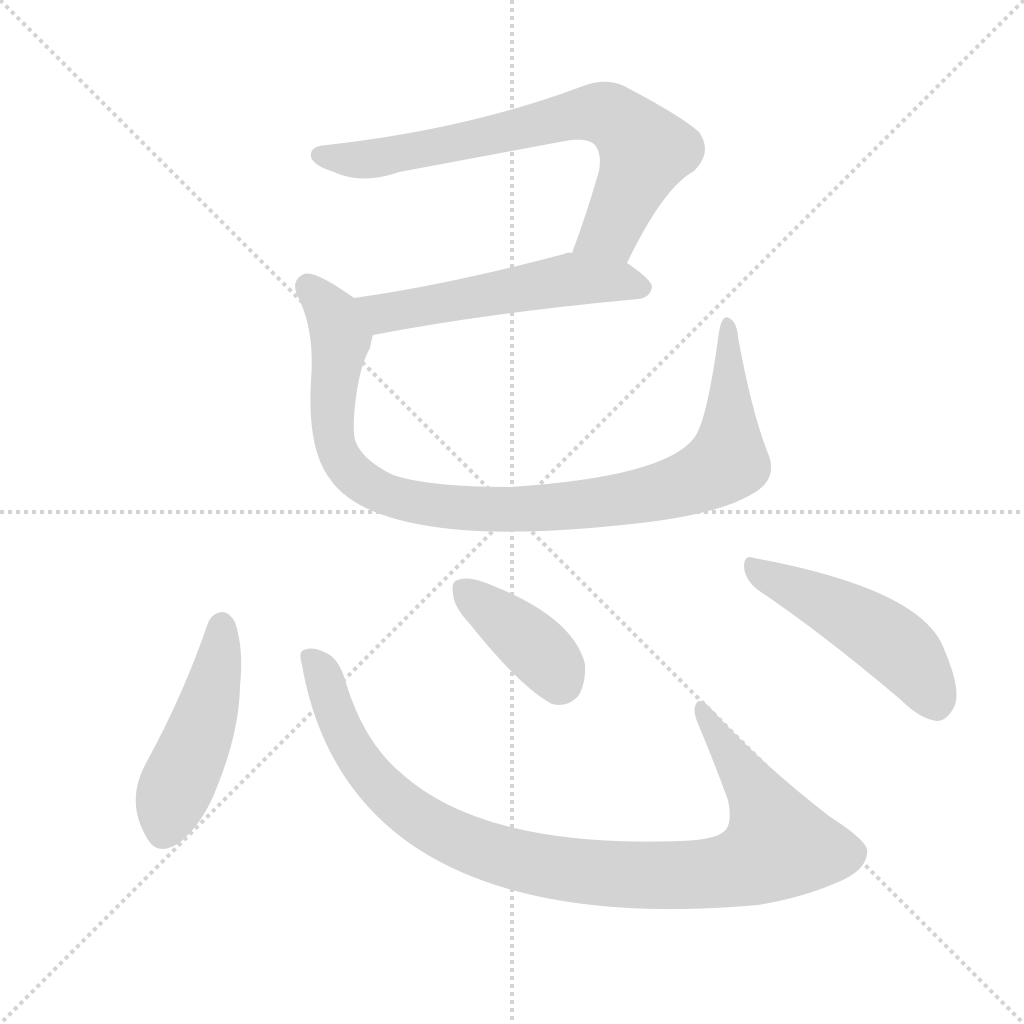
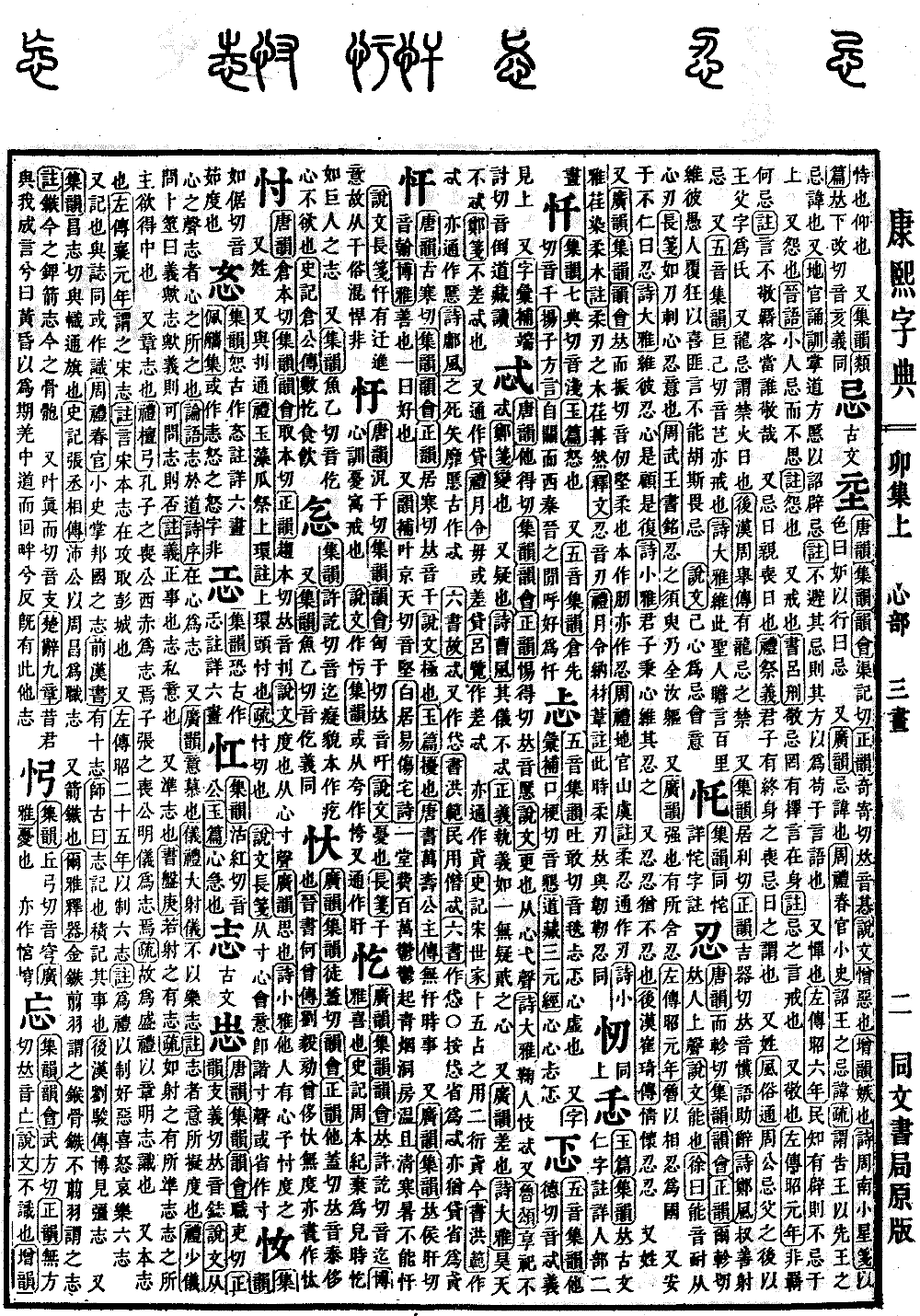
Mao Collection, Upper Volume
Radical: Heart (xīn)
Kangxi stroke count: 7
Page 376, Entry 01
Archaic form: ji
Tang Rhymes (Tangyun), Collected Rhymes (Jiyun), Rhyme Compendium (Yunhui): pronounced ji (falling tone). Correct Rhymes (Zhengyun): pronounced ji (falling tone); the pronunciation is identical to ji.
Shuowen Jiezi: The meaning is to hate or detest.
Zengyun: Jealousy.
Book of Odes (Shijing), Zhou Nan section, Little Stars commentary: Jealousy arising from appearance is called du, while jealousy arising from character is called ji.
Also: Taboo.
Rites of Zhou (Zhouli), Spring Officials, Minor Historian: To announce the taboos of the sovereign.
Commentary: Refers to announcing the taboos of the former kings to the sovereign.
Also: Earth Officials, Recitation Instructions: Responsible for explaining regional taboos to advise people to avoid them.
Note: If one does not avoid those taboos, the local people will consider the speech reckless.
Also: To fear.
Zuo Commentary (Zuozhuan), Year 6 of Duke Zhao: If the common people know there are laws, they will not fear their superiors.
Also: To resent.
Discourses of Jin (Jinyu): Small men resent without reflecting.
Note: Means resentment.
Also: To be cautious and fearful.
Book of Documents (Shangshu), Counsels of Lu: Be respectful and cautious; let there be no words for which one can be criticized in one's own person.
Note: The meaning of ji is to be cautious and fearful.
Also: To be respectful.
Zuo Commentary (Zuozhuan), Year 1 of Duke Zhao: If not the traveler, then whom should one respect?
Note: The meaning is that if one does not respect the traveler, who else should be respected?
Also: Anniversary of a death, referring to the day a parent passed away.
Book of Rites (Liji), Meaning of Sacrifices: A superior person has a lifelong sorrow; this refers to the death anniversary.
Also: A surname.
Comprehensive Customs (Fengsutong): Descendants of the Duke of Zhou's relative Jifu, who took his grandfather's courtesy name as a surname.
Also: Dragon taboo, referring to days when fire is prohibited.
Book of the Later Han (Hou Hanshu), Biography of Zhou Ju: There are prohibitions regarding the dragon taboo.
Also: Collected Rhymes (Jiyun): pronounced ji (falling tone). Correct Rhymes (Zhengyun): pronounced ji (falling tone); the pronunciation is identical to yi. A particle used for emphasis.
Book of Odes (Shijing), Odes of Zheng: How skilled is Shu at archery.
Also: Five Sounds Collected Rhymes (Wuyin Jiyun): pronounced ji (rising tone); the pronunciation is identical to qi, and also carries the meaning of being cautious and fearful.
Book of Odes (Shijing), Greater Odes: Only these sages have vision that reaches a hundred miles. Only those fools, instead, are wildly pleased with themselves. It is not that they cannot speak; why are they so fearful and wary?
Shuowen Jiezi: A heart being guarded (ji) is the character for ji. It is an associative compound character.