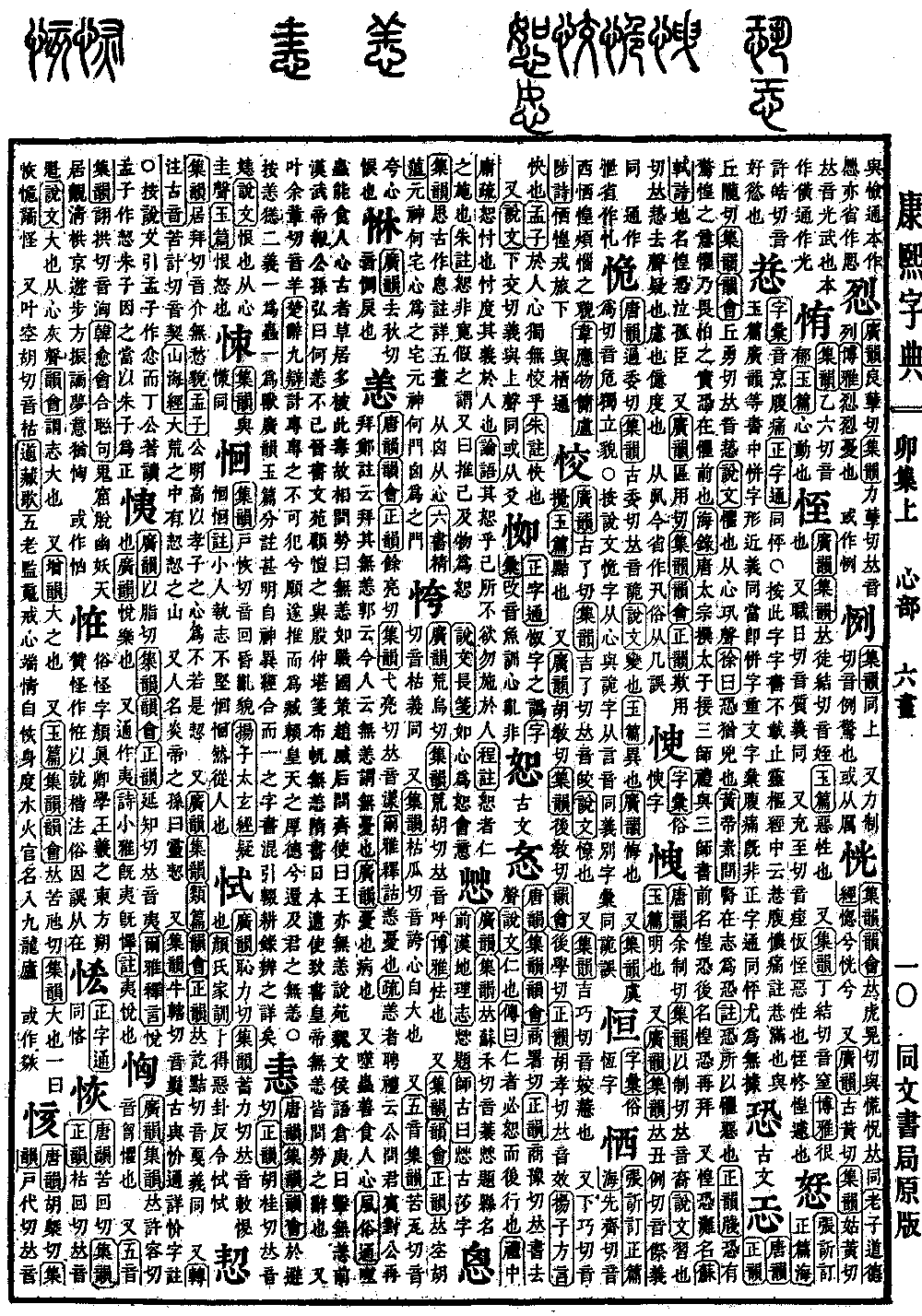
Mao Collection, Upper Volume
Radical: Heart (xīn)
Total strokes: 10
Page 384, Entry 08
Ancient form. Pronounced kong. According to the Shuowen Jiezi (Shuowen), it means to fear. Formed from the Heart radical with the phonetic component gong. Xu says that kong is akin to xiong (dreadful). According to the Yellow Emperor’s Inner Canon (Huangdi Suwen), the intent of the kidney is to feel fear. The commentary notes that fear is how one dreads evil. The Zheng Yun Jian commentary states that kong conveys the meaning of alarm and panic. Fear is the reality of being afraid, and kong precedes fear. According to the Hai Lu, Emperor Taizong of Tang composed the Rites for the Crown Prince Receiving the Three Masters, and in his letters to the three masters, he used the term huang-kong (alarmed and fearful) in the opening and huang-kong zai-bai (alarmed, fearful, and bowing twice) in the closing. It is also the name of a rapid. Su Shi wrote in his poetry, The place named Huang-kong makes the lonely official weep.
Also pronounced kong (departing tone) according to the Guang Yun, Ji Yun, Yun Hui, and Zheng Yun. It means to suspect, to worry, or to speculate. Originally written with the phonetic component. Now simplified to xun. The common practice of using the ji radical is incorrect.