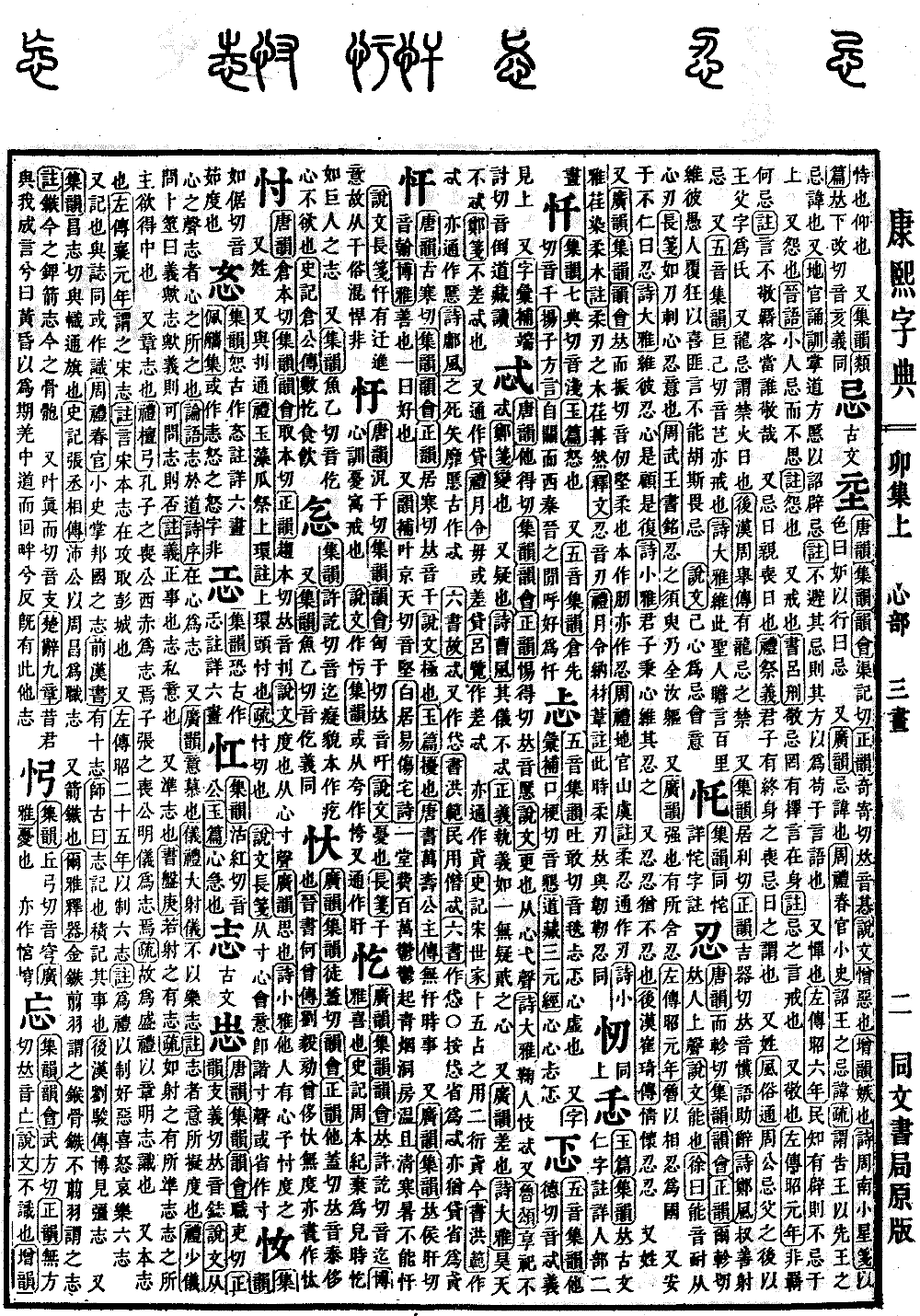
Mao Collection, Upper Volume
Radical: Heart (xīn)
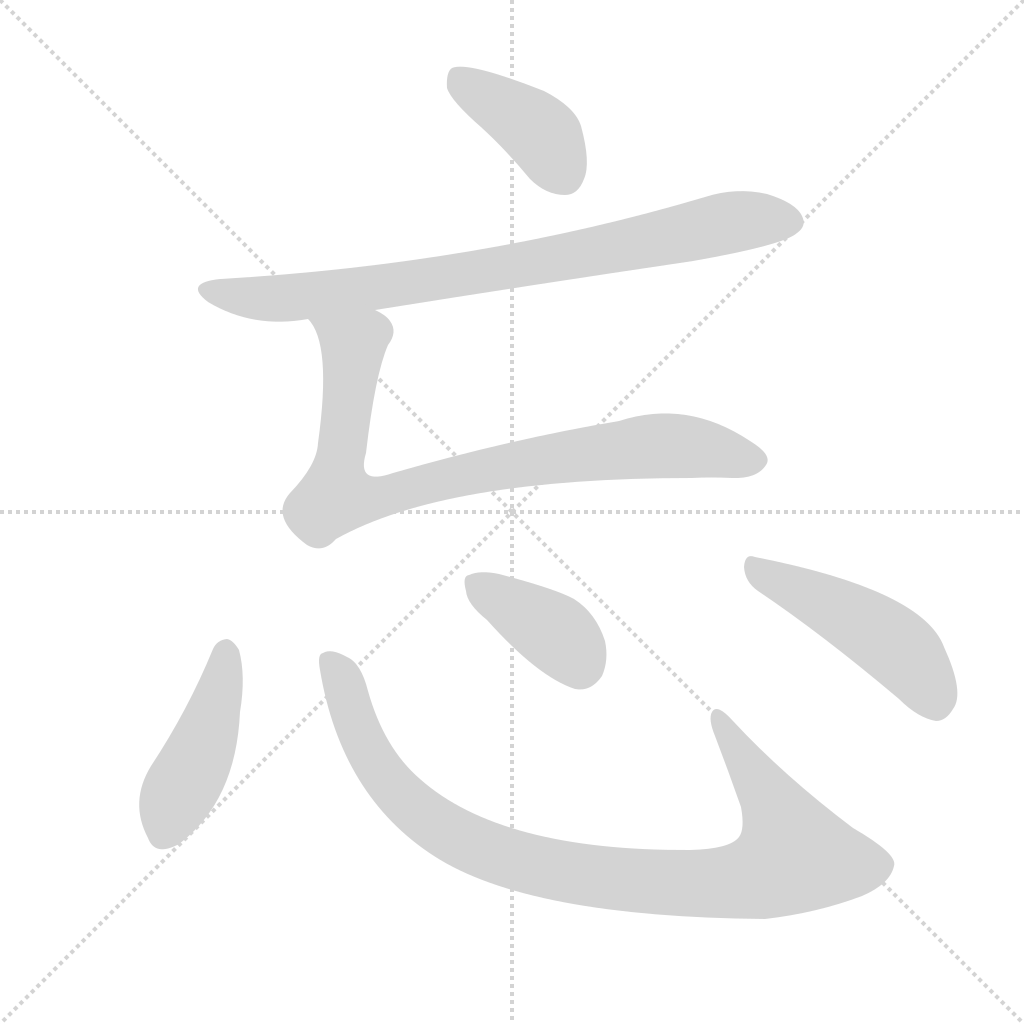
忘
Kangxi stroke count: 7
Page 376, Entry 24
According to the Collected Rimes (Jiyun) and the Collection of Rimes (Yunhui), pronounced wang. According to the Correct Rimes (Zhengyun), pronounced wang.
As defined in the Explaining Graphs and Analyzing Characters (Shuowen), to not know. As defined in the Augmented Rimes (Zengyun), to neglect. Also, to leave behind. As mentioned in the Book of Documents (Shangshu), specifically the Charge to Weizi: I commend your virtue, saying it is sincere and not forgotten, meaning not left behind. Also, as mentioned in the Book of Etiquette and Ceremonial (Yili), in the chapter on the capping ceremony for scholars: longevity and not being forgotten. The commentary states: to possess a good name for a long time, not to suddenly and abruptly vanish. Also, to be prone to forgetting is an illness. As mentioned in the Zhuangzi, in the chapter on Mastering Life: if the vital energy descends and does not rise, it causes a person to be prone to forgetting. Also, to sit and forget, meaning to have no thoughts or anxieties. As mentioned in the Zhuangzi, in the chapter on The Great and Venerable Teacher: Hui sat and forgot.
Also, according to the Expanded Rimes (Guangyun) and the Correct Rimes (Zhengyun), pronounced wang. According to the Collected Rimes (Jiyun) and the Collection of Rimes (Yunhui), pronounced wang. As defined in the Collection of Rimes (Yunhui), to abandon and forget. As defined in the Augmented Rimes (Zengyun), to leave out or forget. As mentioned in the Rites of Zhou (Zhouli), in the section on the Office of Earth and the Supervisor of Punishments: there are three types of leniency, the first is called inadvertent omission. Also, when one's intent is not present. As mentioned in the Zuo Commentary (Zuozhuan), in the seventh year of Duke Yin: the Earl of Zheng made a covenant and smeared his lips as if he had forgotten. The commentary states: his intent was not on the smearing of blood. Also, as mentioned in the poetry of Han Yu, in the poem parting from Official Dou: middle plates were brought with oranges and chestnuts, thrown and tossed, pouring out dried meat and sauce. When joy is exhausted, a heart of sorrow arises; lingering in attachment, unable to forget.
As defined in the Explaining Graphs and Analyzing Characters (Shuowen), the character is composed of the radical for heart and the character for to lose, representing the combined meaning.