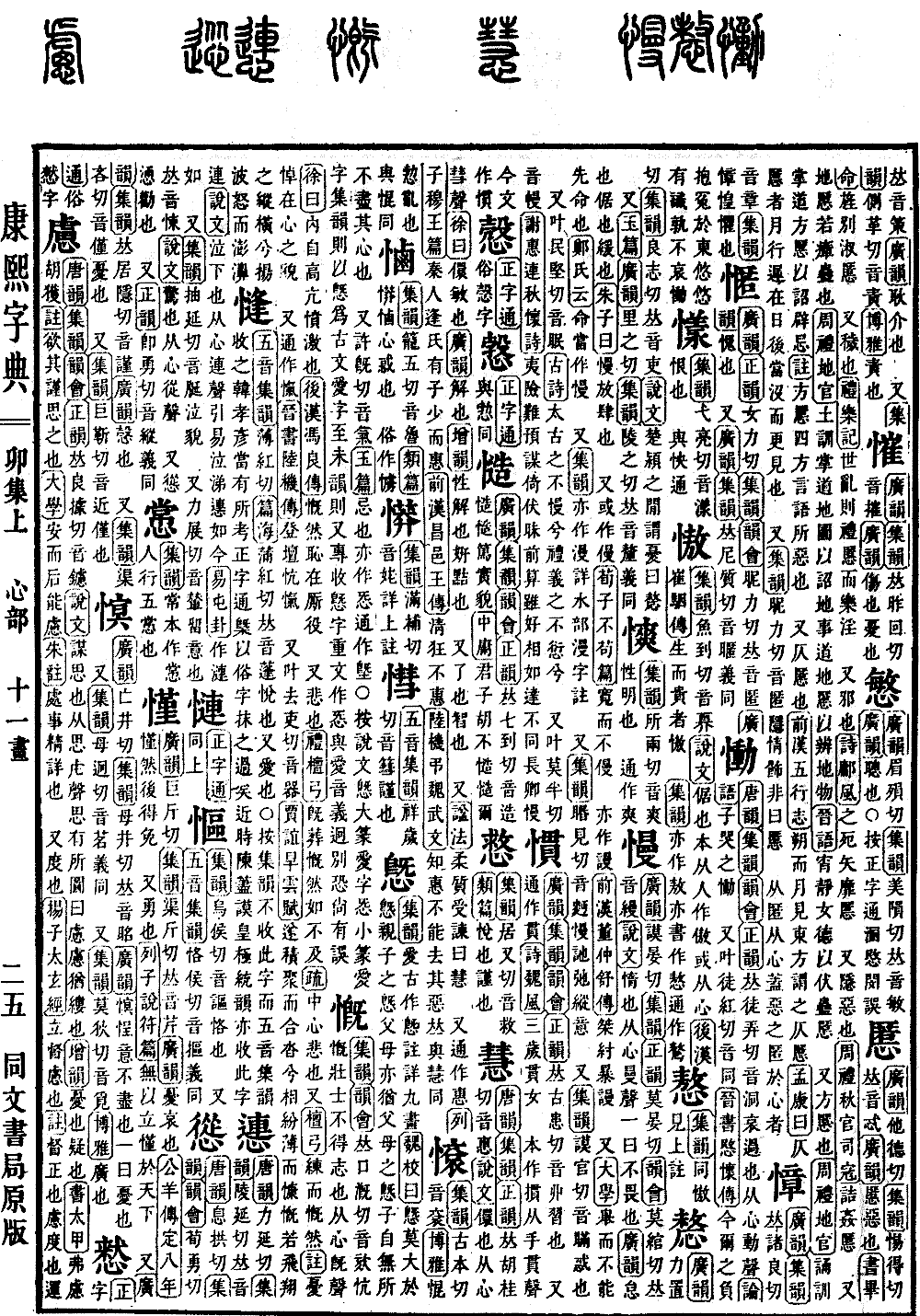
Shen Collection, Middle Volume. Radical: Tiger (hǔ). 15 strokes. Page 399, Entry 01.
Yu Pian (Book of Rhymes): Pronounced fang. Describes the appearance of sorrow.
Tang Yun (Tang Rhymes), Jiyun (Collection of Rhymes), Yunhui (Consolidated Rhymes), Zhengyun (Correct Rhymes): Pronounced lü (falling tone), same pronunciation as lü.
Shuowen Jiezi (Explanation of Graphs and Analysis of Characters): Denotes planning and thinking. The character structure includes "thought" (si) and uses "tiger" (hu) as the phonetic element. Mental scheming is called lü. The meaning of lü is similar to lü (to think through as if unwinding a silk thread).
Zengyun (Augmented Rhymes): Means to have sorrow or misgivings.
Book of Documents (Shujing), Taijia: If one does not think, how can one attain success? Commentary: This implies a wish for one to think cautiously.
Great Learning (Daxue): Only after the heart is tranquil can one think thoroughly. Zhu Commentary: This refers to handling affairs with precision and thoroughness.
Also means to estimate or speculate. Yangzi (Master Yang's) Taijing (Great Mystery): Establishing standards to conduct an assessment. Commentary: Du means to straighten, lü means to speculate. Operating with correct standards.
Also used as a term for total calculation, called wanglü. History of the Former Han (Qian Hanshu) Commentary: A term for generalization, meaning one can know the general situation without careful calculation.
Also, banners carried when an army moves forward are called lüwu. Zuo Tradition (Zuo Zhuan), Year 12 of Duke Xuan: The vanguard maintains vigilance to guard against the unexpected. Commentary: Considering potential or future events. Orthodox Meaning: Explains the need to consider things not yet happened so people are prepared.
Shiming (Explanation of Names): Lü is like lü (to travel), and lü means many.
Book of Changes (Yijing), Xici (Appended Remarks): The principles converge into one, yet thoughts are of a hundred kinds. Commentary: Thoughts involve many things in pursuit of unity.
Also a surname. Zuo Tradition: Among the ministers of Nan Kuai was Lü Gui.
Guangyun (Broad Rhymes): Pronounced li (rising tone). Jiyun, Yunhui, Zhengyun: Pronounced lü (rising tone), same pronunciation as lü. Zhengyun: Means thought or anxiety.
Huainanzi (Masters of Huainan), Yuan Dao Xun (Exposition on the Original Way): Serene and without distractions, indifferent and without anxiety. Taking the sky as a carriage canopy, taking the earth as a carriage body.
Also the name of a tree. Erya (Approaching Elegance), Shi Mu (Explanation of Trees): Zhulü is mountain lei (a type of vine).
Also a place name. Longlü in Henei Commandery; Wulü in Liaodong Commandery; Qulü in Linhuai Commandery; Qilü in Liaoxi Commandery; Changlü in Haidong. Long is pronounced lin, Qu is pronounced qu, Qi is pronounced ju.
Gujin Zikao (Investigation of Ancient and Modern Characters): Pronounced lü (rising tone), same pronunciation as lü. Jishan Ge (Song of Mount Ji): The sun and moon run and shine; there is nothing unseen or unrecorded. Wandering freely between heaven and earth, what is there to worry about or avoid?
Zhengzitong (True Character Mastery): Pronounced lu. Tang History (Tangshu), Baiguan Zhi (Treatise on Officials): The Court of Judicial Review manages investigations and judgments. Every five days, any imprisoned convicts must have their case records reviewed.
History of the Former Han, Biography of Juan Buyi: Every time he inspected subordinate counties, he would review the case files of prisoners before returning. Shigu Commentary: Luqiu is now written as lüqiu; it was originally just the entering tone pronunciation of the character lu. Modern common people do not understand its meaning and mistakenly attribute it to the lü (thought) of "deliberation," thus losing its origin. Note: Yan Shigu's remark seems close to understanding the characters but actually fails to grasp phonology. Because he did not understand phonology, he cannot be said to understand the origins of the characters. Every character originally possesses four tones; for example, the character lü starting from the level tone: lü (level), lü (rising), lü (falling), and lu (entering). Lü fundamentally means to plan or think but also implies detailed examination; therefore, the "recording of prisoners" in the History of the Former Han is also "deliberation of prisoners." The character lü originally possessed an entering tone with the pronunciation lu; must it be exclusively in the falling tone to be considered its origin?
Also matches the rhyme pronounced lu. Chuci (Songs of Chu), Jiuzhang (Nine Chapters): Only the beautiful one has a heart different from the rest, picking fragrant peppers to dwell alone. Sighing repeatedly with sorrow, living in solitary seclusion to ponder and worry.
Note: This character is originally from the "thought" (si) radical. Shuowen and Yu Pian both categorize it under the "thought" (si) radical. Zihui (Collection of Characters) merges it under the "heart" (xin) radical for ease of reference.