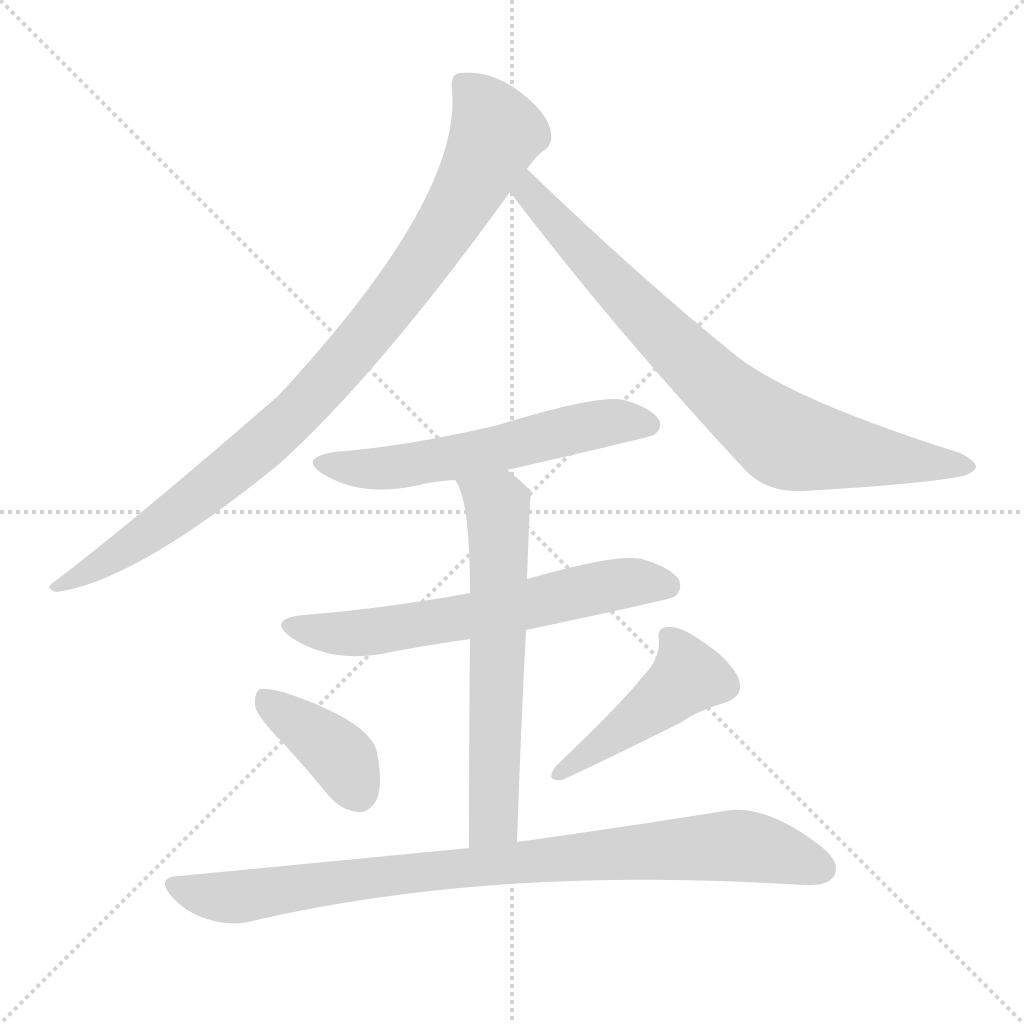
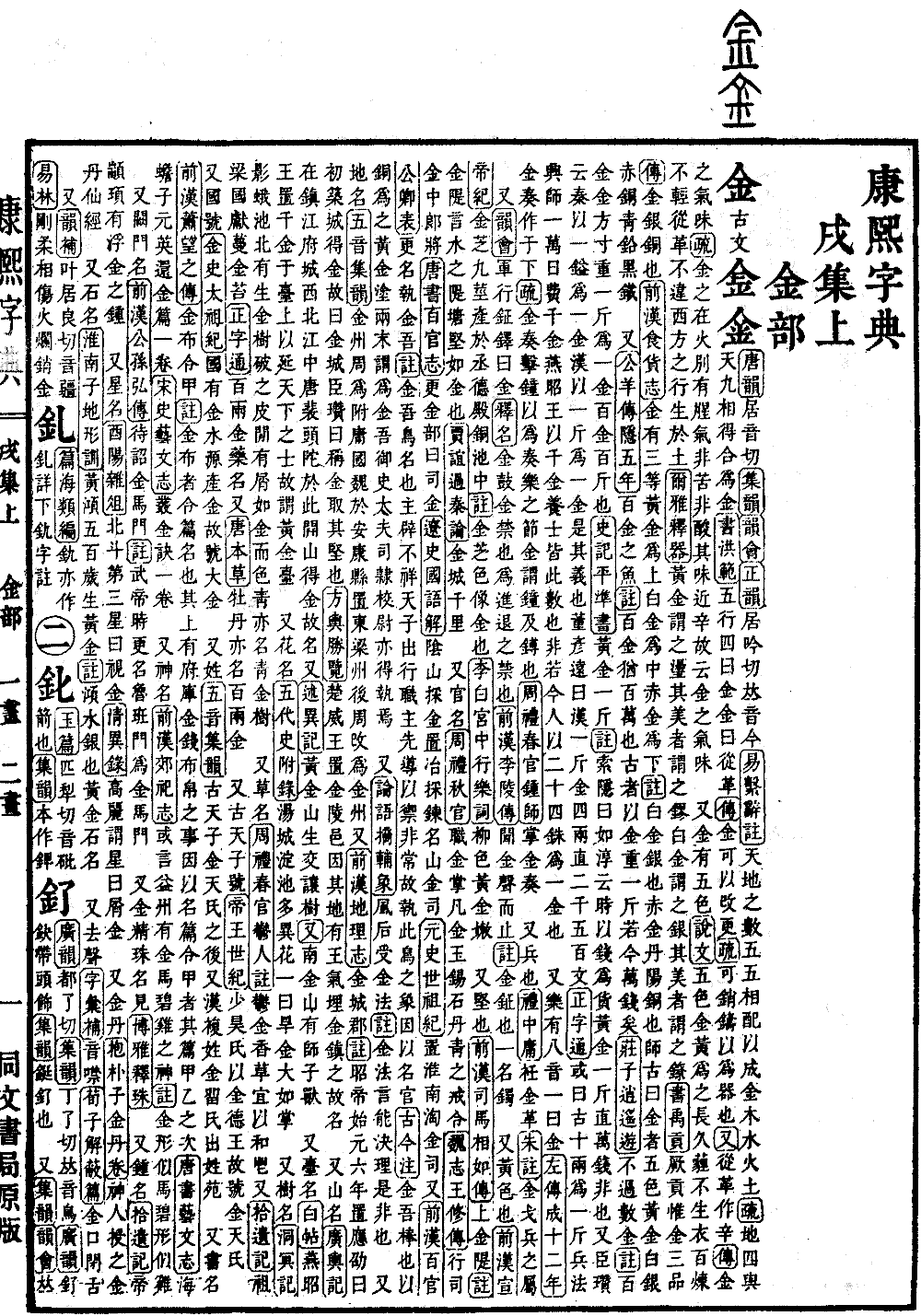
Xu Collection, Upper Volume. Radical: Metal (jīn); Kangxi Dictionary strokes: 8; Page 1295, Entry 01.
Ancient form. Tangyun: Pronounced jin. Jiyun, Yunhui, Zhengyun: Pronounced jin.
Classic of Changes (Yijing), Commentary on the Appended Statements: The numbers of Heaven and Earth, five and five combined to form gold, wood, water, fire, and earth. Commentary: The four of Earth and nine of Heaven correspond, combining to form metal.
Book of Documents (Shujing), Hongfan: Of the five elements, the fourth is metal; metal is described as yielding and changing. Commentary: Metal can be melted and reshaped into vessels. Again: Following the changing process, it becomes pungent (xin). Commentary: The taste and scent of metal. Commentary: When metal is in fire, it has a distinct fishy scent, neither bitter nor sour; its taste is close to pungent, which is why the taste of metal is explained this way. Furthermore, metal has five colors.
Shuowen Jiezi: The five-colored metals; yellow is the most precious. If buried for a long time, it does not rust. Refined a hundred times, it does not lose weight; it follows the path of transformation without resistance. It is the element of the West, born from within the earth.
Erya, Shiqi: Gold is called yang; the refined sort is called liu. White metal is called silver; the refined sort is called liao.
Book of Documents (Shujing), Yu Gong: The tribute consisted of only three kinds of metal. Commentary: Refers to gold, silver, and copper.
History of the Former Han (Qian Hanshu), Treatise on Food and Money: Metal is divided into three grades; gold is the superior grade, silver is the middle grade, and red metal is the inferior grade. Note: White metal is silver. Red metal is Danyang copper. Shigu says: Metal has five colors: gold, silver, red copper, green lead, and black iron.
Gongyang Zhuan, Year 5 of Duke Yin: Fish worth a hundred jin of gold. Note: A hundred jin is like saying a million. In ancient times, one jin of gold weighed one pound (jin), similar to the modern ten thousand cash.
Zhuangzi, Xiaoyaoyou: No more than a few jin. Note: A hundred jin—when a square inch of gold weighs one jin, it is called one jin. A hundred jin means one hundred pounds.
Records of the Grand Historian (Shiji), Treatise on the Balance of Standards: One jin of gold. Note: Suoyin says: Rushun says that at the time, money was the currency, and one jin of gold was worth ten thousand cash, but this is incorrect. Chen Zan says: The Qin dynasty considered one yi as one jin, and the Han dynasty considered one jin as one jin; this is the correct meaning. Dong Yanyuan says: One Han jin of gold was four liang, worth two thousand five hundred wen.
Zhengzitong: Some say in ancient times ten liang made one jin. The Art of War says: To mobilize ten thousand troops, the daily expense is one thousand jin. King Zhao of Yan used one thousand jin to support scholars; these were all of this magnitude. It is not like modern people who consider twenty-four zhu to be one jin.
Also refers to the eight musical sounds, of which the first is called metal.
Zuo Zhuan, Year 12 of Duke Cheng: The metal music began below. Commentary: Metal music refers to striking bells to provide the beat for the performance. Metal refers to bells and bo (large bells).
Rites of Zhou, Spring Officials, Bell Master: In charge of metal music.
Also refers to weaponry.
Book of Rites (Liji), Doctrine of the Mean: Pillowing on metal and leather. Zhu Xi's commentary: Metal refers to weapons such as daggers and spears.
Yunhui: The zheng (small bell) or duo (large bell) struck by troops when marching is called metal.
Shiming: Metal drum. Metal implies the meaning of prohibition; it acts as a prohibition for advancing or retreating.
History of the Former Han (Qian Hanshu), Biography of Li Ling: Upon hearing the sound of metal, they halted. Note: Metal refers to the zheng. Also called zhuo.
Also refers to the color yellow.
History of the Former Han (Qian Hanshu), Annals of Emperor Xuan: A nine-stemmed golden fungus (jinzhi) grew in the copper pool of the Hande Hall. Note: Golden fungus has a color like gold.
Li Bai, Palace Songs: Willow colors are like tender yellow gold.
Also refers to something solid.
History of the Former Han (Qian Hanshu), Biography of Sima Xiangru: Ascending the metal dike. Note: Metal dike refers to water embankments that are as solid as metal.
Jia Yi, The Faults of Qin: A metal city (impenetrable fortress) spanning a thousand miles.
Also refers to official titles.
Rites of Zhou, Autumn Officials: The metal official is in charge of all regulations concerning gold, jade, tin, stone, cinnabar, and pigments.
Records of the Three Kingdoms (Weizhi), Biography of Wang Xiu: Served as Sijin Zhonglangjiang.
Book of Tang, Treatise on Officials: Renamed the Metal Bureau to Sijin.
History of Liao, Explanations of National Language: Mining and smelting sites set up in the Yin Mountains were called Shanjin Si.
History of Yuan, Annals of Shizu: Established the Huainan Gold Washing Office.
History of the Former Han (Qian Hanshu), Table of Officials and Ministers: Renamed to Zhijinwu. Note: Jinwu is the name of a bird; its main duty is to dispel bad omens. When the Son of Heaven travels, its duty is to lead the way and defend against unusual events, so the official holds an image of this bird, hence the name.
Gujin Zhu: Jinwu is a type of staff. Made of copper with both ends coated in gold, it is called the Jinwu Yushi Daifu. The Sili Xiaowei may also carry it.
Analects of Confucius (Lunyu), Zhaifuxiang: Feng Hou received the metal law. Note: Metal law refers to the principles by which right and wrong can be determined.
Also refers to a place name.
Wuyin Jiyun: Jinzhou was a vassal state during the Zhou dynasty. The Wei established Dongliangzhou in Ankang County, and the Northern Zhou renamed it Jinzhou.
History of the Former Han (Qian Hanshu), Geography Treatise: Jincheng Prefecture. Note: Established in the sixth year of the Shiyuan era of Emperor Zhao. Ying Shao says: Gold was found when the city was first built, hence the name Jincheng. Chen Zan says: Calling it metal is to signify its strength.
Fangyu Shenglan: King Wei of Chu established Jinling City; because the area possessed royal vitality, he buried gold there to suppress it, hence the name.
Also refers to a mountain name.
Guangyu Ji: Located in the middle of the river northwest of Zhenjiang Prefecture city. The Tang monk Pei Toutuo excavated the mountain here and found gold, hence the name.
Shuyiji: Golden Mountain, where the jiaorang tree grows.
Also: Nanjin Mountain has the lion beast.
Also refers to a terrace name.
Baitie: King Zhao of Yan placed one thousand jin on a terrace to attract scholars of the world, hence it is called the Golden Terrace.
Also refers to a flower name.
History of the Five Dynasties (Wudaishi), Appendix: Tangcheng Dian Pond has many exotic flowers. One is called the dry gold flower (hanjin), the size of a palm.
Also refers to a tree name.
Dongmingji: North of Ying'e Pond grows the gold-producing tree. When split, there are fragments between the bark like gold but green in color; also called the green gold tree (qingjin).
Also refers to a grass name.
Rites of Zhou, Spring Officials, Yuren commentary: Yujin fragrant grass is suitable for blending with chang wine (ritual wine).
Shiyiji: The state of Zuliang presented vine gold moss.
Zhengzitong: Hundred-liang gold is a medicinal name.
Tang Bencao: Peony is also called hundred-liang gold.
Also refers to an ancient title for the Son of Heaven.
Diwang Shiji: The Shaohao clan reigned by the virtue of metal, hence they were styled Jintian.
Also refers to a dynasty name.
History of Jin (Jinshi), Annals of Taizu: There is a gold-producing river in the country, and the source produces gold, hence the dynasty name Great Jin.
Also refers to a surname.
Wuyin Jiyun: Ancient emperors, descendants of the Jintian clan.
There is also a compound surname during the Han dynasty, Jinliu, from the Xingyuan.
Also refers to a book title.
History of the Former Han (Qian Hanshu), Biography of Xiao Wangzhi: Jinbu Lingjia. Note: Jinbu is the title of a legal chapter. It contains matters regarding treasury funds, money, and silk, so this name was used as the chapter title. Lingjia refers to the order of chapters A and B.
Book of Tang, Arts and Literature Treatise: Haichan Zi Yuanying's Huanjin Pian, one volume.
History of Song, Arts and Literature Treatise: Congjin Jue, one volume.
Also refers to a deity name.
History of the Former Han (Qian Hanshu), Treatise on Suburban Sacrifices: Some say Yizhou has the deities of the Golden Horse and the Jade Chicken. Note: The gold is shaped like a horse, and the jade is shaped like a chicken.
Also refers to a palace gate name.
History of the Former Han (Qian Hanshu), Biography of Gongsun Hong: Awaiting the edict at the Golden Horse Gate. Note: During the reign of Emperor Wu, the Luban Gate was renamed the Golden Horse Gate.
Also refers to jin-jing, the name of a pearl. See Boya Shizhu.
Also refers to a bell name.
Shiyiji: Emperor Zhuanxu had the floating gold bell.
Also refers to a star name.
Youyang Zazu: The third star of the Big Dipper is called Shijin.
Qingyilu: The Goryeo people call stars xiejin.
Also refers to the Golden Elixir (jindan).
Baopuzi, Golden Elixir Chapter: The divine being transmitted to him the Golden Elixir Immortal Scripture.
Also refers to a stone name.
Huainanzi, Topographical Training: Yellow mercury after five hundred years becomes gold. Note: Mercury is quicksilver. Gold is the name of a type of stone.
Also pronounced in the departing tone (falling tone).
Zihui Bu: Pronounced jin.
Xunzi, Dispelling Blindness Chapter: Golden mouth and closed tongue (to keep silent).
Also, Yunbu: Matches the rhyme of ju-liang, pronounced jiang.
Yilin: Hard and soft injure each other; fire consumes and melts the gold.