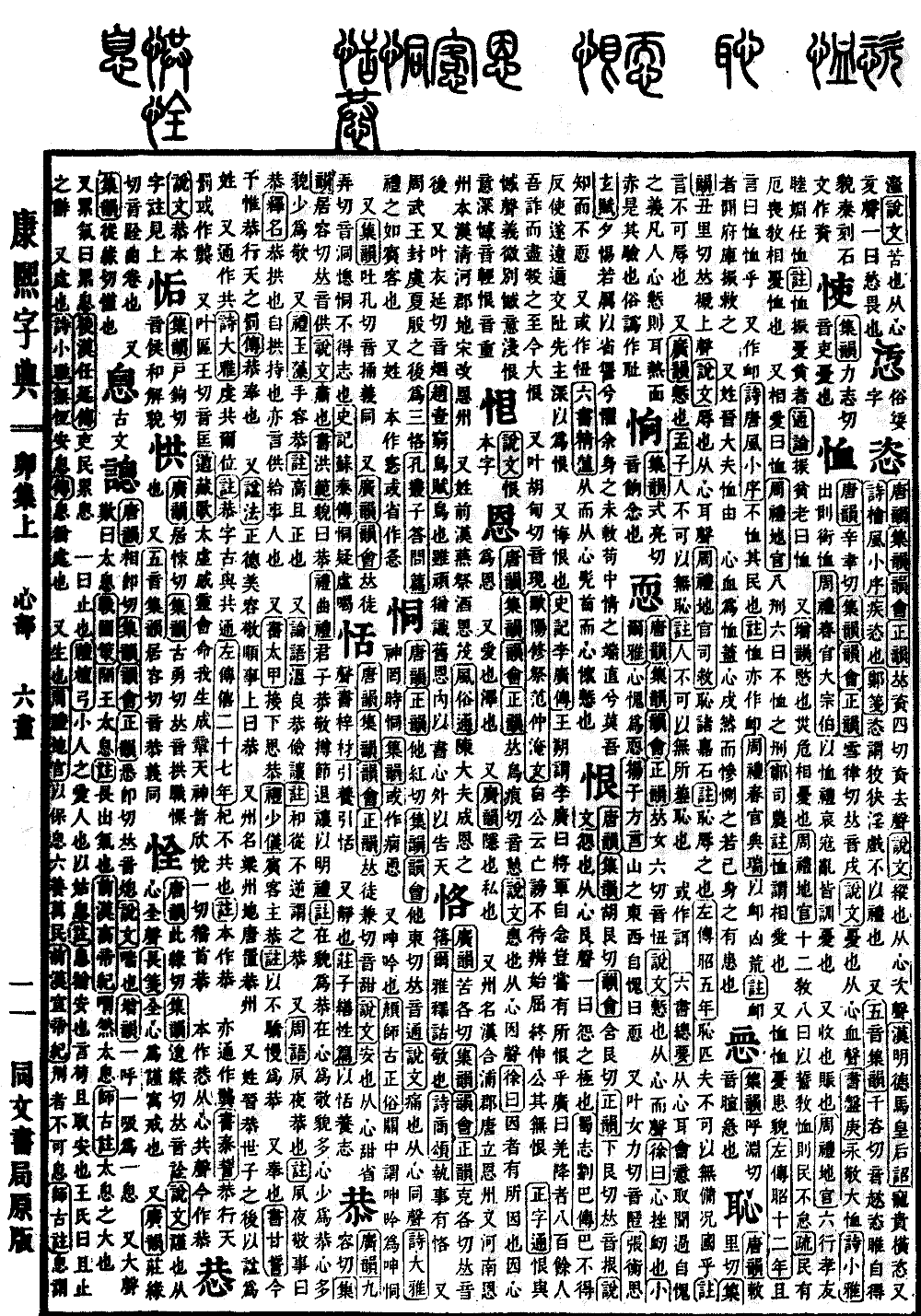
Mao Collection, Upper Volume
Radical: Heart (xīn); Kangxi radical strokes: 10; Page 385, Entry 15
Guangyun (Dictionary of Sounds and Meanings): Pronounced gong; Jiyun (Compilation of Rhymes): Pronounced gong; the pronunciation is the same as the word for supply (gōng).
Shuowen Jiezi (Explaining Simple and Analyzing Compound Characters): To be respectful and reverent.
Book of Documents (Shujing), Great Plan (Hongfan): In appearance, one must be respectful.
Book of Rites (Liji), Summary of the Rules of Propriety (Qu Li): A superior person must be respectful, restrain themselves, and practice humility and withdrawal to manifest ritual decorum.
Sub-commentary (Shu): Expression in outward appearance is called respect (gong), while internal presence is called reverence (jing). When outward appearance is significant but inner intent is slight, it is called respect; when inner intent is significant but outward appearance is slight, it is called reverence.
Also, Book of Rites (Liji), Jade Pattern (Yu Zao): The posture of the hands must be respectful.
Commentary (Zhu): High and upright.
Also, Analects (Lunyu): Gentle, kind, respectful, frugal, and humble.
Sub-commentary (Shu): To be harmonious and obedient without insubordination is called respect.
Also, Discourses of the States (Guoyu): To be respectful in the morning and evening.
Commentary (Zhu): Diligently attending to affairs morning and evening is called respect.
Explanation of Names (Shiming): Respect means to arch (gong), arching one's hands to maintain composure. It can also mean to supply or serve others.
Also, Book of Documents (Shujing), Tai Jia: In receiving subjects, one must consider respect.
Book of Rites (Liji), Lesser Rules of Deportment (Shao Yi): With guests, respect is the primary consideration.
Commentary (Zhu): Not being arrogant or negligent is respect.
Also, it means to carry out.
Book of Documents (Shujing), Speech at Gan (Gan Shi): Now I merely carry out the punishment of Heaven.
Commentary (Zhuan): Respect means to carry out.
Also, Posthumous Titles Law (Shifa): One who maintains upright moral conduct, refines their outward behavior, and serves their superiors with reverence, caution, and obedience is called Gong.
Also, the name of a prefecture. A region in Liangzhou, where Gong Prefecture was established during the Tang Dynasty.
Also, a surname. Descendants of the Crown Prince Gong of the State of Jin took his posthumous title as their surname.
Also, interchangeably used with the character meaning together (gong).
Book of Odes (Shijing), Greater Odes (Daya): Respectfully fulfill your duties.
Commentary (Zhu): In ancient times, the character for respect was interchangeable with the character meaning together (gong).
Zuo Tradition (Zuo Zhuan), 27th Year of Duke Xi: The State of Qi was not respectful.
Commentary (Zhu): Originally written as the character for respect. Also interchangeable with the character meaning to present (gong).
Book of Documents (Shujing), Great Oath (Tai Shi): To carry out the punishment of Heaven. Some editions write this as the character meaning to present (gong).
Also, rime-aligned pronunciation kuang; the pronunciation is the same as that of the word for square or correct (kuāng).
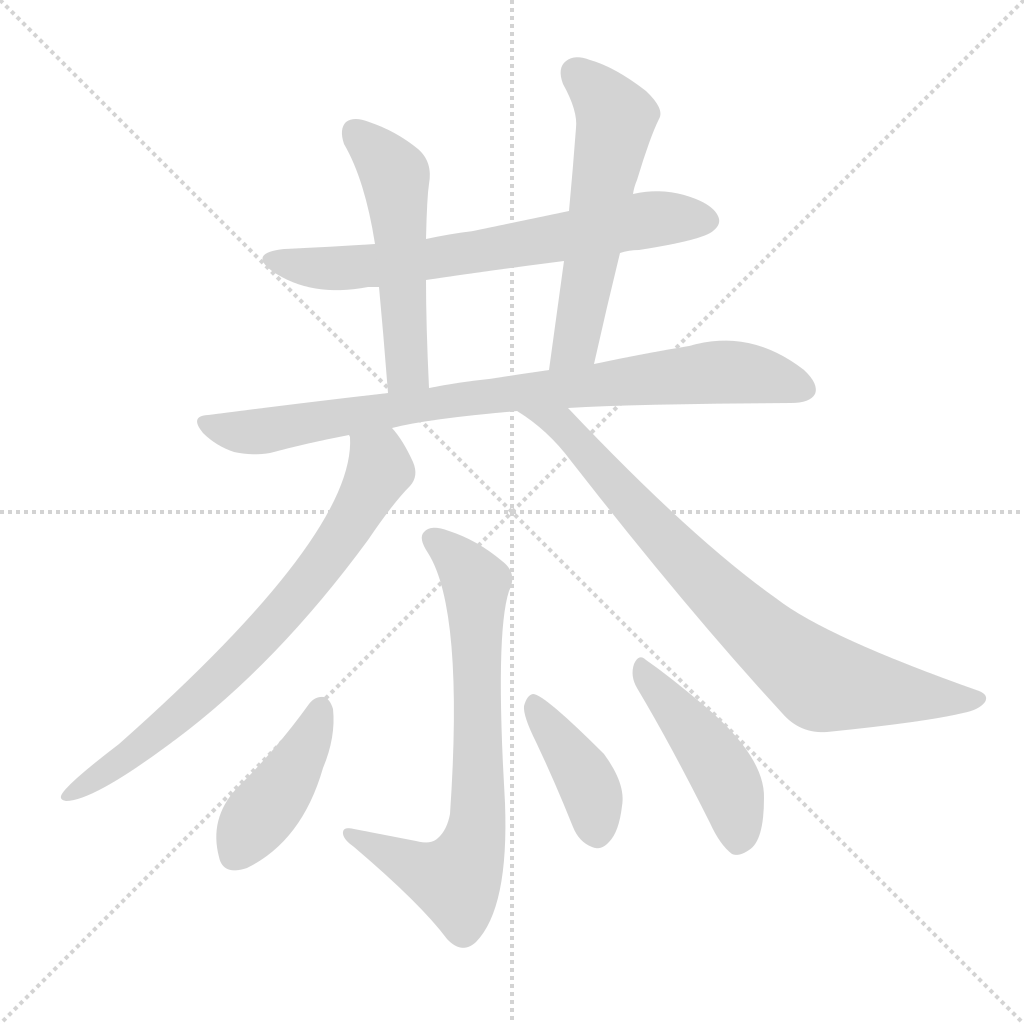
Daoist Canon Song (Daozang Ge): At the marvelous convergence of the Great Void's responsiveness, I am commanded to create literature. The heavenly spirits are universally joyful, and all living beings kowtow in respect. The original character was written with a different form. It belongs to the Heart radical. Uses the character meaning together (gong) as a phonetic component. Now written as this character.
Textual Research: Book of Rites (Liji), Summary of the Rules of Propriety (Qu Li): A superior person must be respectful, restrain themselves, and practice humility and withdrawal to manifest ritual decorum.
Commentary (Zhu): Expression in outward appearance is called respect, while internal presence is called reverence. Note: Corrected to cite the sub-commentary in accordance with the original text.
Analects (Lunyu): Gentle, kind, respectful, frugal, and humble.
Commentary (Zhu): To be harmonious and obedient without insubordination is called respect. Note: Corrected to cite the sub-commentary in accordance with the original text.