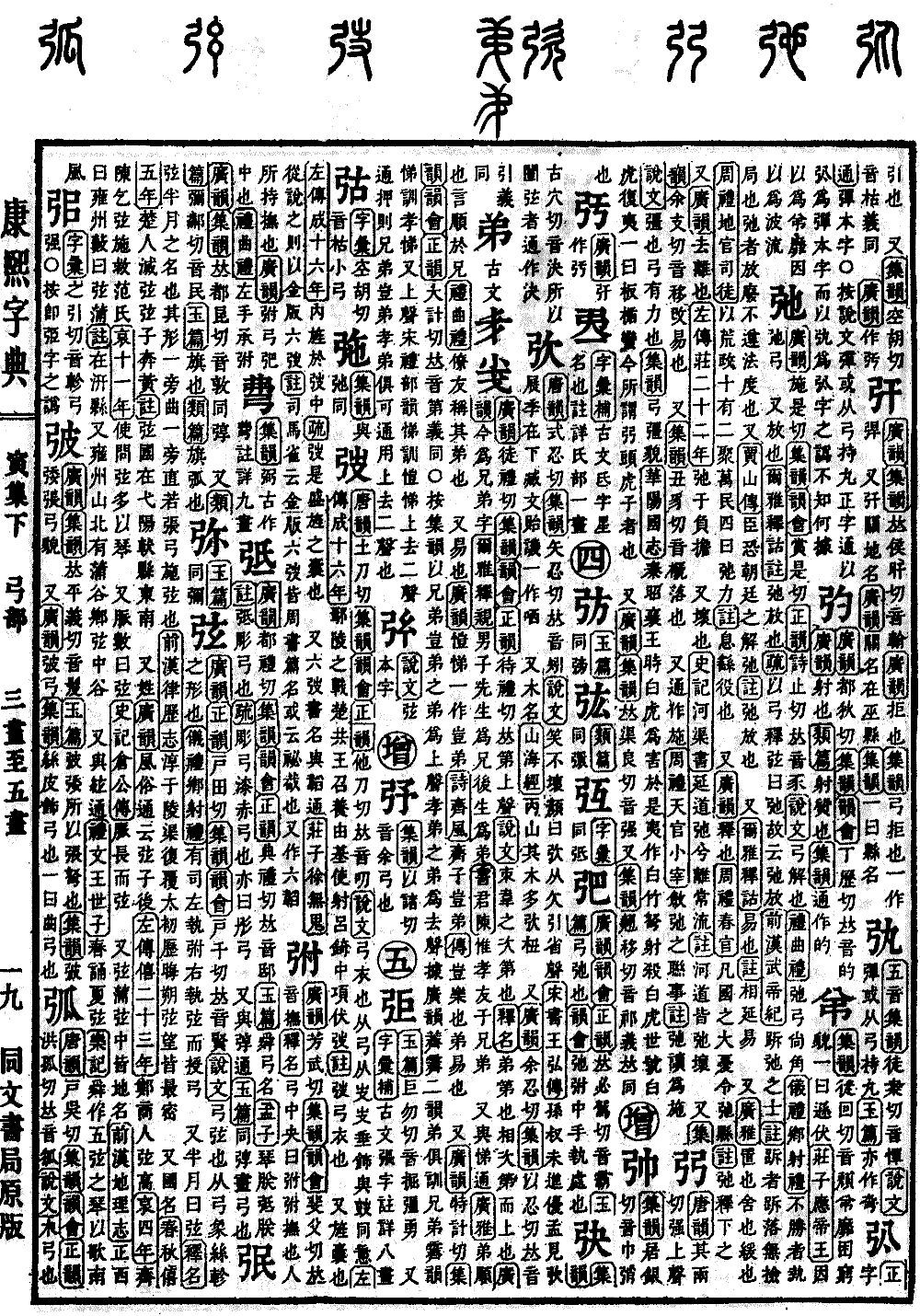
Yin Collection, Lower Volume
Radical: Bow (gōng)
Page 357, Entry 34
Pronounced hu (level tone). Pronounced hu (level tone). Pronounced hu (level tone). Pronounced hu (level tone). Pronounced hu (level tone). Its pronunciation is the same as the word for fox.
Explained in Explaining and Analyzing Characters (Shuowen Jiezi) as a bow made of wood. The character structure is derived from the Bow radical, with the component for melon (gua) indicating the sound. Another interpretation defines an arc (hu) as a bow with a slight curvature but high string tension.
Records in the Record of Wu (Wulu) state that the legendary figure Hui began crafting bows after observing the constellation of the Arc (hu xing).
The Book of Changes (Yijing), in the section titled Appended Remarks (Xici), describes using strings stretched over wood to create bows.
It also refers to a bow-shaped implement used for suspending banners. The Book of Rites (Liji), in the section titled The Hall of Distinction (Mingtang Wei), describes riding in a grand chariot, which carries the arc for displaying banners, the bag for holding bows, and the banners themselves. The commentary states that the arc is an implement used to spread out the fabric of the banners. The sub-commentary explains that the arc is made of bamboo and is shaped like a bow.
The Rites of Zhou (Zhouli), in the section titled Winter Official: Record of Artificers (Dongguan Kaogongji), mentions arc-banners (hujing) and crooked arrows (wangshi). The commentary explains that the arc is used to spread out the silk surface of the banner. The sub-commentary explains that what is called an arc-banner is a bow-shaped implement on the banner; since it has a bow to spread the silk, it is called an arc-banner.
It is also the name of a constellation. The Book of Rites (Liji), in the section titled Monthly Ordinances (Yueling), states that in the third month of spring, the sun is in the Kui constellation, and at dusk, the Arc star (hu xing) appears in the southern meridian. The Records of the Grand Historian (Shiji), in the section titled Treatise on the Celestial Offices (Tianguan Shu), states that below the Wolf star (lang xing) there are four stars called the Arc (hu). The commentary states that the Arc consists of nine stars located southeast of the Wolf star; it is the bow of heaven, used to punish rebels and soothe distant states, and it oversees defenses against bandits and the detection of treachery.
The Book of the Later Han (Houhanshu), in the section titled Records of the Eastern Barbarians (Dongyi Zhuan), states that in the Jinhan state, the word for bow is called an arc (hu).
There is also the term mao-hu, which is the name of a flag. The Zuo Tradition (Zuo Zhuan), in the eleventh year of Duke Yin, records that Ying Kaoshu took the Duke of Zheng's banner, the Mao-hu, and was the first to scale the city wall.
There is also the short arc (duan hu), which is the name of an insect. The Book of the Former Han (Qianhanshu), in the section titled Treatise on the Five Elements (Wuxing Zhi), states that the bug (yu) lives by the water and can spray venom to harm people; in the south, it is called the short arc. The commentary notes that this is the shooting-worker (shegong), also known as the water-crossbow.
Also, in the Classified Anthology (Leipian), the pronunciation is given as wang-hu, with the same sound as the word for foul (wu), meaning to curve. The Rites of Zhou (Zhouli), in the section titled Winter Official: Record of Artificers (Dongguan Kaogongji), states that when using fire to soften and bend carriage shafts, one wishes them to be smooth and straight without having deep curves (hu). The commentary states that here the character for arc (hu) has the same pronunciation and meaning as the word for foul (wu).
Textual Research: The Records of the Grand Historian (Shiji) Treatise on the Celestial Offices (Tianguan Shu) states: "Below the Wolf star are four stars called the Arc." The commentary says: "The Arc consists of nine stars to the northeast of the Wolf star; it is the bow of heaven." We respectfully note that the original text of the Records of the Grand Historian commentary should be amended from "northeast" to "southeast."
The Book of the Later Han (Houhanshu) Records of the Eastern Barbarians (Dongyi Zhuan) states: "In the Jinhan state, horses are called arcs (hu)." We respectfully note that the original text should be amended from "horses" to "bows."