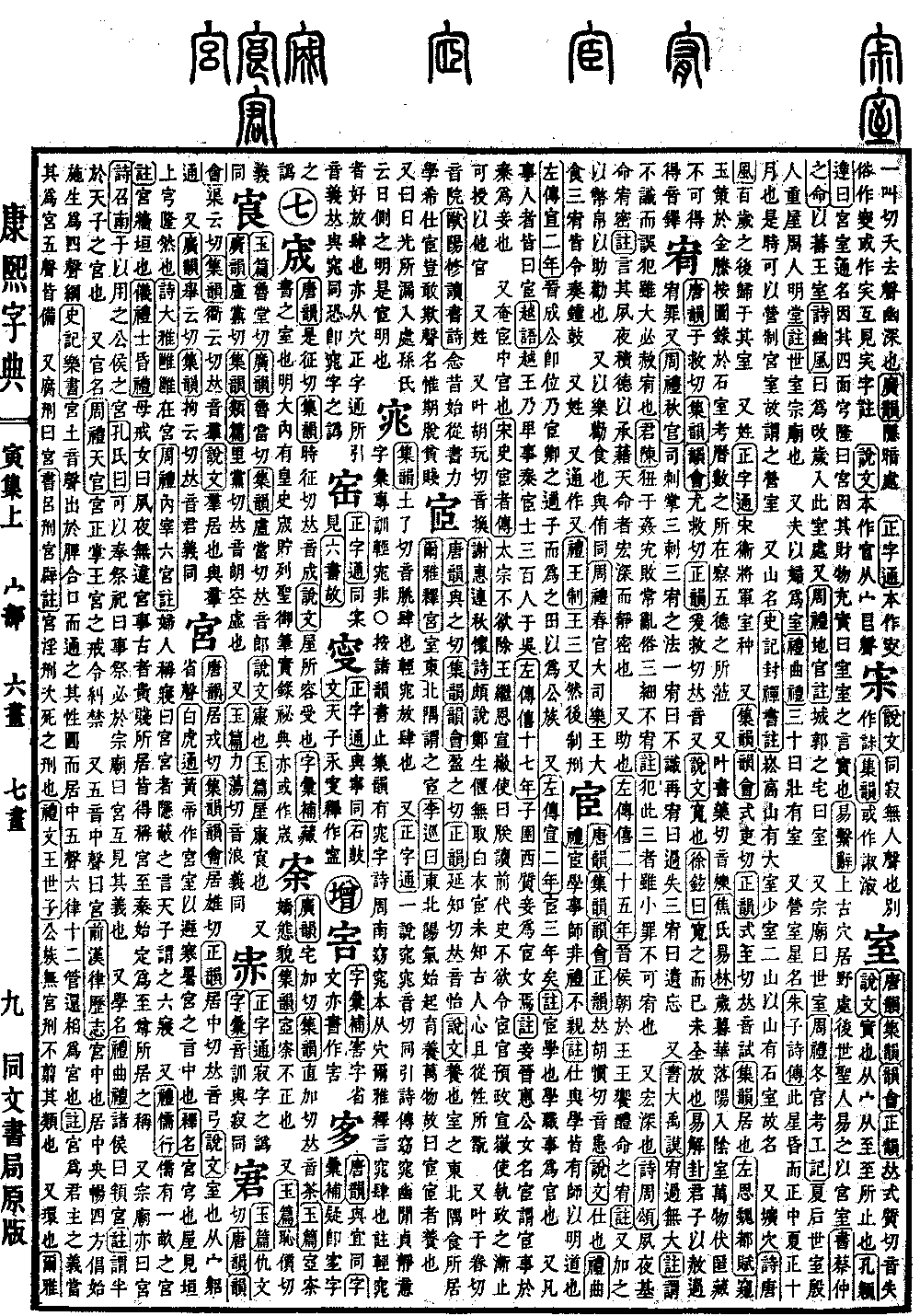
Yin Collection, Upper Volume
Radical: Roof (bù)
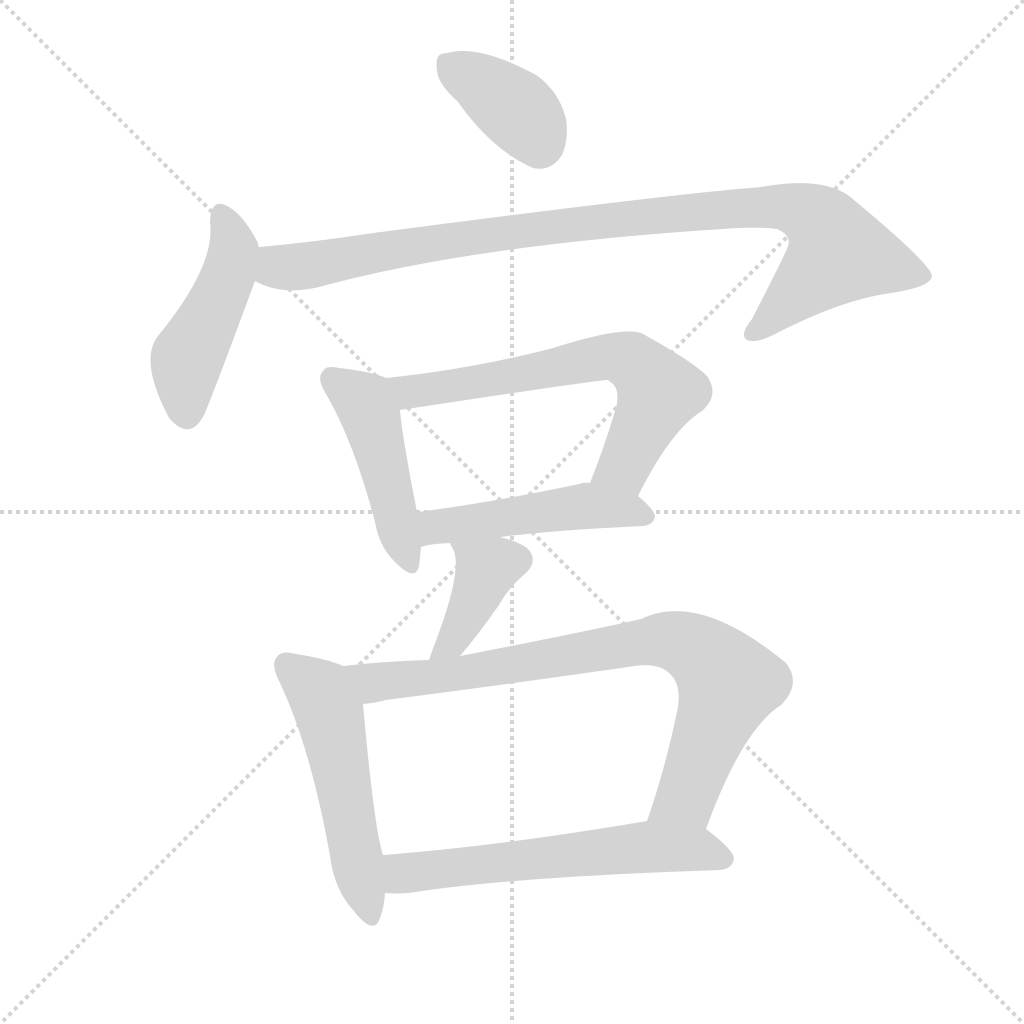
Gong; Kangxi strokes: 10; Page 285, Entry 16
Pronounced gong.
Shuowen Jiezi (Explanation of Graphs and Analysis of Characters): A room. Composed of the roof radical, with gong acting as a simplified phonetic indicator.
Baihu Tong (Comprehensive Discussions in the White Tiger Hall): The Yellow Emperor created palaces and dwellings to avoid the cold and heat. The term palace (gong) implies the center (zhong).
Shiming (Explanation of Names): Palace (gong) means vault (qiong). It refers to the roof structure appearing vaulted and elevated above the walls.
Book of Odes (Shijing), Great Odes: Harmonious and peaceful within the palace.
Rites of Zhou (Zhouli), Notes on the Inner Steward and the Six Palaces: For women, the sleeping quarters are called palace. The term palace refers to what is hidden and secluded; for the Son of Heaven, it is called the six sleeping chambers.
Book of Rites (Liji), Conduct of Scholars: A scholar possesses a one-mu palace. Note: Palace here refers to the surrounding walls.
Ceremonial and Rituals (Yili), Marriage Rites for Scholars: The mother admonishes her daughter saying: Morning and night, do not neglect the affairs of the palace. In ancient times, both the noble and the humble could refer to their dwellings as palaces; it was not until the Qin dynasty that the term was reserved exclusively for the residence of the supreme ruler.
Ancestral temples are also called palaces.
Book of Odes (Shijing), Odes of Shao: Used for the palace of the dukes and marquises. Master Kong says: That which can be used to perform sacrifices is called affair, and because sacrifices must be held in ancestral temples, these are called palaces; the two terms share this significance.
A type of school. Book of Rites (Liji), Summary of Rites: The feudal lords have the Pan Palace. Note: This means it is half the scale of the palace of the Son of Heaven.
An official title. Rites of Zhou (Zhouli), Officers of Heaven: The Palace Rectifier (gongzheng) manages the prohibitions and commands within the royal palace.
The middle sound of the five notes is called gong.
History of the Former Han (Qian Hanshu), Treatises on Harmonics and Calendars: Gong is the middle. It resides in the center, facilitates the four directions, initiates the manifestation of life, and acts as the leader for the four other notes.
Records of the Grand Historian (Shiji), Treatise on Music: Gong is the earth note; the sound emerges from the mouth, which is joined and then released; its nature is circular and resides in the center. In the system of the five notes, six pitch standards, and twelve tubes, they all return to gong as the base. Note: Gong represents the meaning of the sovereign ruler; when it acts as the base note, the other five notes are all complete.
Also, castration is called gong.
Book of Documents (Shujing), Commentary on the Lu Punishments: Gong is [a punishment for] lasciviousness, a penalty secondary only to death.
Book of Rites (Liji), Heir of King Wen: The royal clans are not subject to the gong punishment, so as not to sever their lineage.
To surround. Erya (Approaching Elegance), Interpretation of Mountains: A large mountain is called a palace (gong), a small mountain is called a huo. Note: Palace refers to the surrounding enclosure. The Book of Rites says: The ruler builds a temporary enclosure for the funeral, which is an example of this.
Rites of Zhou (Zhouli), Officers of Spring: Zheng adjusts the positions of the musical bells, the Son of Heaven uses the palace-style suspension. Note: Palace-style suspension means the bells are hung on all four sides.
A surname. Zuo Commentary (Zuozhuan) mentions Yu Gongzhiqi; Warring States period mentions Gong Tuo.
Beigong and Nangong are both double-character surnames.
Shougong is the name of a tree. Erya (Approaching Elegance), Interpretation of Trees: Shougong is the locust tree.
Also, shougong is the name of a lizard, written alternatively.
Also rhyming with guhuang, pronounced guang.
Ban Gu, Inscription for Zhang Ao: Achievements attained and virtues established, I inherit the fief of Nangong. The name shall persist for ten thousand eras, forever protecting the boundless borders.
Also rhyming with guyuan, pronounced juan.
Huangting Jing (Yellow Court Classic): From the high to the low, all are true men; the jade hall and scarlet chambers are entirely the primal palace.