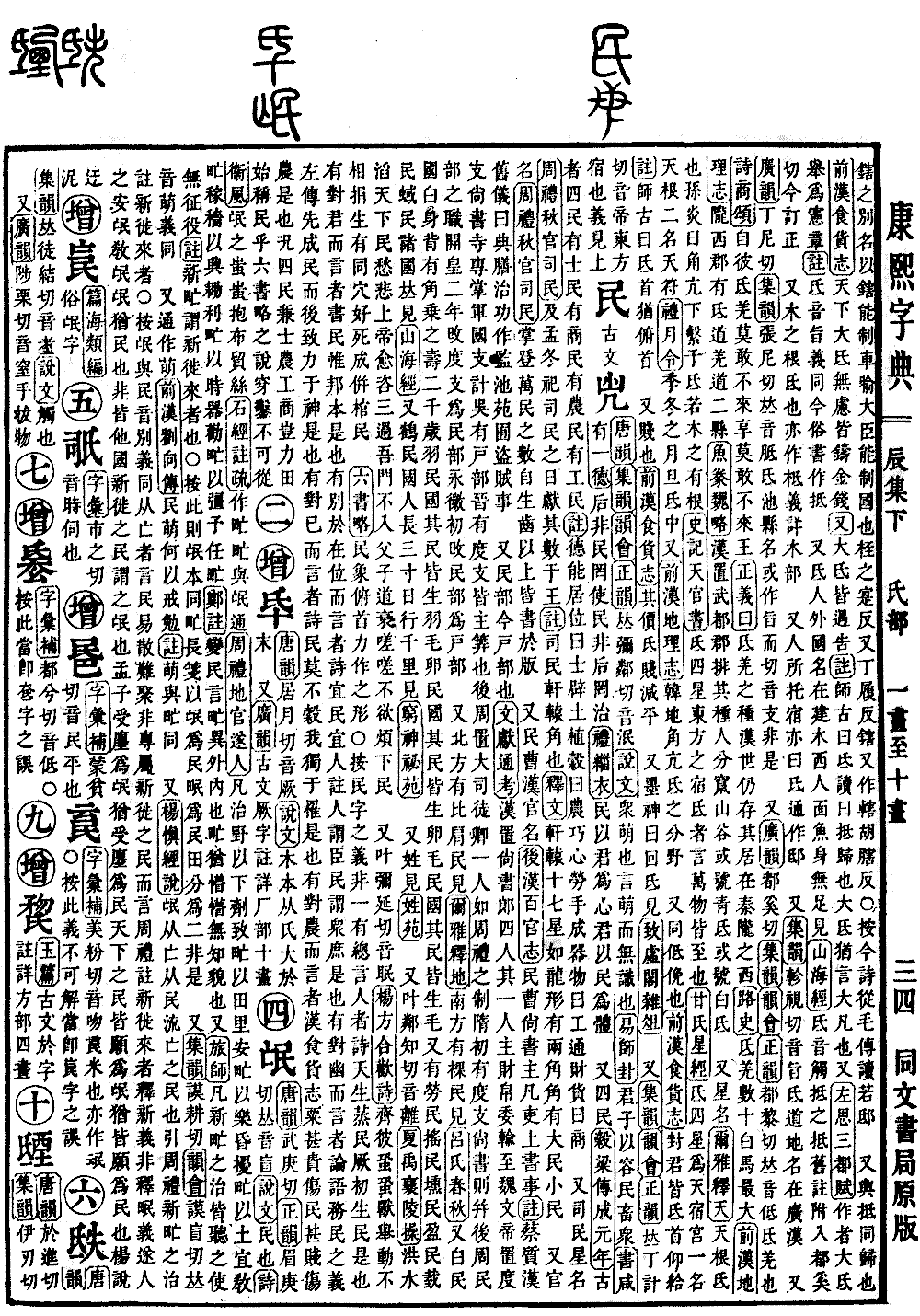
Chen Collection, Lower Volume
Radical: Clan (shì)
Page 598, Entry 04
Pronounced mang (level tone).
According to the Explaining Graphs and Analyzing Characters (Shuowen Jiezi), it refers to the people.
In the Book of Odes (Shijing), in the section Wei Wind, it is written: The people were simple and honest, carrying cloth to trade for silk.
The Stone Classics Commentary (Shijing Zhushu) writes it as meng. Meng and mang are interchangeable.
In the Rites of Zhou (Zhouli), section Offices of Earth, Suiren: In governing the wild areas, use the lower level regulations to assemble the people (meng); use the land and residential areas to settle the people; use music and marriage ceremonies to harmonize the people; use the suitability of the land to teach the people agriculture; use farming tools to benefit the people; use seasonal implements to encourage the people; and use land distribution to provide for the people.
Zheng’s commentary states: Changing the term for people to meng distinguishes between the internal and external populations. Meng is synonymous with meng (ignorant). Meng refers to the appearance of having no knowledge.
Also in the section Travelers and Teachers: In all matters concerning the administration of newly settled people (meng), hear their cases and exempt them from taxes and labor duties. The commentary states: New meng refers to those who have recently migrated here.
Note: Based on this, mang is originally the same as meng. The Long Scroll (Changjian) treats mang as people, and meng as people who farm, separating them into two, which is incorrect.
Also, in the Collected Rhymes (Jiyun) pronounced meng (level tone), and in the Rhyme Collection (Yunhui) pronounced meng (level tone). The meaning is the same. It is also interchangeably written as meng (sprout).
In the History of the Former Han (Qianhan Shu), Biography of Liu Xiang: How should the people (meng) be warned and encouraged? The commentary states: Meng is the same as meng (people).
Also, according to Yang Shen’s Explanations of the Classics (Jingshuo): The character for mang is composed of the radical for flee and the radical for person. It refers to people who have drifted away. He cites the Rites of Zhou, the administration of new meng, and the commentary which states they are those who have newly migrated. Note: Mang and min (people) differ in sound but are identical in meaning. The use of the radical for flee implies that the people are easily scattered and difficult to gather, but it does not exclusively refer to those who have newly migrated. The commentary on the Rites of Zhou regarding those who have newly migrated explains the meaning of new, not the meaning of meng. In the Suiren section regarding settling the people and teaching the people, the term meng is synonymous with people, not merely people who have migrated from other states. In the Mencius, receiving a residence makes one a person (meng), just as receiving a residence makes one a commoner; when the people of the world all desire to be residents, it is the same as desiring to be commoners. Yang’s explanation is convoluted and misguided.
Textual research: The commentary on the Rites of Zhou regarding those who have newly migrated explains the meaning of new, not the meaning of meng. I have carefully revised this according to the textual meaning to refer to meng.