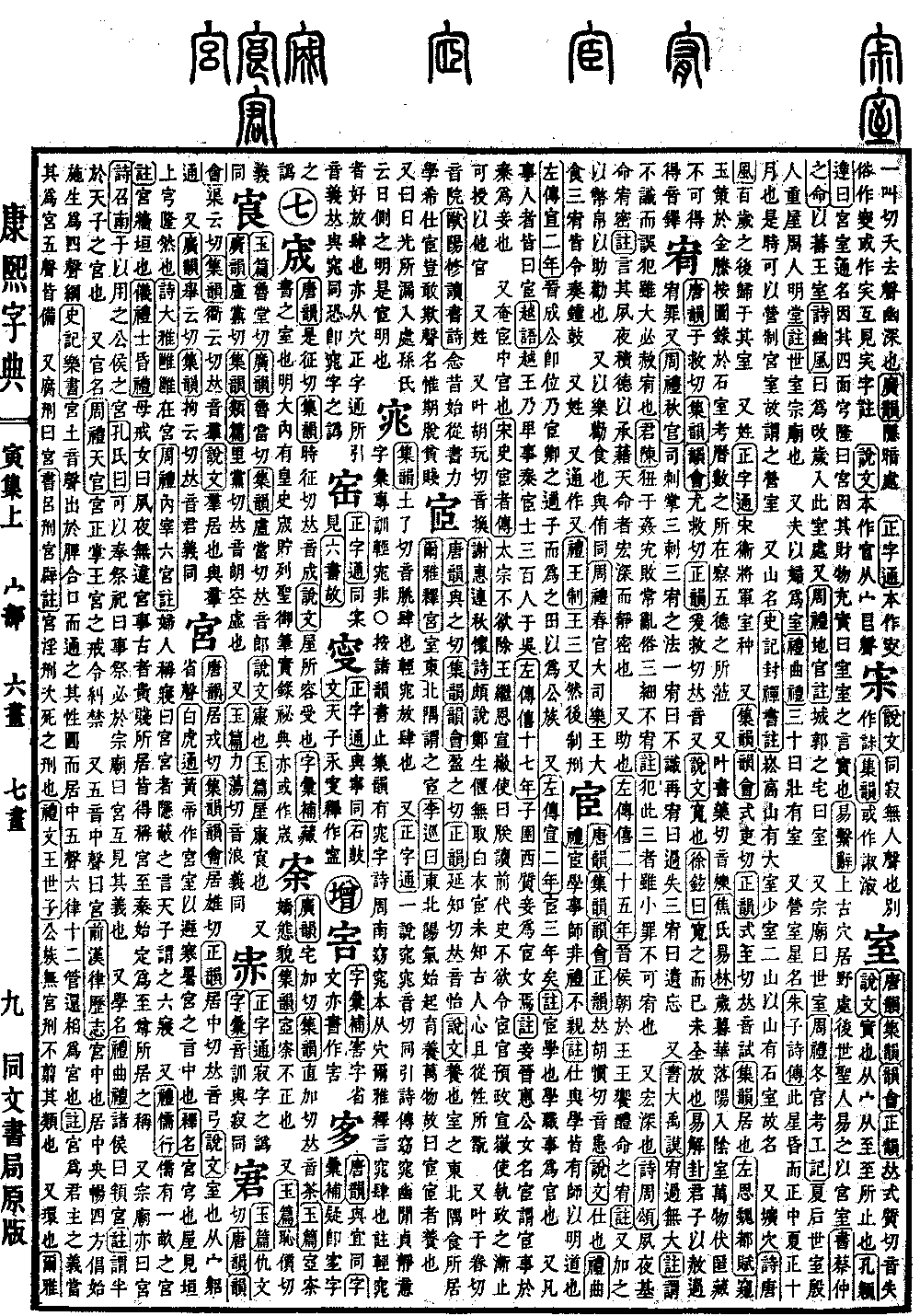
Yin Collection, Upper Volume
Radical: Roof (mián)
宫
Kangxi Strokes: 10
Page 285, Entry 10
Pronounced gong.
According to the Explanation of Characters (Shuowen), it means a chamber. It is composed of the radical for roof, with the phonetic element gong (shěng).
According to the Comprehensive Discussions in the White Tiger Hall (Baihu tong), the Yellow Emperor constructed palaces (gongshi) to shelter from cold and heat. Gong signifies the center.
According to the Explanation of Names (Shiming), gong means a dome. It refers to a structure appearing arched or dome-like above the walls.
Book of Odes (Shijing), Greater Odes (Daya): Harmonious and happy in the palace.
Book of Rites (Zhouli), Inner Superintendent of the Six Palaces Commentary: When women refer to their sleeping quarters, they are called gong. Gong is an expression of seclusion; the Son of Heaven calls them the six chambers.
Also, Book of Rites (Liji), The Conduct of a Scholar (Ruxing): A scholar has a palace of one acre. Commentary: Gong refers to the surrounding walls.
Ceremonial and Rituals (Yili), Master of Ceremonies for Marriage: The mother admonished her daughter, saying: Do not neglect the duties within the palace morning and evening. In ancient times, the residences of both the noble and the humble could be called gong. Only from the Qin dynasty onwards was the term restricted exclusively to the residence of the Emperor.
Also, the ancestral temple is called gong.
Book of Odes (Shijing), Odes of Shao (Zhaonan): Where one makes use of it, the palace temple of the duke or marquis.
Kong's Commentary: Where one conducts rites is called the business, and since sacrifices must take place in the ancestral temple, it is called gong, the two terms reflecting each other's meaning.
Also, a name for schools.
Book of Rites (Liji), Summary of the Rules of Propriety (Quli): The school of a feudal lord is called Pan Gong. Commentary: It is said to be half of the school of the Son of Heaven.
Also, a title for an official.
Book of Rites (Zhouli), Office of Heaven: The Palace Warden (Gong Zheng) manages the prohibitions and audits within the royal palace.
Also, the middle tone among the five musical notes is called gong.
Book of Han (Qianhan), Treatise on Music and the Calendar (Luli zhi): Gong is the center. It resides in the center, communicates with the four directions, initiates the growth of all things, and serves as the governing principle for the four other tones.
Records of the Grand Historian (Shiji), Treatise on Music (Yueshu): Gong is the earth tone; the sound originates from the spleen, with the mouth closed and then opened to allow resonance, and its nature is rounded and situated in the center. The five tones, six musical pitch pipes, and twelve pitch standards rotate to serve as the gong tone. Commentary: Gong carries the meaning of a ruler; when it serves as the gong tone, the five tones are all complete.
Also, the punishment of castration is called gong punishment (gong xing).
Book of Documents (Shujing), Punishments of Lu (Lü xing) Commentary: Gong punishment is a licentious punishment, second only to the death penalty.
Book of Rites (Liji), Royal Son of King Wen (Wenwang shizi): Members of the ducal clan were not subjected to gong punishment, so as not to extinguish their lineage.
Also, it means to surround or encircle.
Classic of Etymology (Erya), Explanation of Mountains (Shishan): A large mountain is called gong, a small mountain is called huo. Commentary: Gong means to be surrounded. The Book of Rites states: The ruler builds a wall around the hut for mourning; this is what is meant.
Also, Book of Rites (Zhouli), Office of Spring (Chunguan), Lesser Usher: To calibrate the position of hanging musical instruments; the Son of Heaven uses gong suspension. Commentary: Gong suspension means suspended on four sides.
Also, a surname. The Zuo Tradition (Zuozhuan) mentions Gong Zhiji of the state of Yu; the Warring States period mentions Gong Tuo.
Also, Beigong and Nangong are both double-character surnames.
Also, shougong (a plant name).
Classic of Etymology (Erya), Explanation of Trees (Shimu): Shougong refers to the pagoda tree.
Also, shougong is the name of a lizard, sometimes written as a variant form.
Also pronounced guang.
Ban Gu, Inscription for Zhang Ao: Achievements are established and virtues are solidified, inheriting the title at Nangong. May the name be passed down for ten thousand years, forever maintained without limit.
Also pronounced juan.
Yellow Court Classic (Huangting jing): From high to low are the True Men, and the Jade Hall and Vermilion Chamber are all immortal palaces. The character is read as ran.