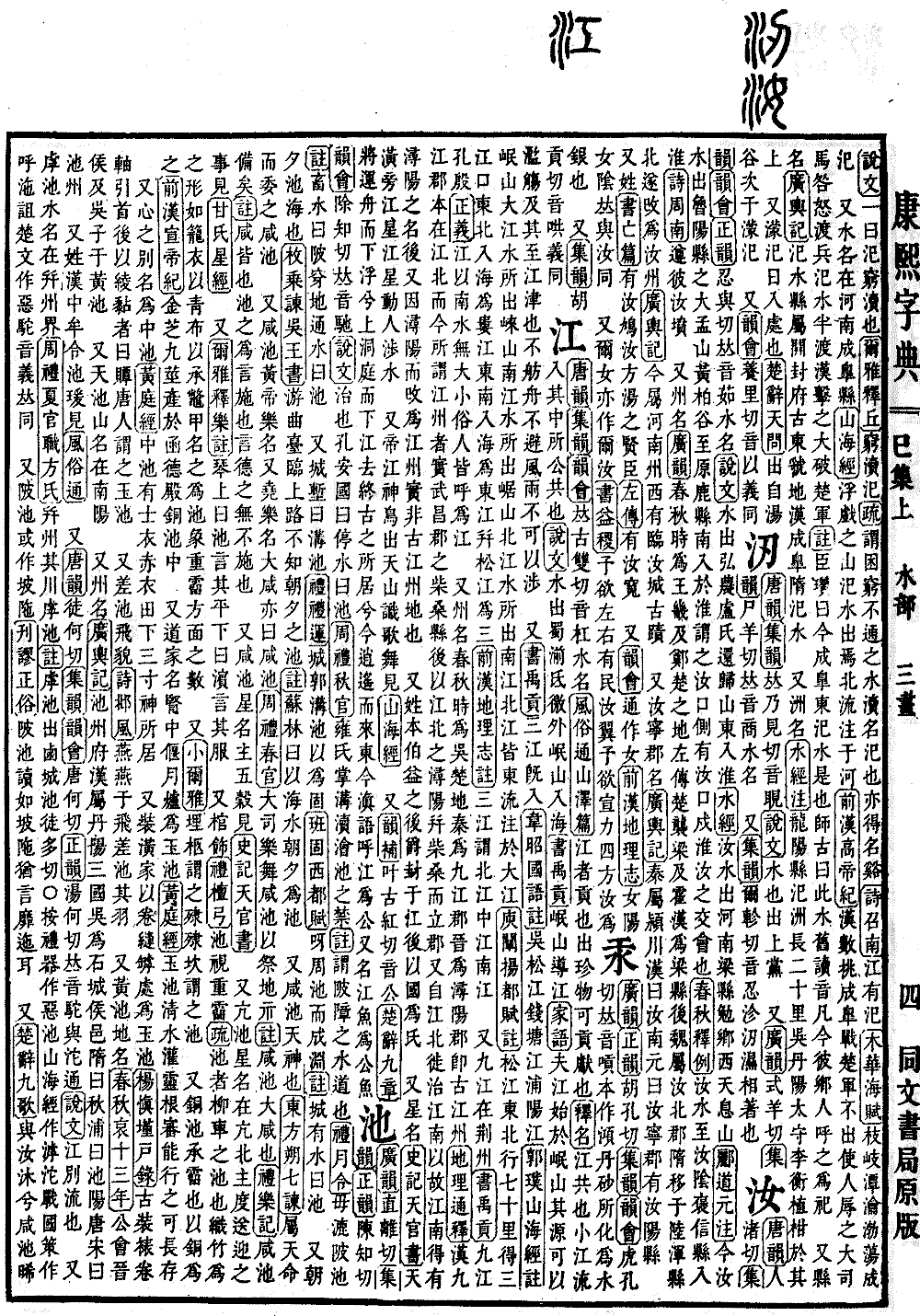
Si Collection, Upper Volume
Radical: Water (shuǐ)
Page 606, Entry 02
Pronounced ru (rising tone)
Name of a river.
According to the Explaining Graphs and Analyzing Characters (Shuowen), the river originates in Lushi, Hongnong, circles back through the east of the mountains and enters the Huai River.
The Commentary on the Water Classic (Shuijing Zhu) states the Ru River originates in the Tianxi Mountains, west of Mianxiang, Liang County, Henan.
The commentary by Li Daoyuan states that the modern Ru River originates in Huangbogushan in Dayushan, Luyang County, and reaches Yuanlu County, where it flows south into the Huai River; this is known as the Ru Estuary. Beside it is the Ru Estuary garrison, which is the confluence of the Huai and Ru rivers.
Explication of the Spring and Autumn Annals (Chunqiu Shili) states the Ru River enters the Huai River at Baoxin County, Ruyin.
Book of Odes (Shijing), Zhou South: Following the mounds of the Ru.
Also the name of a prefecture.
Guangyun: During the Spring and Autumn period, this was the royal domain and the land of the states of Zheng and Chu. According to the Zuo Commentary (Zuo Zhuan), Chu attacked Liang and reached Huo. During the Han dynasty, it was Liang County; under the Northern Wei, it belonged to Rubei Commandery; during the Sui, it was moved to the north of Luhun County and renamed Ru Prefecture.
Universal Geography (Guangyu Ji): Now belongs to a prefecture in Henan, with the ancient site of Linru City to the west.
Also Runing, the name of a commandery.
Universal Geography: In the Qin dynasty, it belonged to Yingchuan; during the Han, it was called Runan; in the Yuan, it was called Runing Commandery, which contained Ruyang County.
Also a surname.
Book of Documents (Shujing), Lost Chapters: Mentions Rujiu and Rufang, who were wise ministers under King Tang.
Zuo Commentary: Mentions Ru Kuan.
Also, in the Rhyme Collection (Yunhui), it is commonly used as a variant of the pronoun you (nǚ).
Book of Han (Qianhan), Treatise on Geography: Nuyang and Nuyin are used interchangeably with Ru.
Also, er-ru is used to mean you.
Book of Documents, Yiji: If you wish to have assistants, the people will be your wings. If you wish to display your strength, you should do so throughout the four quarters.
Editorial Note: In the Commentary on the Water Classic, the text states the Ru River originates in the Dayu Mountains, Huangbo Valley, Luyang County. Corrected based on the original text: Meng changed to Yu, Huang changed to Meng.