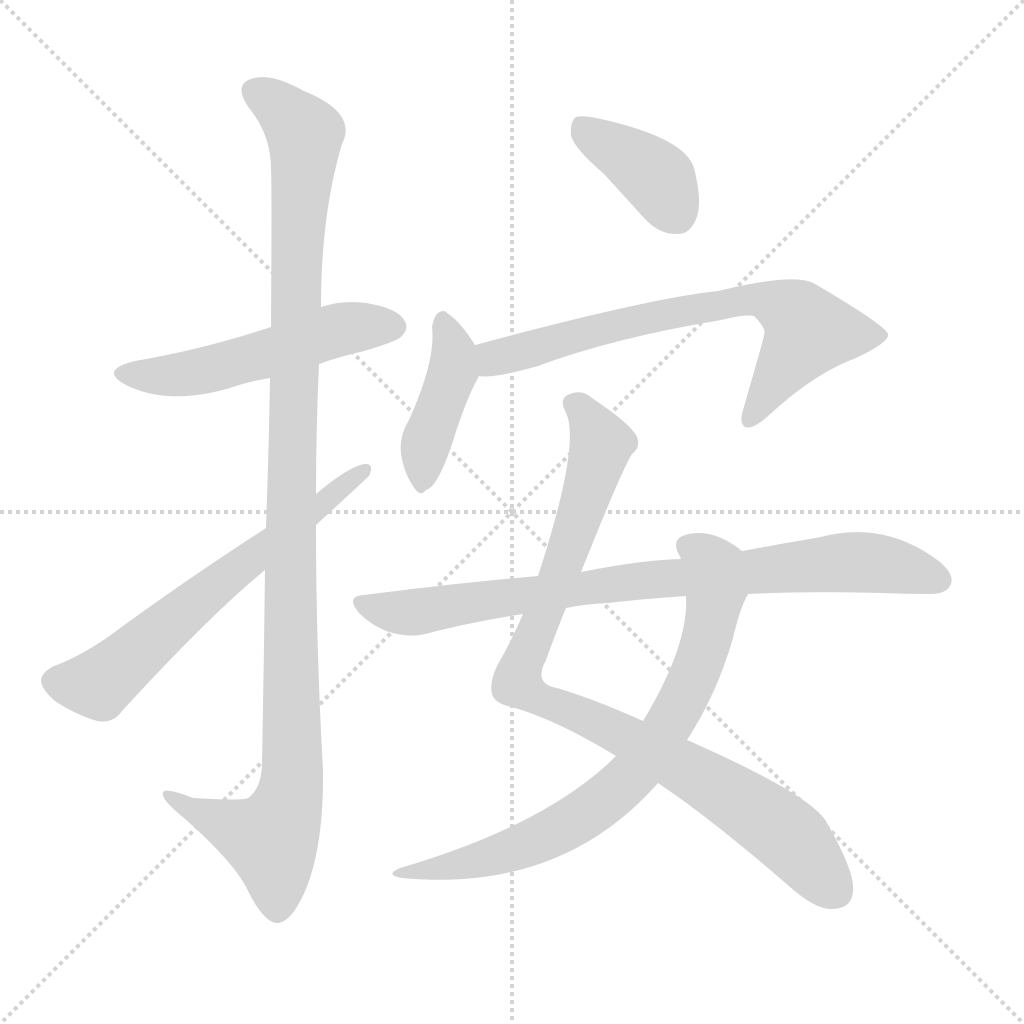
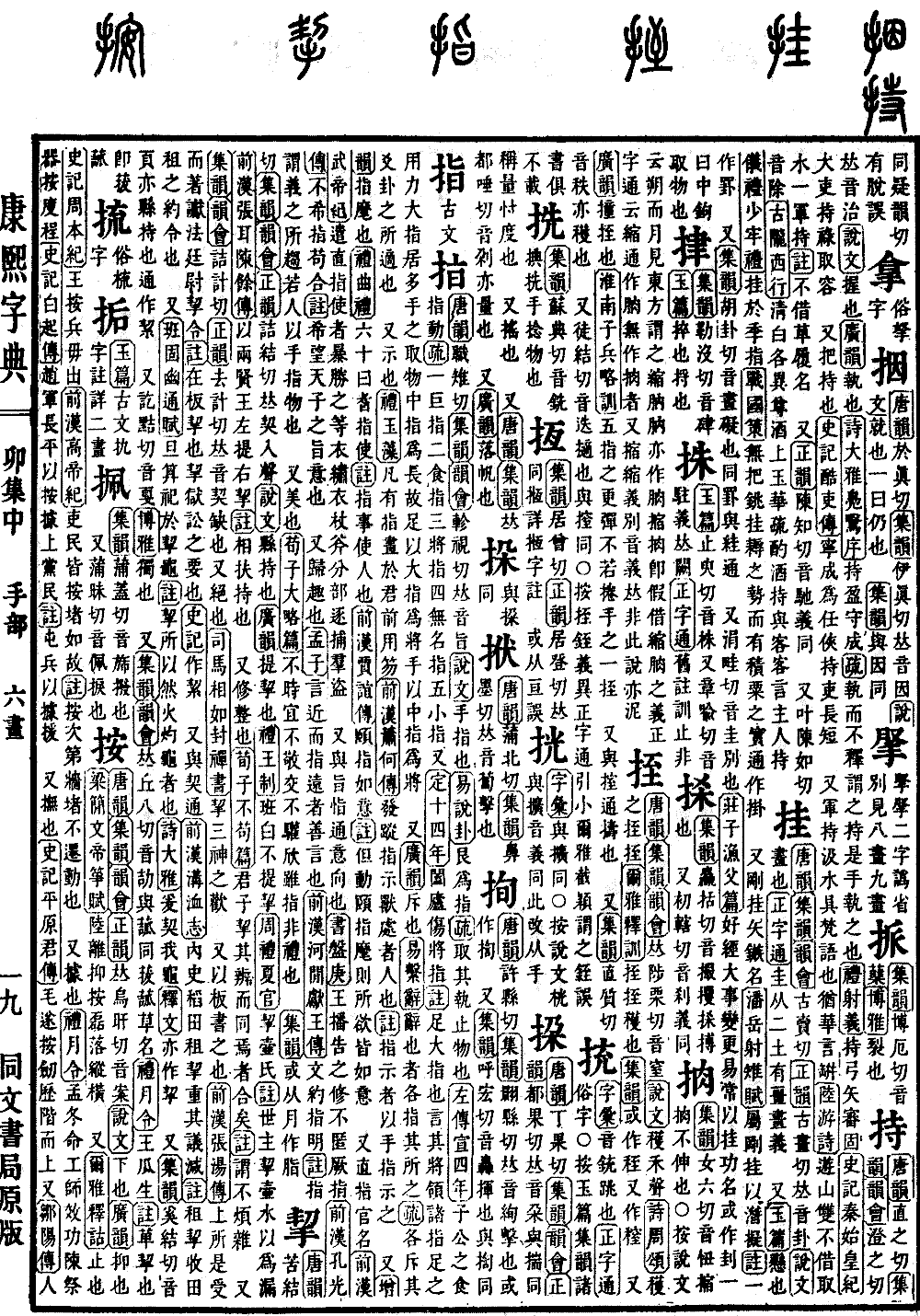
Mao Collection, Middle Volume. Radical: Hand (shǒu). Kangxi strokes: 10. Page 429, Entry 26.
Pronounced an. From Tang Rhymes (Tangyun), Collection of Rhymes (Jiyun), Collection of Rhymes (Yunhui), and Correct Rhymes (Zhengyun). In the Explanation of Writing (Shuowen), it means to go down. In the Broad Rhymes (Guangyun), it means to suppress. In the Rhapsody on the Zheng Zither by Emperor Yuan of Liang, it says, "Moving dazzlingly, suppressing and pressing, sprawling and crossing."
Also, in the Approaches to Explanation (Erya), it means to stop. In the Records of the Grand Historian (Shiji), Biography of Zhou, it states, "The King held back the troops and did not advance." In the History of the Former Han (Qianhan), Annals of Emperor Gao, it states, "The officials and people all remained in their dwellings as before." The commentary notes this means to remain in their homes and walls without moving.
Also, it means to rely upon. In the Book of Rites (Liji), Monthly Ordinances, it states, "In the first month of winter, the overseers are ordered to examine the work and sacrificial vessels according to the prescribed standards." In the Records of the Grand Historian (Shiji), Biography of Bai Qi, it states, "The Zhao army was at Changping, using it to base themselves and hold the people of Shangdang." The commentary notes this refers to stationing troops to occupy and support.
Also, it means to comfort or steady. In the Records of the Grand Historian (Shiji), Biography of Lord Pingyuan, it states, "Mao Sui steadied his sword, climbed the steps, and ascended." In the Biography of Zou Yang, it states, "Everyone reached for their swords and looked at each other."
Also, it means to control. In the Records of the Grand Historian (Shiji), Biography of the Marquis of Jiang, it states, "The Son of Heaven then pulled on the reins and moved slowly."
Also, it means to investigate, examine, impeach, or bring up. In the History of the Former Han (Qianhan), Biography of Jia Yi, it states, "Verify it with the past, and examine it against the tasks of the present." In the Biography of Bing Ji, it states, "When clerks were not competent, he would simply grant them long leave; he never impeached or investigated them. That the government offices did not impeach officials began with Ji."
Also, it means to massage. In the History of the Former Han (Qianhan), Treatise on Literature and Arts, it mentions, "The Massage of the Yellow Emperor and Qibo in ten scrolls."
Also, pronounced e. From Collection of Rhymes (Jiyun) and Collection of Rhymes (Yunhui). It means to press down. In the Book of Odes (Shijing), Greater Odes, it states, "To stop the gathered troops." The commentary states it means to stop. The explanation of the text notes that it is also written as a variant form (e).
In the Collection of Rhymes (Yunhui) and Correct Rhymes (Zhengyun), it is noted that the characters for press and stand are interchangeable. It is also commonly written as a variant form (an).