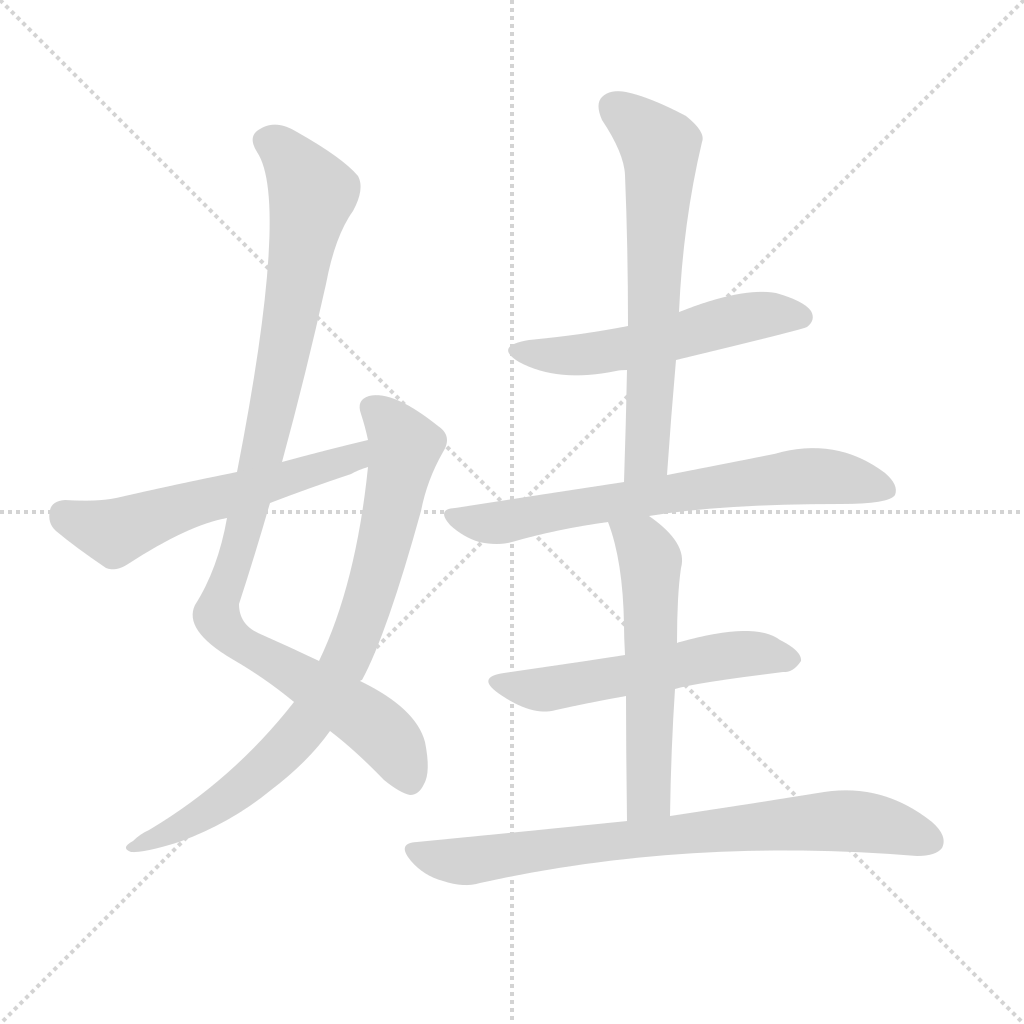
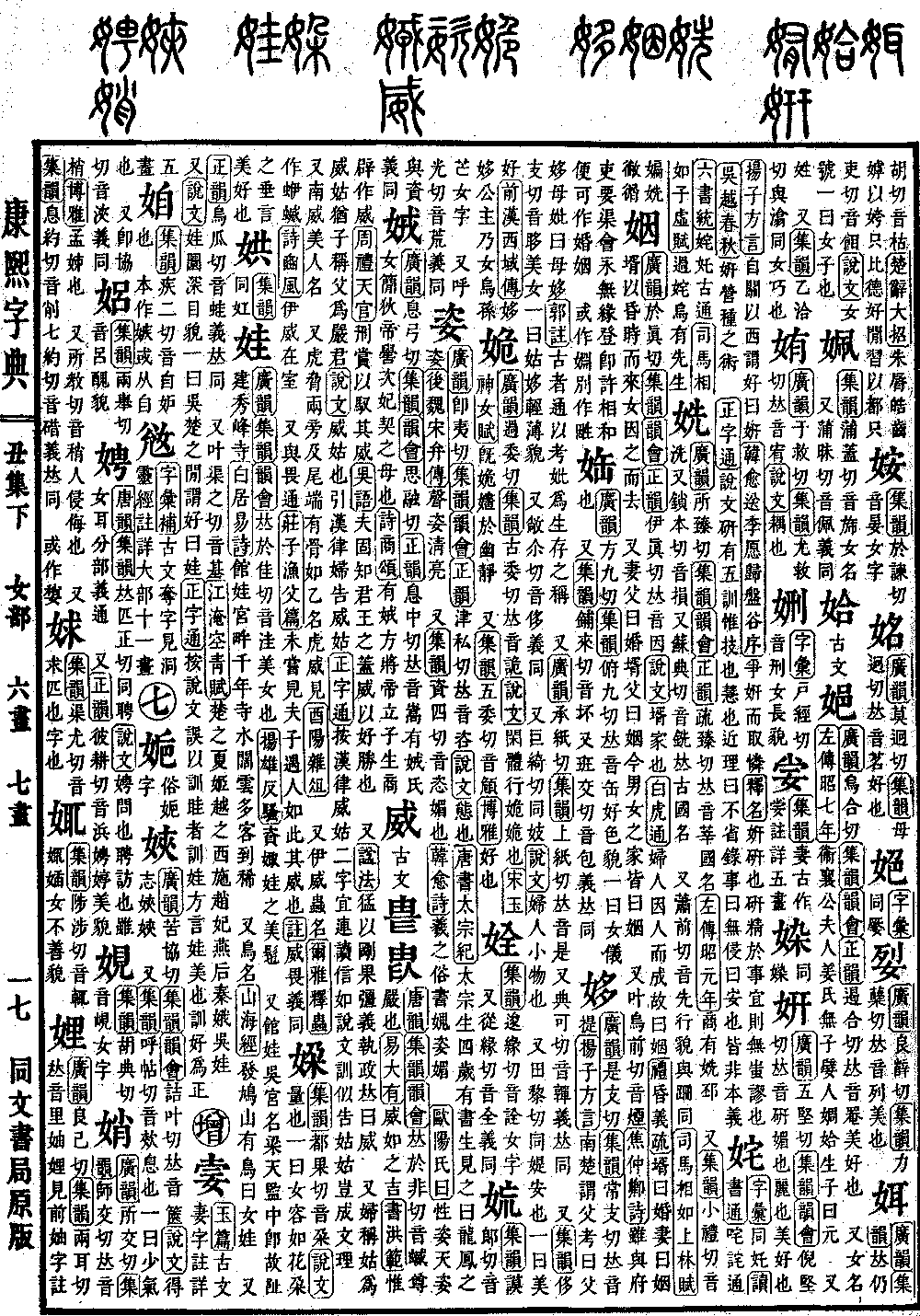
Chou Collection, Lower Volume
Radical: Woman (nǚ)
9 strokes
Page 261, Entry 29
According to the Extensive Rhymes (Guangyun), the Collected Rhymes (Jiyun), and the Rhyme Collection (Yunhui), the character is pronounced wa (level tone), similar to the sound wa (level tone). It refers to a beautiful woman. In the Anti-Sorrow (Fansao) by Yang Xiong, it is written: Endowed with the beauty of the Ju and Wa. Also, Guanwa is the name of a palace in the State of Wu. During the Tianjian era of the Liang dynasty, the Xiufeng Temple was built on the old site. In a poem by Bai Juyi, it is written: Beside the Guanwa Palace stands a thousand-year-old temple; the waters are wide and clouds are many, though few guests arrive. Also the name of a bird. In the Classic of Mountains and Seas (Shanhaijing), it is written: On Mount Fajiu there is a bird called Nuwa. According to the Correct Rhymes (Zhengyun), it is also pronounced wa (level tone), with the same meaning. Also, pronounced ji (level tone), appearing in the Rhapsody on Empty Green (Kongqing Fu) by Jiang Yan: Xia Ji of Chu, Xi Shi of Yue, Empress Zhao and Empress Yan, Qin E and Wu Wa. According to the Analytical Dictionary of Characters (Shuowen Jiezi), the character describes a round face with deep-set eyes. Another source says that in the regions of Wu and Chu, beauty is referred to as wa. According to the General Explanation of Characters (Zhengzitong), the Analytical Dictionary of Characters mistakenly confused the definition of this character with that of sui (a stare). The Regional Sayings (Fangyan) states that wa means beautiful, so the definition of beautiful is the correct one.