Zi Collection, Page Position: Upper
Radical: Line (gǔn)
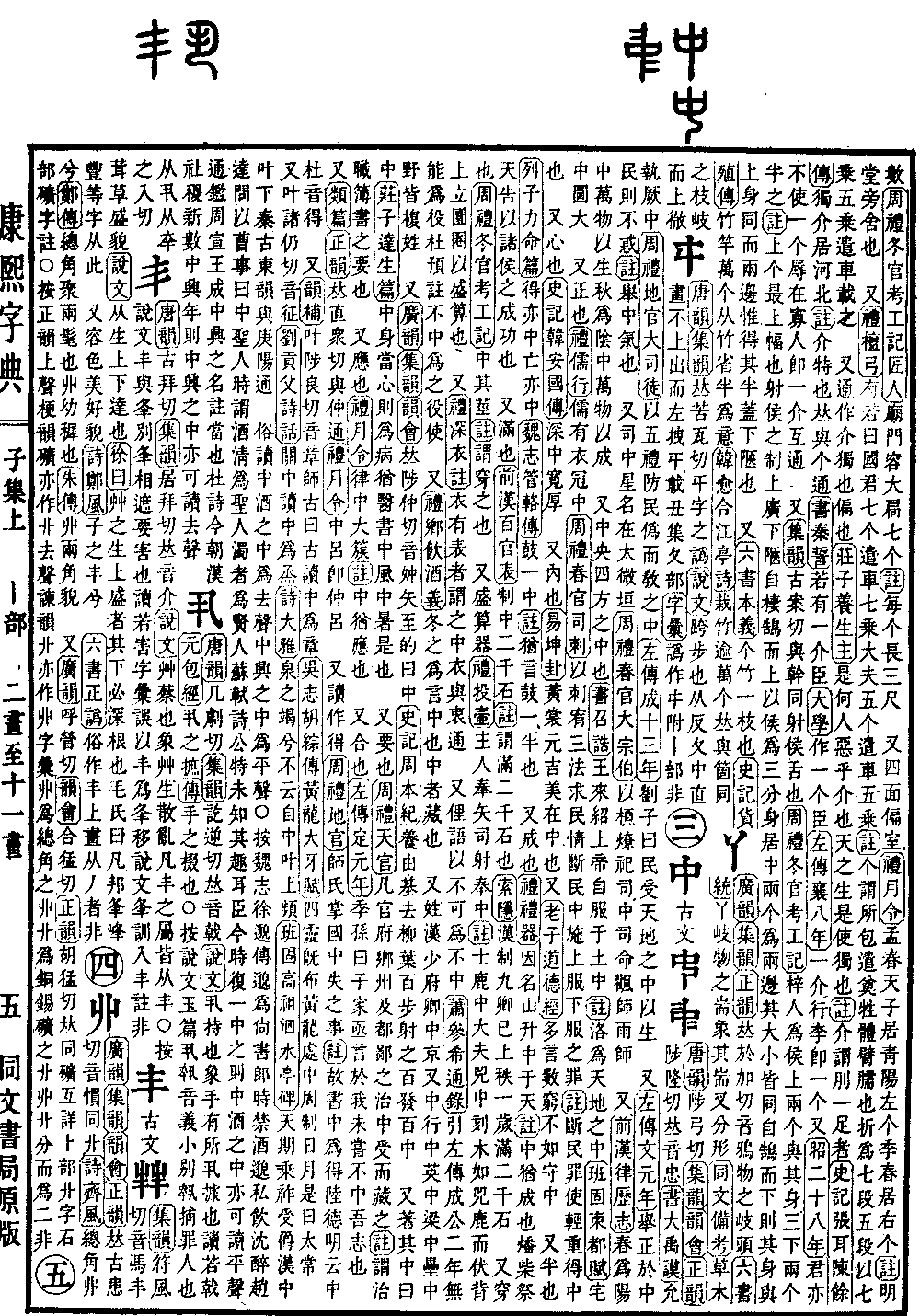
Zhong
Kangxi Stroke Count: 4
Page 79, Number 03
Tang Dynasty Rhymes (Tangyun): zhi + gong. Collected Rhymes (Jiyun), Collected Rhymes (Yunhui), and Correct Rhymes (Zhengyun): zhi + long. Pronounced like zhong.
Sincerity hold fast the mean — Book of Documents (Shujing)
Using the five rites to prevent deceit among the people and teaching them the mean — Rites of Zhou (Zhouli)
Liu Zi said: People receive the mean of heaven and earth to be born — Zuo Commentary (Zuozhuan)
Also: By rectifying the middle, the people will not be confused. Note: This refers to the central qi (zhongqi) — Zuo Commentary.
Also Sizhong, a star name. Located in the Supreme Palace Enclosure (Taiwei Yuan).
Using firewood to sacrifice to Sizhong, Siming, the Master of Wind, and the Master of Rain — Rites of Zhou.
Also: Spring is the middle of Yang, by which all things are born. Autumn is the middle of Yin, by which all things are completed — Book of Han (Hanshu).
Also the center, the middle of the four directions.
The King came to continue the work of the Sovereign on High, serving from the center of the land. Note: Luo is the center of heaven and earth — Book of Documents.
Residing in the center, round and great — Rhapsody on the Eastern Capital (Dongjing Fu) by Zhang Heng.
Also upright or correct.
The scholar has cap and gown that are correct — Book of Rites (Liji).
Using these three methods to seek the people's circumstances, to judge the people's fairness, and to apply the punishments of upper and lower garments. Note: To judge the people's crimes so that the severity is appropriate — Rites of Zhou.
Also the heart or mind.
Deep within, he was broad and generous — Records of the Grand Historian (Shiji).
Also the interior.
Yellow lower garment, supreme good fortune; the pattern is within — Book of Changes (Yijing).
Also: Many words lead to exhaustion; it is better to guard the center — Classic of the Way and Virtue (Daodejing).
Also half.
Gaining is half, losing is half — Liezi.
The drum struck once in the middle. Note: Meaning the drum was halfway — Records of the Three Kingdoms (Sanguozhi).
Also to complete or achieve.
Ascending to heaven from famous mountains to report success. Note: Zhong is like success. Burning firewood to sacrifice to heaven, reporting the achievements of the feudal lords — Book of Rites.
Also full or to reach a limit.
Regulated at a full two thousand dan. Note: Meaning reaching two thousand dan. Seeking the Obscure (Suoyin): In the Han system, for those above the Nine Ministers, the annual salary reached two thousand dan — Book of Han.
Also to pierce or pass through.
Pierce its stem. Note: Meaning to pass through it — Rites of Zhou.
Also a vessel for holding counting tallies.
The host presents the arrows, the master of archery presents the tally-vessel. Note: Scholars use a deer-shaped vessel, grandees use a rhinoceros-shaped vessel; wood is carved like a crouching rhinoceros or deer, with a circle on the back to hold the tallies — Book of Rites.
Also: Clothing with an outer layer is called inner clothing (zhongyi). Interchangeable with the word for inner (zhong) — Book of Rites.
Also in colloquialism, "not possible" is called "bu zhong."
Cited in Records of Master Xiao's Universal Understanding (Xitong Lu), quoting Zuo Commentary: Unable to serve. Du Yu's note: Unfit to be employed for service.
Also: Winter is spoken of as zhong. Zhong means to store — Book of Rites.
Also a surname. Zhong Jing, Minister of the Imperial Household in the Han Dynasty.
Also Zhonghang, Zhongying, Zhongliang, Zhonglei, and Zhongye are all compound surnames.
Broad Rhymes (Guangyun), Jiyun, and Yunhui: zhi + zhong. Pronounced like zhong in the falling tone.
An arrow hitting the target is called zhong.
Yang Youji was a hundred paces from the willow leaf; he shot at it and hit it every time — Records of the Grand Historian.
Also, hitting the center is called zhong.
Hitting the body or the heart causes illness, just as medical books speak of being struck by wind or struck by heat — Zhuangzi.
Also essentials or records.
For all administrative records of government offices, districts, and towns, they are received and stored. Note: Refers to the essentials of administrative registers — Rites of Zhou.
Also to correspond to.
The pitch-pipe corresponds to Taicu. Note: Zhong is like corresponding — Book of Rites.
Also to match or accord with.
Jisun said: Zijiazi has spoken to me many times, and never has he not accorded with my will — Zuo Commentary.
Classed Chapters (Leipian) and Zhengyun: zhi + zhong. Interchangeable with the middle brother (zhong).
Zhonglü is the same as Zhonglü — Book of Rites.
Also read as to obtain (de).
The Shishi official manages the successes and failures of the state. Note: In the old text, zhong was written as de. Lu Deming says: Zhong is pronounced like de — Rites of Zhou.
Also Rhyme Supplement (Yunbu): Rhyming as zhi + liang, pronounced like zhang. Yan Shigu says: In ancient times, zhong was read as zhang.
The four spirits are spread, the yellow dragon resides in the center. The Zhou system of sun and moon is called the Great Banner — Records of Wu (Wuzhi).
Also rhyming as zhu + reng, pronounced like zheng.
In the Guanzhong region, zhong is read as zheng — Poetry Talk by Liu Gongfu.
The springs are dried up; do not say it is from within. Rhymes with pin — Book of Odes (Shijing).
The heavenly cycle follows the mandate, receiving the title in Hanzhong. Rhymes with Qin. The ancient Dong rhyme category was interchangeable with Geng and Yang — Ban Gu.
Popularly, the zhong in "zhongjiu," meaning affected by wine, is read in the falling tone. The zhong in "zhongyu," meaning restoration, is read in the level tone. According to the Records of the Three Kingdoms: Xu Miao was a Secretariat Drafter when wine was prohibited. He drank privately and became drunk. When Zhao Da asked about affairs, he said he was "hit by the Sage." At that time, clear wine was called the Sage and turbid wine was called the Worthy. In a poem by Su Shi: You simply do not know the interest in it; I now and then get hit by it. Thus, the zhong in "zhongjiu" can also be read in the level tone. Comprehensive Mirror in Aid of Governance (Tongjian): King Xuan of Zhou achieved the restoration; Note: Meaning to match. In Du Fu's poem: Today the Han altars of state are newly counted in the years of restoration. Thus, the zhong in "zhongyu" can also be read in the falling tone.
Corrected from Ban Gu's Rhapsody on the Eastern Capital to Zhang Heng's Rhapsody on the Eastern Capital according to the original text.
Corrected Spring Offices to Autumn Offices in the Rites of Zhou. Corrected the citation text as well.
Corrected "beauty is within" to "the pattern is within" in the Book of Changes.
Added the character "zi" after "Zijia" in the Zuo Commentary.
Corrected Celestial Offices to Spring Offices in the Rites of Zhou.