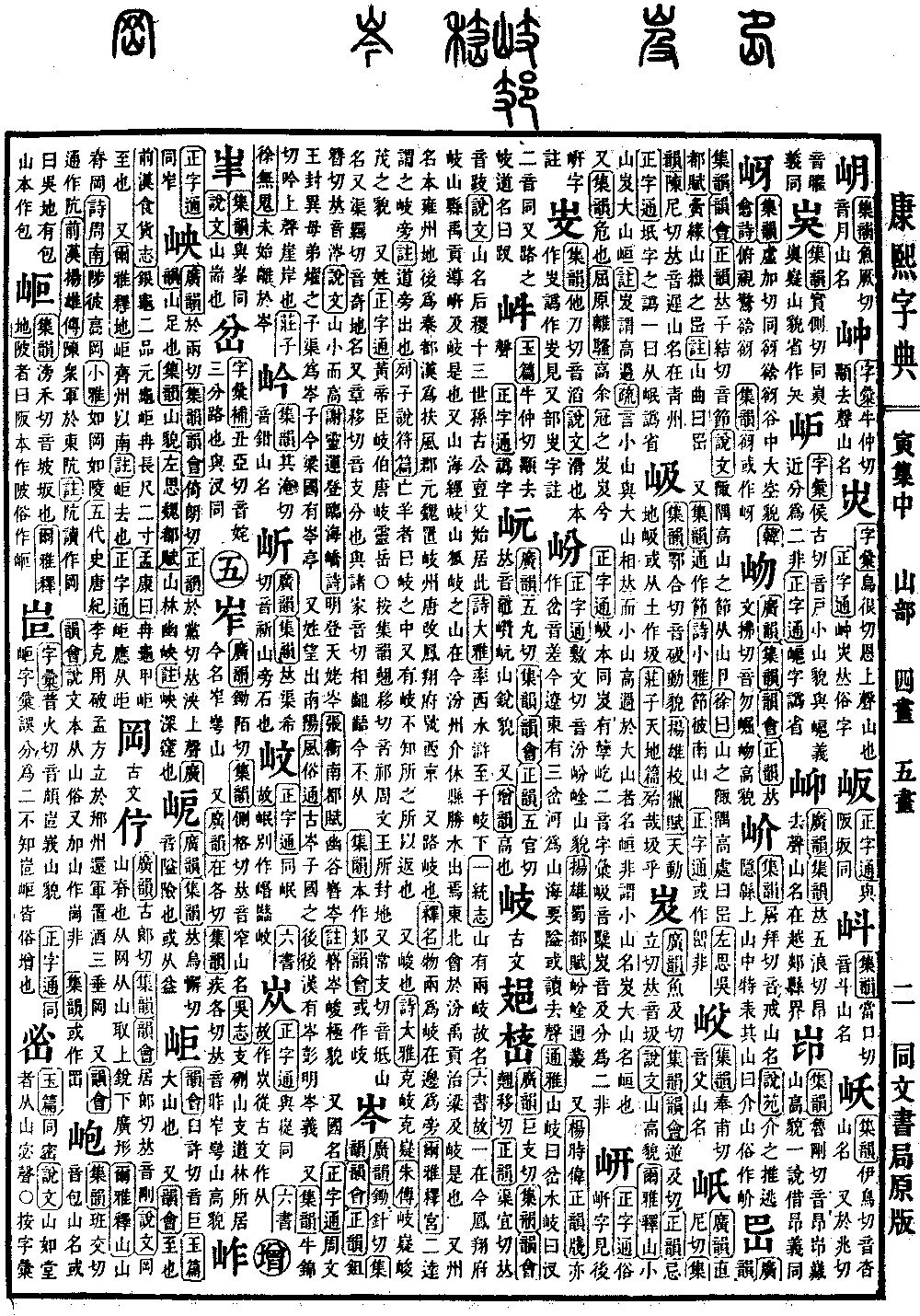
Yin Collection, Middle Volume
Radical: Mountain (shān)
Kangxi strokes: 8
Page: 308
Ancient script.
According to the Guangyun (Guǎngyùn), pronounced gu-lang qie. According to the Jiyun (Jíyùn) and Yunhui (Yùnhuì), pronounced ju-lang qie, with the sound of gang.
According to the Shuowen (Shuōwén): Gāng means a mountain ridge. It is composed of wǎng and shān, taking the form of a sharp top and broad base.
According to the Erya (Ěryǎ), Explanation of Mountains: A mountain ridge is a gāng.
In the Book of Odes (Shijing), Zhou Nan: "Ascend that high ridge."
In the Book of Odes (Shijing), Lesser Odes: "Like ridges, like mounds."
In the History of the Five Dynasties (Wǔdàishǐ), Annals of Tang: Li Keyong defeated Meng Fangli in Xingzhou, and upon returning with his army, he held a feast at Sanshui Ridge.
Also, according to the Yunhui (Yùnhuì), it is interchangeable with kēng.
In the Former Han History (Qiánhànshǐ), Biography of Yang Xiong: "The multitude of armies gathered at Dong Kēng." The commentary states that kēng should be read as gāng.
According to the Yunhui (Yùnhuì): The original character in the Shuowen (Shuōwén) is composed of shān. Later, colloquially, the shān radical was added to form the character gǎng, which is incorrect.
According to the Jiyun (Jíyùn), it is sometimes also written in a variant form.