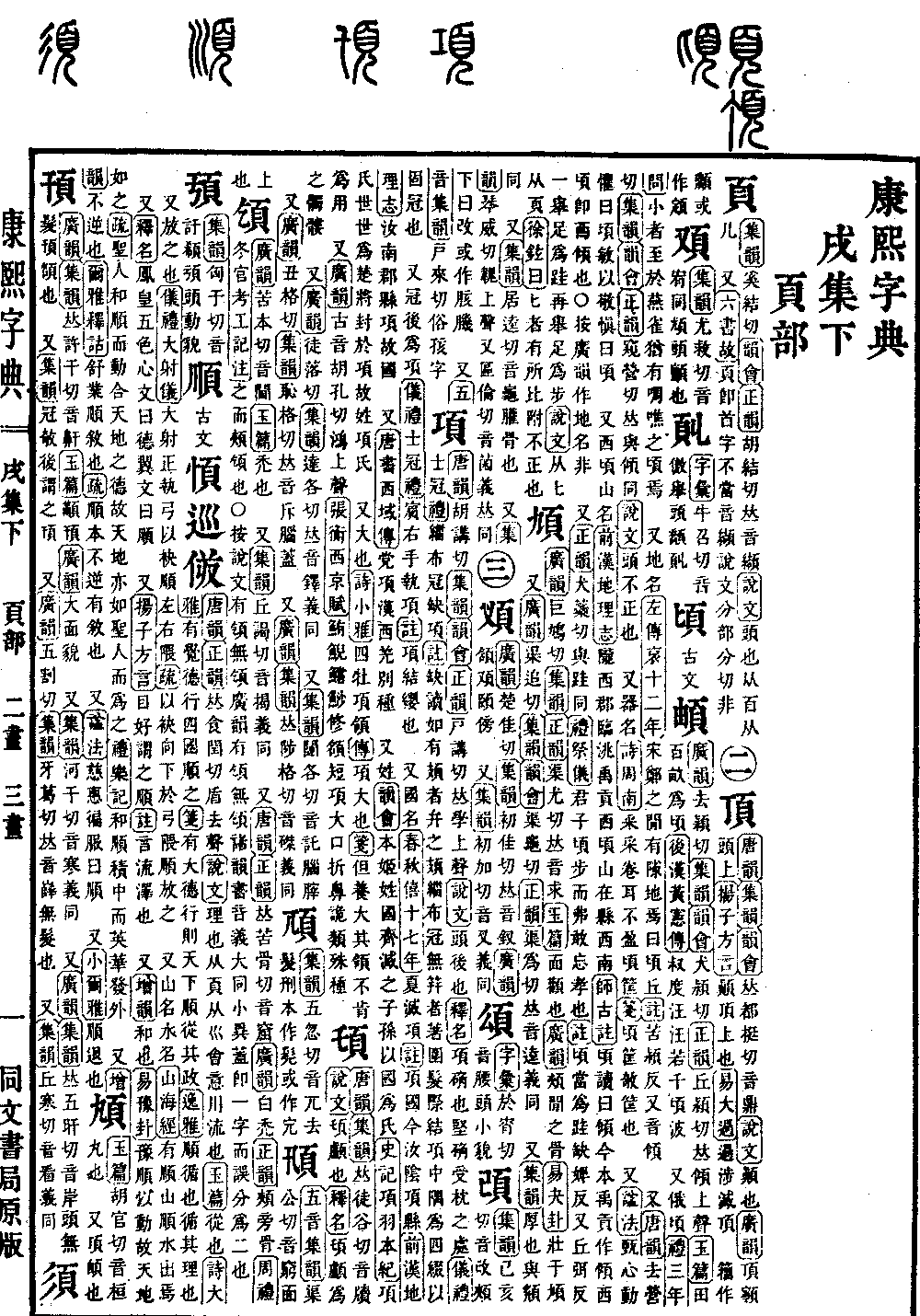
Xu Collection, Lower Volume
Radical: Page (yè)
Kangxi Strokes: 12
Page 1399, Entry 01
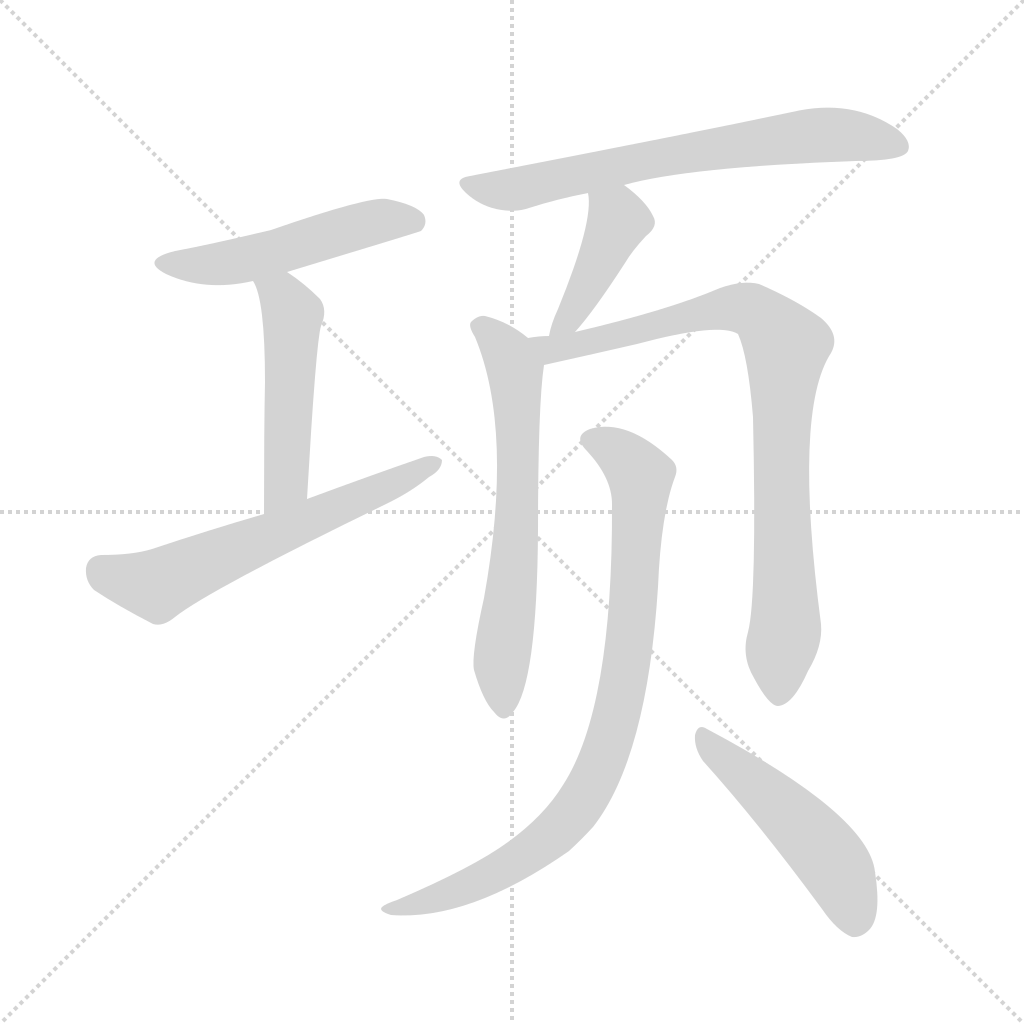
Pronounced xiang (rising tone).
According to the Explaining Graphs and Analyzing Characters (Shuowen): The back of the head.
According to the Explanation of Names (Shiming): Xiang means firm. It is the firm part that supports the pillow.
According to the Book of Etiquette and Ceremonial (Yili): Black cloth cap with a deficiency at the neck band. Commentary: The term deficiency is read like the kui in the phrase caps with kui; a black cloth cap without a hairpin has a band that circles the hairline, tied at the middle of the neck, with four corners attached to secure the cap.
Also, the back of a cap is called the xiang.
According to the Book of Etiquette and Ceremonial (Yili): The guest holds the neck band with his right hand. Commentary: Xiang refers to the knotted chin strap.
Also, the name of a state. According to the Spring and Autumn Annals (Chunqiu): In the summer, the state of Xiang was destroyed. Commentary: The state of Xiang is the present-day Xiang County in Ruyin.
According to the History of the Former Han (Qianhan Shu): In Runan Commandery, there is a county named Xiang; it is the former state.
Also, according to the Old Book of Tang (Tangshu): The Dangxiang are a separate tribe of the Western Qiang during the Han dynasty.
Also, a surname. According to the Rhyme Compendium (Yunhui): Originally a state of the Ji surname; after Qi destroyed it, the descendants took the state name as their clan name. According to the Records of the Grand Historian (Shiji): The Xiang family were generals of Chu for generations and were enfeoffed at Xiang, thus they were surnamed Xiang.
Also, meaning large. According to the Book of Odes (Shijing): Four stallions with large necks. Commentary: Xiang means large. Exegesis: They only cultivate a large neck but are unwilling to be put to use.
Also, pronounced hong (rising tone).
According to the Western Capital Rhapsody (Xijing Fu) by Zhang Heng: Sturgeon and catfish, with long foreheads and short necks. Big mouths and hooked noses, strange types and distinct species.
Textual research: In the Book of Etiquette and Ceremonial, regarding the black cloth cap, the commentary contains a missing character in the description of the band; the character has been added in accordance with the original text.
Regarding the note on the Ancient Rhyme Compendium (Guangyun) pronunciation: This pronunciation is actually found in the Tang Dynasty Phonetic Corrections (Tangyun Zheng), not the Guangyun. The text has been updated accordingly.