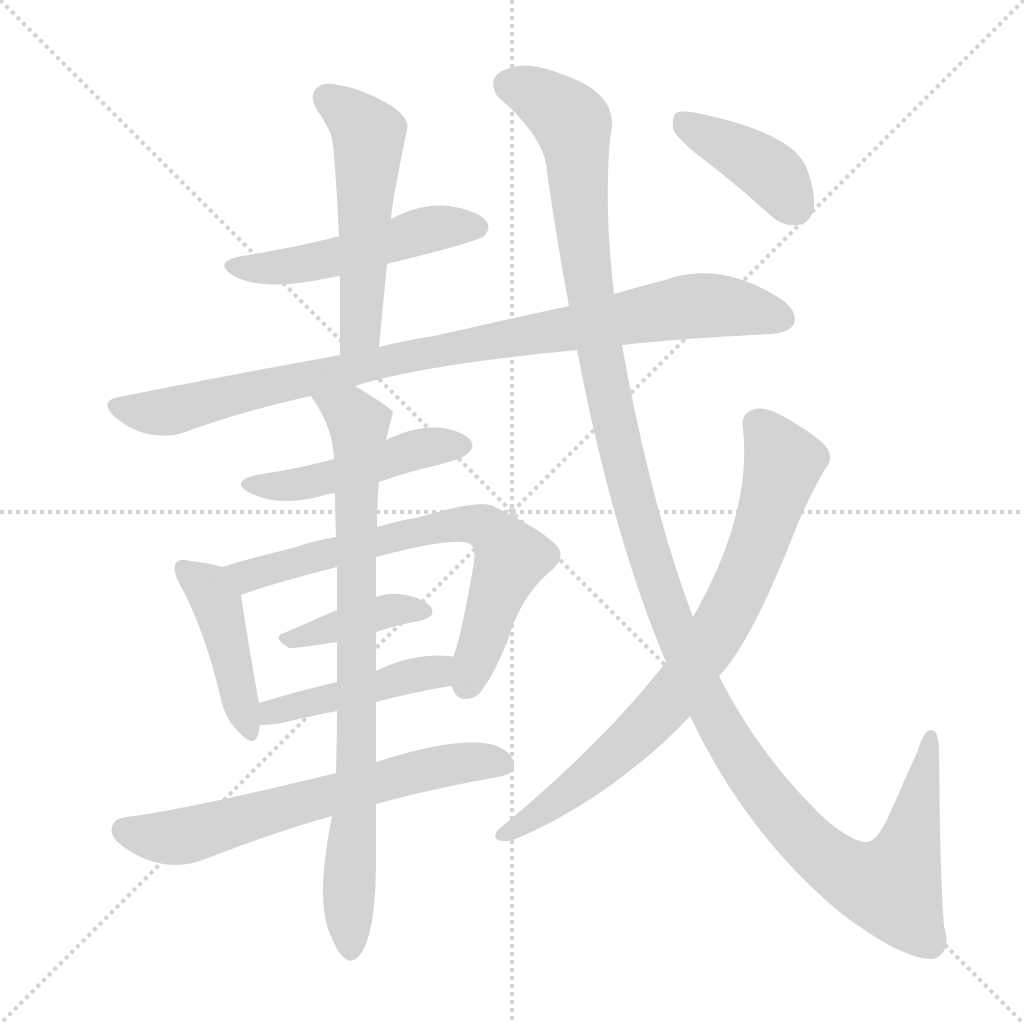
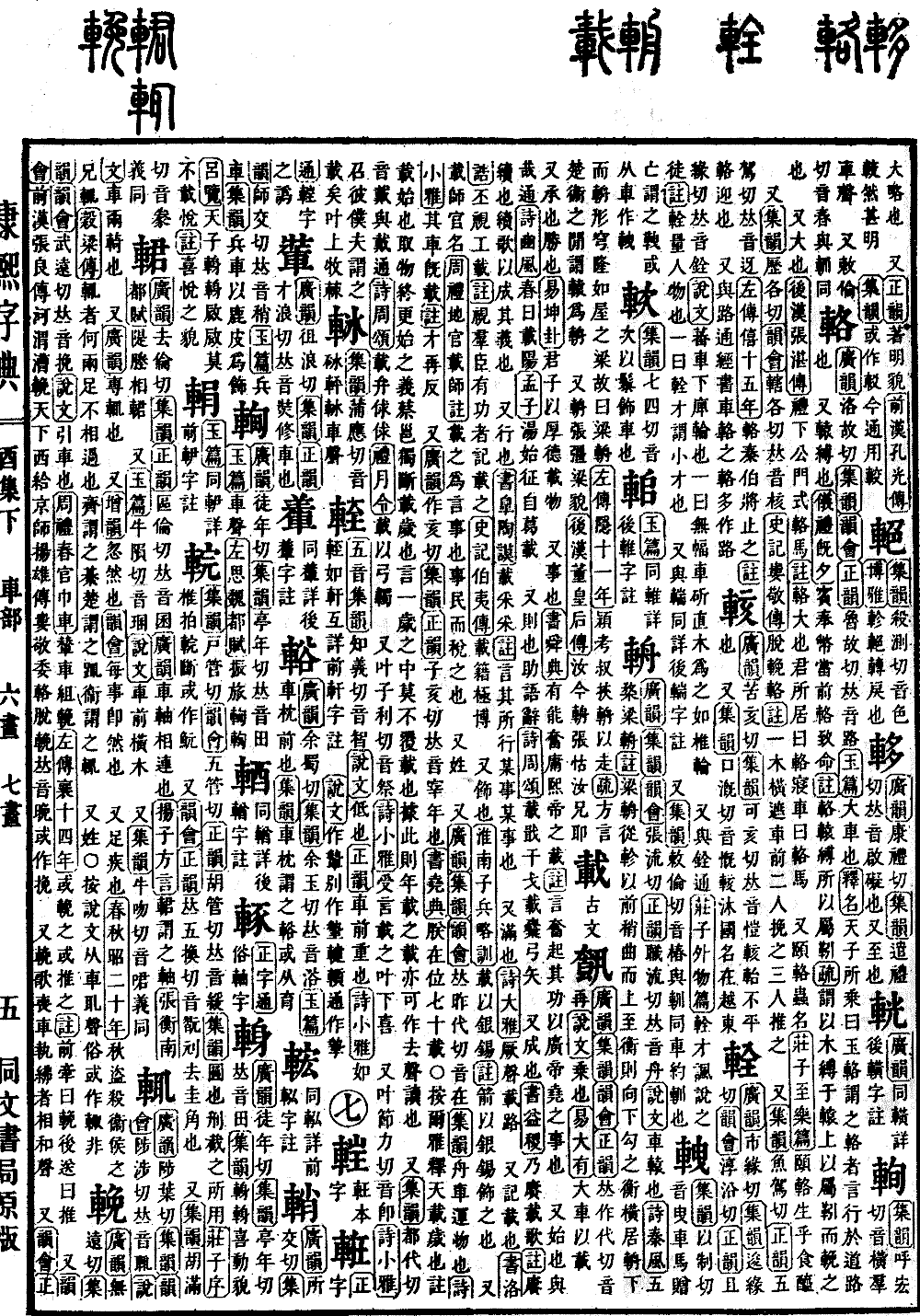
You Collection, Lower Volume
Radical: Carriage (chē)
Page 1243, Entry 12
Ancient form. Guangyun (Broad Rhymes), Jiyun (Collected Rhymes), Yunhui (Compendium of Rhymes), Zhengyun (Correct Rhymes): Pronounced zai (falling tone).
Shuowen (Explaining Graphs): To ride.
Book of Changes (Yijing): A large carriage used for transport.
Also to bear or sustain.
Book of Changes (Yijing): The gentleman uses his virtuous nature to sustain all things.
Also affairs or tasks.
Book of Documents (Shujing): Able to exert merit and brighten the works of the Emperor. Commentary: Refers to exerting efforts to expand the tasks of Emperor Yao.
Also to begin. Used interchangeably with zai.
Book of Odes (Shijing): In spring, the sun begins to appear.
Mencius: Tang began his conquest, starting from Ge.
Also a particle used to indicate an action or as a conjunctive.
Book of Odes (Shijing): Then store the shields and spears, then pack away the bows and arrows.
Also to complete.
Book of Documents (Shujing): Then they continued the song. Commentary: Geng means to continue. To continue the song to complete its meaning.
Also to perform or act.
Book of Documents (Shujing): The duties performed. Commentary: Refers to the specific affairs carried out.
Also to fill.
Book of Odes (Shijing): Its sound filled the road.
Also to record.
Book of Documents (Shujing): Grandly oversee the record of merit. Commentary: Oversee those among the officials who have merit and record them.
Records of the Grand Historian (Shiji): The records and books are extremely vast.
Also to decorate.
Huainanzi (Huainanzi): Decorated with silver and tin. Commentary: Arrows decorated with silver and tin.
Also Zaishi (Officer of Affairs), a title of an official.
Rites of Zhou (Zhouli): The term zai refers to affairs, meaning to manage the people and collect taxes from them.
Also a surname.
Guangyun (Broad Rhymes), Jiyun (Collected Rhymes), Yunhui (Compendium of Rhymes): Pronounced zai (falling tone).
Jiyun (Collected Rhymes): The transport of goods by boat or carriage.
Book of Odes (Shijing): The carriage is already loaded. Commentary: Pronounced zai (falling tone).
Guangyun (Broad Rhymes): Pronounced zai (rising tone). Jiyun (Collected Rhymes), Zhengyun (Correct Rhymes): Pronounced zai (rising tone). A year.
Book of Documents (Shujing): I have been on the throne for seventy years.
Note: Erya (Approaching Elegance) states that zai means a year. Commentary: Zai means to begin. It takes the meaning of the cycle of things ending and beginning anew. Cai Yong, Duduan (Sole Judgment): Zai means a year. It refers to the fact that within a single year, everything is covered and sustained. According to this, the character for year can also be read with a falling tone.
Jiyun (Collected Rhymes): Pronounced dai (falling tone). Used interchangeably with dai (to wear).
Book of Odes (Shijing): Wearing the ceremonial cap respectfully.
Book of Rites (Liji): Carried in a bow case.
Also rhymes with zi and li (entering tone), pronounced ji.
Book of Odes (Shijing): Receive and carry it. Rhymes with xi.
Also rhymes with jie and li (entering tone), pronounced ji.
Book of Odes (Shijing): Call those servants, and tell them to load it. Rhymes with mu and ji.
Textual Verification:
Book of Documents (Shujing): Originally read as gong (work) zai, corrected to gong (merit) zai according to the original text. Commentary: Oversee those among the officials who have merit and record them.