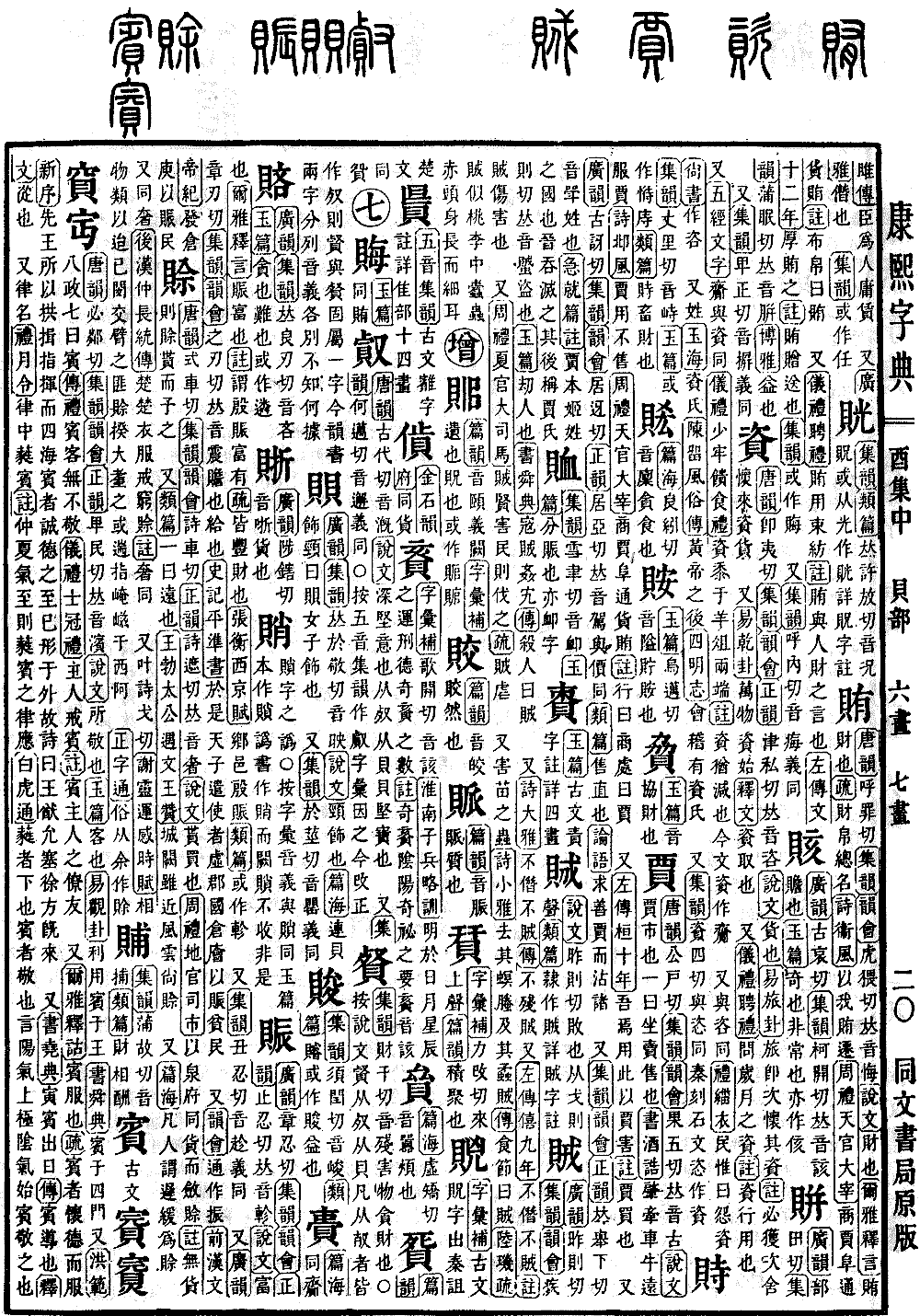
You Collection, Middle Volume. Radical: Shell (bèi). Kangxi stroke count: 13. Page 1208, Entry 01.
According to Broad Rimes (Guangyun) and Collected Rimes (Jiyun) and Treasury of Rimes (Yunhui), the pronunciation is ze. It refers to a thief or bandit.
In the Jade Chapter (Yupian), it is defined as a person who robs others of their property.
In the Book of Documents (Shangshu), Chapter of the Canon of Shun (Shundian): To harm those who are wicked or villainous. The commentary states that one who commits murder is called a thief.
Also, in the Book of Odes (Shijing), Greater Odes (Daya): Neither excessive nor harmful. The commentary states that it means to not act with cruelty or harm.
Also, in the Zuo Commentary (Zuozhuan), ninth year of Duke Xi: Neither excessive nor harmful. The annotation states that thief means the meaning of harm.
Also, in the Rites of Zhou (Zhouli), Summer Offices (Xiaguan), Grand Marshal (Da Sima): If they harm the virtuous and injure the people, then punish them. The sub-commentary states that thief means tyrannical.
It also refers to pests that harm crops. In the Book of Odes (Shijing), Lesser Odes (Xiaoya): Remove the grain-eating insects, the larvae, and the stem-borers. The commentary states that insects that gnaw on the stems and joints of grain seedlings are called thieves. Lu Ji's commentary states that the thief insect is similar to the borer found in peach and plum trees, with a red head and a long, slender body.