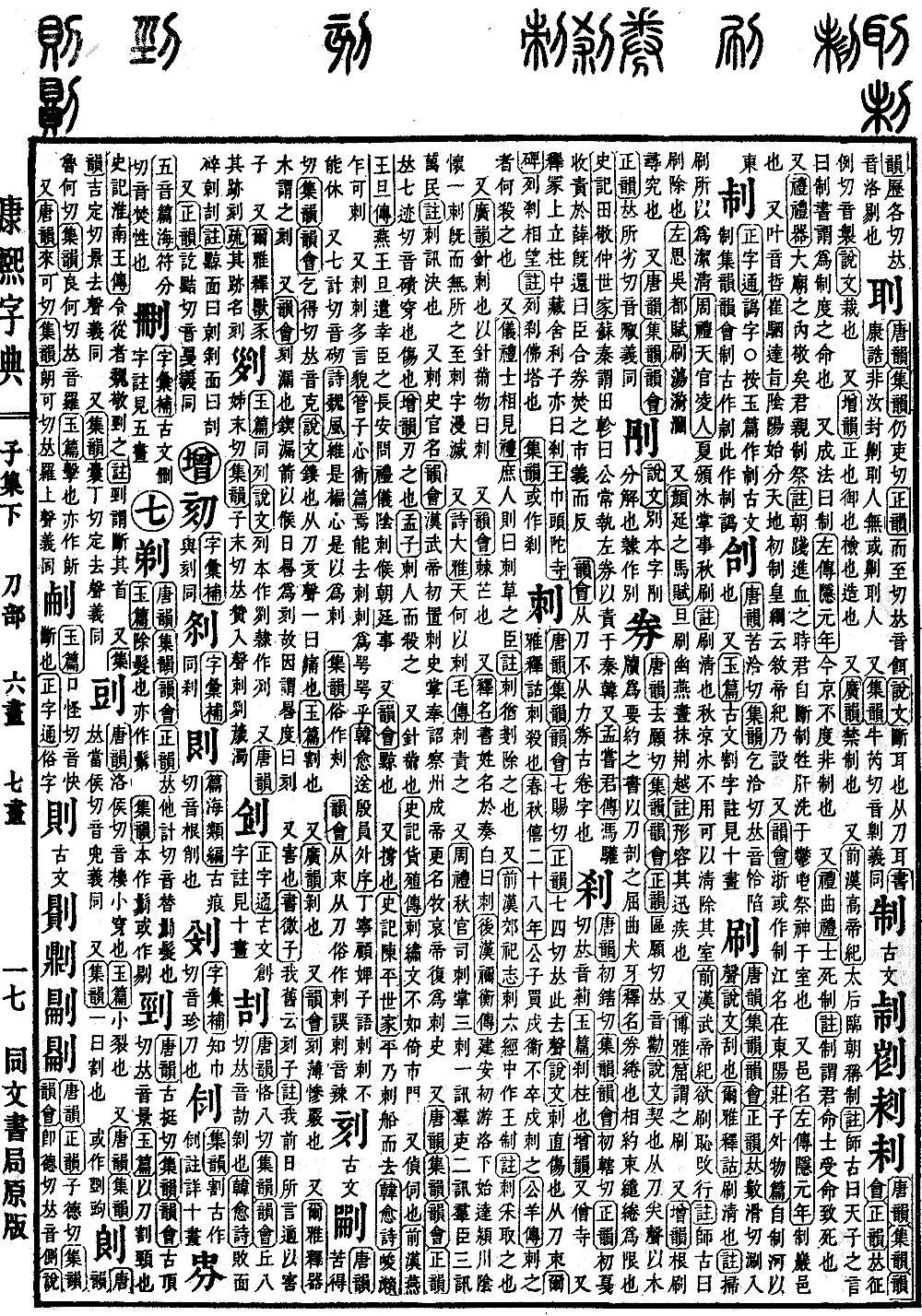
Zi Collection, Page Position: Lower
Radical: Knife (dao)
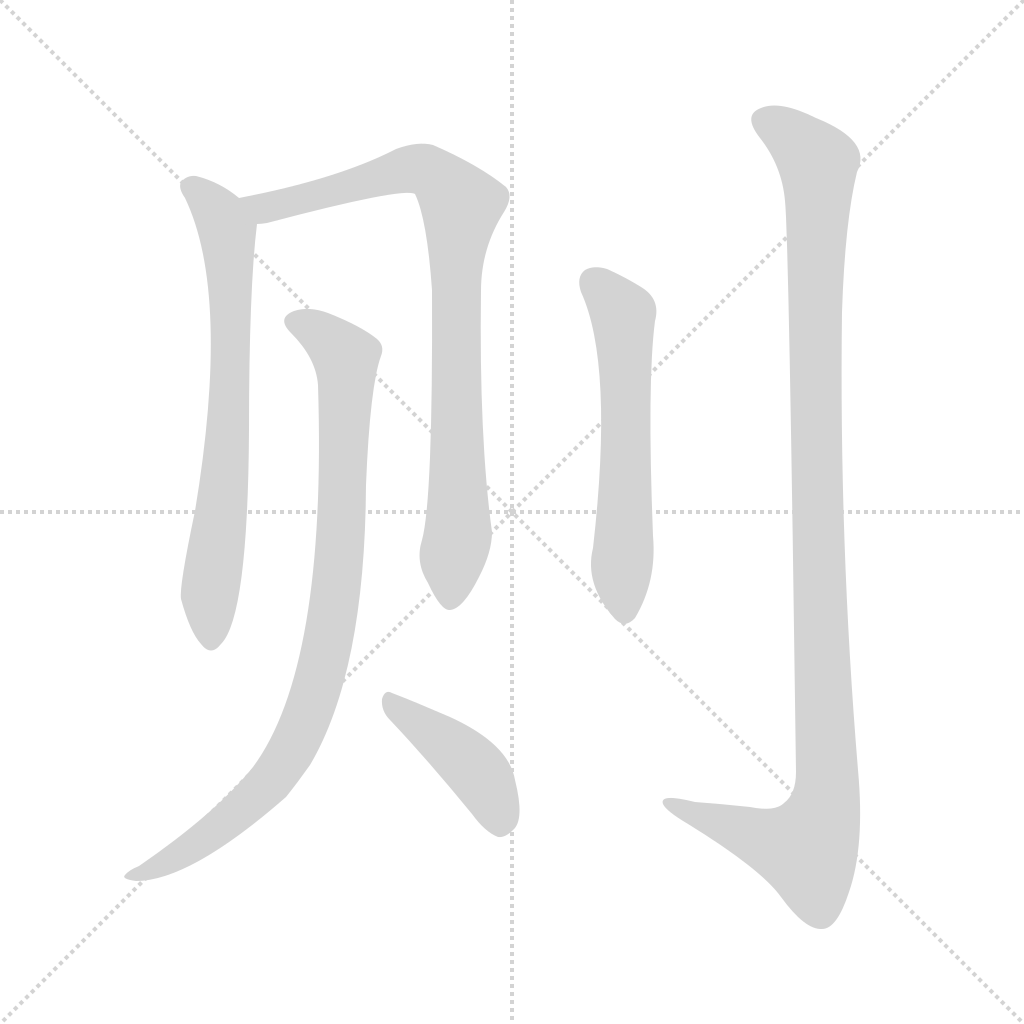
ze
Kangxi stroke count: 9
Page 139
Ancient form
According to the Tangyun and Zhengyun, the pronunciation is derived from the sounds of zi and de. According to the Jiyun and Yunhui, it is derived from the sounds of ji and de. It is pronounced similarly to ce.
The Shuowen Jiezi (Shuowen Jiezi) states that ze means to equalize or mark out objects. It is composed of the radicals for knife and cowry shell. Cowry shells were ancient goods and currency. Xu Xuan states that ze means moderation or regulation. There is moderation in what is taken and used, and the knife is the tool used to cut and regulate it.
Additionally, the Jade Chapters (Yupian) defines it as law. The Erya (Erya) states it means constant or standard. The commentary explains it refers to constant rites and laws. The Rites of Zhou (Zhouli) mentions using the eight rules to govern the capital and the borders. Zheng Xuan's commentary states that ze means law. The Zengyun notes that all systems and specifications are called ze. The Book of Documents (Shujing) states that the wise and discerning truly establish the standards.
Natural principles that are without error are also called ze. As seen in the Book of Changes (Yijing), then one perceives the laws of heaven, and in the Classic of Poetry (Shijing), following the rules of the Supreme Deity. It also means to model oneself after what is worthy of emulation. The Book of Documents states that from now on, the succeeding kings shall take as their rule not to indulge in excess regarding spectacles, ease, wandering, or hunting. The commentary notes this was a warning to King Cheng to follow the example of King Wen. The Classic of Poetry also states that the gentleman models himself on this and follows this.
Furthermore, in the Rites of Zhou, the commentary on the five ranks of bestowal defines ze as the name for land that has not yet become a formal state. Yize is also the name of the musical pitch for the seventh month. The Book of Han (Hanshu) states that ze means law, signifying that the yang energy follows established laws while causing the yin energy to level or harm things.
According to the Yunhui, it also serves as an auxiliary word or a particle meaning then. For instance, in the Analects (Lunyu), if one has energy to spare after acting, then one should use it to study literature.
Textual Verification: Regarding the commentary on the five ranks of bestowal in the Rites of Zhou, ze is defined as the name for land that has not yet become a formal state. This entry has been corrected according to the original text.