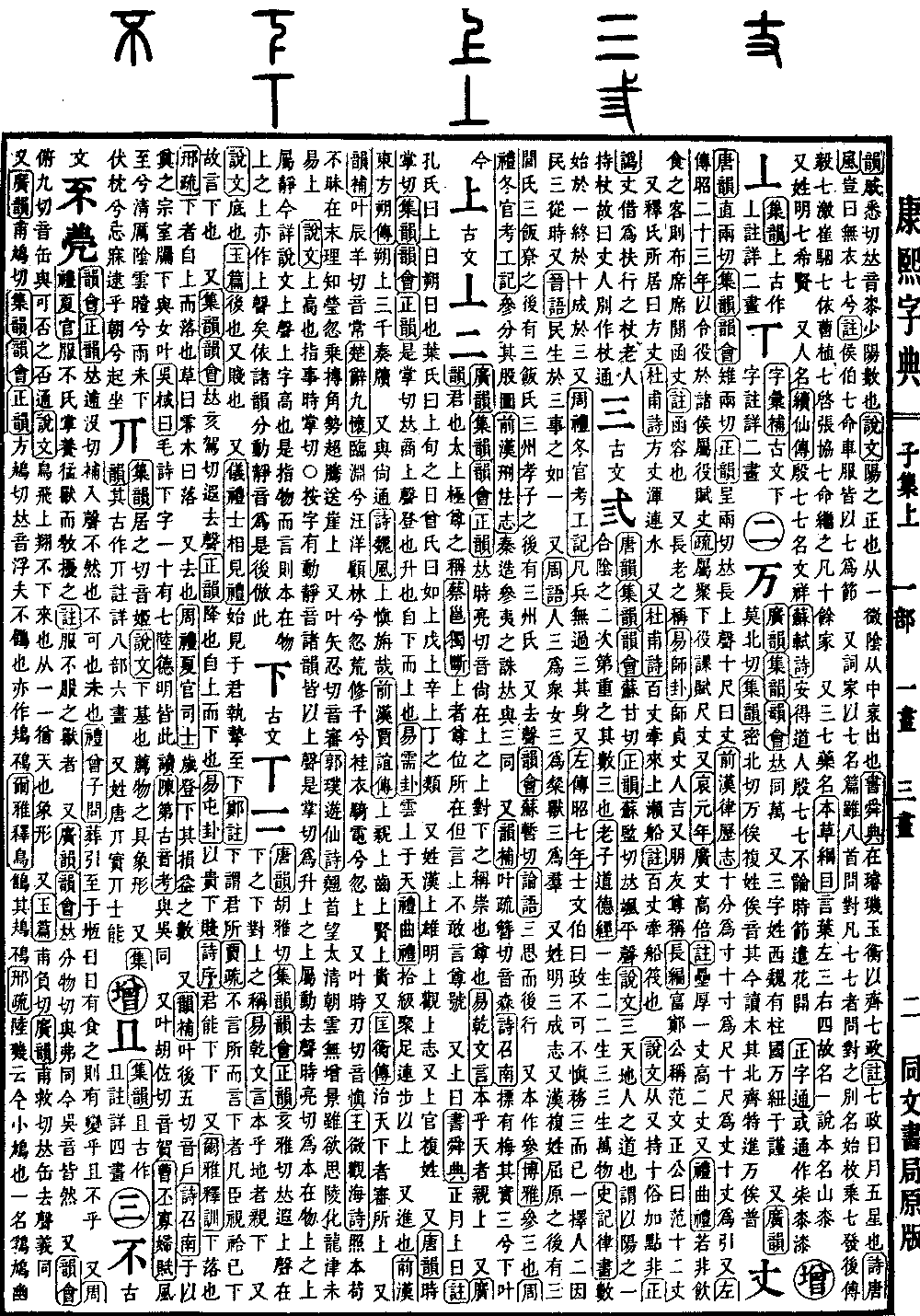
Zi Collection, Page Position: Upper. Radical: One (yī). wàn. Kangxi strokes: 15. Page: Page 76, Number 03.
In the Broad Rhymes (Guangyun), Collected Rhymes (Jiyun), and Rhyme Meeting (Yunhui), this character is noted as the same as the traditional form pronounced wàn. It is also a three-character surname; in the Western Wei dynasty, there was a Pillar of State named Wanniu Yu Jin. Also, according to the Broad Rhymes (Guangyun) and Collected Rhymes (Jiyun), it is formed by the initial sound combination of mò and běi or mì and běi. It is used in the compound surname Moqi. The second character is pronounced qí, and the name is currently read as mùqí. In the Northern Qi dynasty, there was a high official named Moqi Pu. In ancient script, according to the Tang Rhymes (Tangyun), it has the initial sound combination of wú and fàn, and is pronounced like màn. The Explanation of Graphs and Analysis of Characters (Shuowen Jiezi) defines it as an insect. The Increasing of the Erya (Piya) states that the bee is also called a wàn. This is because bees are numerous and are often counted by the tens of thousands. It is also a numerical term; the Image of the Qian Hexagram in the Book of Changes (Yijing) states that ten thousand nations are all at peace. The Treatise on Rhythm and the Calendar in the Book of Han (Hanshu) states that numbers begin at one, harmonize at ten, grow at a hundred, become great at a thousand, and expand at ten thousand. It is also the name of a dance; the Odes of Bei in the Book of Odes (Shijing) mentions being about to perform the Wan dance. The Commentary (Shu) explains that Wan is a general name for dances. The Lesser Calendar of the Xia in the Records of the Elder Dai on Ritual (Da Dai Liji) states that the Wan dance refers to a dance with shields and battle-axes. The Rhyme Meeting (Yunhui) notes that because Kings Tang and Wu gained the world with ten thousand people, the shield dance was called the Wan dance. It is also the name of a prefecture; the Records of the World (Huanyu Ji) notes that it was the Badong Commandery during the Han dynasty, and was named Wan Prefecture during the Zhenguan era of the Tang dynasty. It is also a surname; the Compendium of Clans and Families (Tongzhi Shizu lve) mentions the Wan clan, such as Wan Zhang, a disciple of Mencius. Also, according to the Rhyme Supplement (Yunbu), it enters the xiǎn rhyme. Bai Juyi wrote in his poem sent to Yuan Jiu: I pity you as an exiled official, in poverty and with a cramped home. I sent resources for food and clothing three times, the amount exceeding two hundred thousand. The Correction of the Six Scripts (Liushu Zheng'e) states that writing it in the abbreviated form is incorrect.