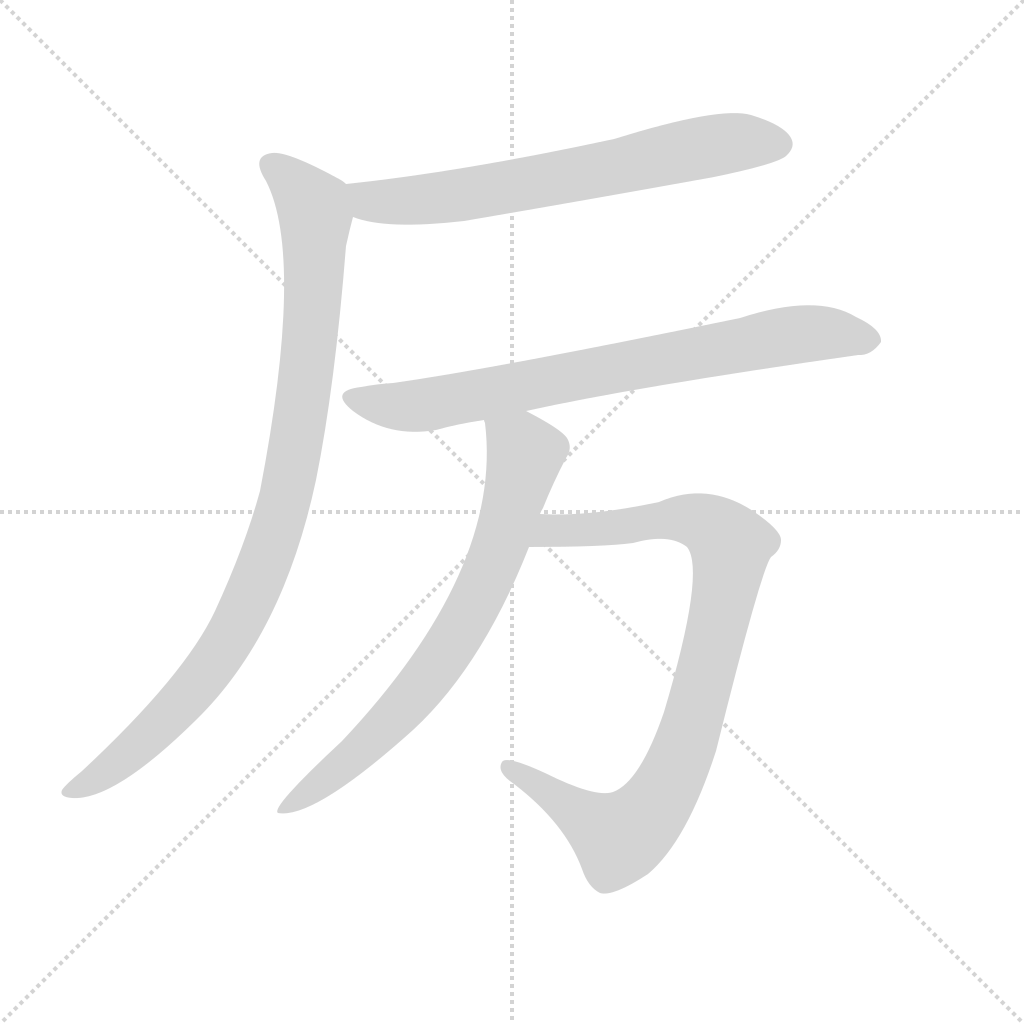
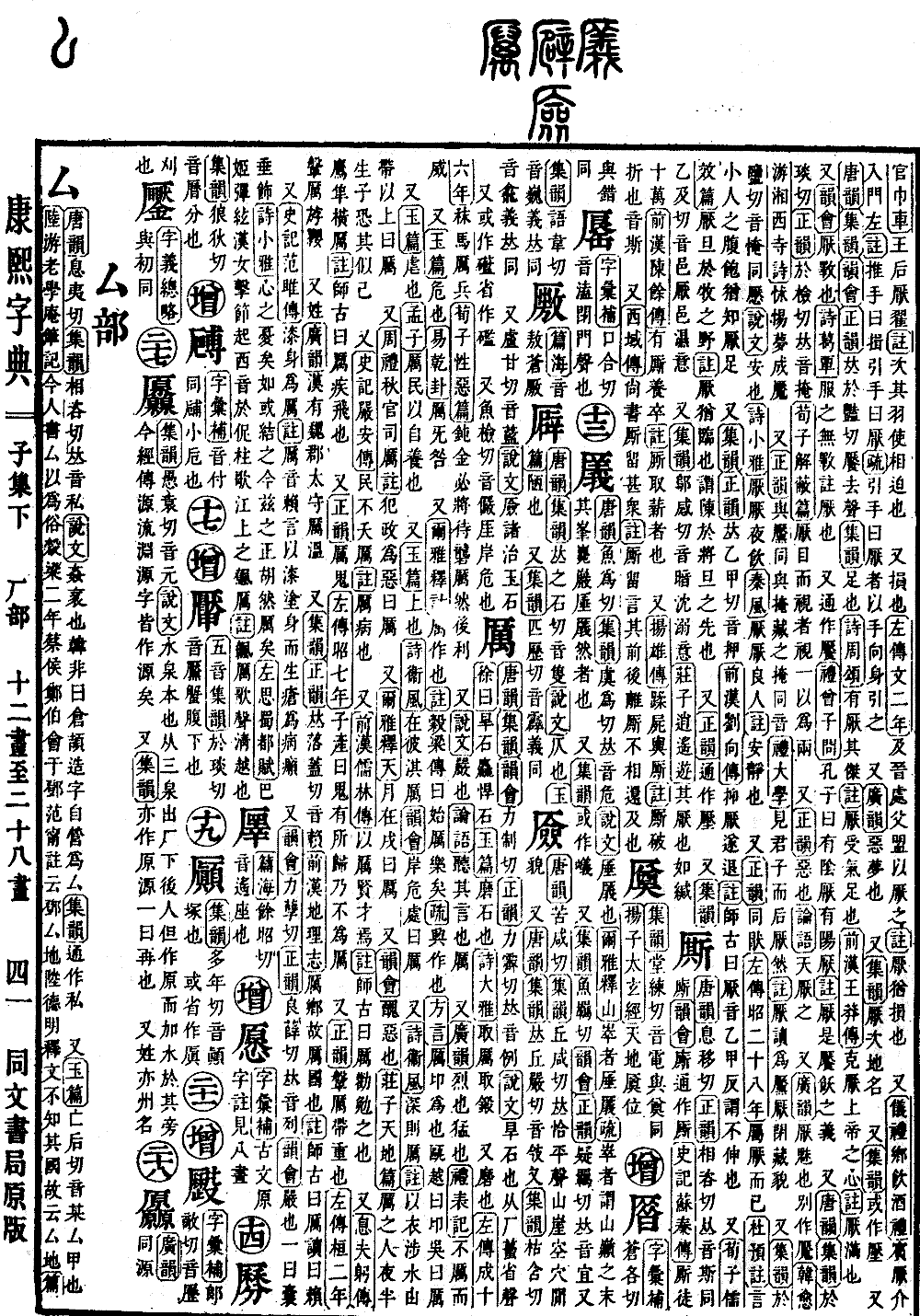
Zi Collection, Page Position: Lower. Radical: Cliff (hàn). Character: Li. Kangxi Stroke Count: 15. Page 163.
According to the Tangyun (Tangyun), Jiyun (Jiyun), and Yunhui (Yunhui), the pronunciation follows the fanqie li-zhi. According to the Zhengyun (Zhengyun), it follows the fanqie li-ji. It is homophonous with the character li.
The Shuowen (Shuowen) defines it as a dry whetstone. It is derived from the Radical: Cliff (hàn) and the phonetic component chai abbreviated. Xu says: a dry stone, a coarse and hard stone. The Jade Chapters (Yupian) defines it as a grindstone. "Taking the whetstones and the anvils" — Book of Odes (Shijing).
Also means to sharpen. "Feeding the horses and sharpening the weapons" — Zuo Commentary (Zuozhuan). The Xunzi (Xunzi) in the chapter Man's Nature is Evil states: "Dull metal must await grinding and sharpening before it becomes sharp."
Also defined in the Shuowen as severe. "Hearing his words, they were severe" — Analects (Lunyu).
Also, according to the Guangyun (Guangyun), it means fierce or intense. "Not fierce, yet commanding awe" — Record of Ritual (Liji).
Also, the Jade Chapters defines it as perilous. "In peril, yet without blame" — Classic of Changes (Yijing).
Also, the Erya (Erya) defines it as to act. The Guliang Commentary (Guliangzhuan) states: "The music began to be performed." The sub-commentary says: it means to arise or act. The Fangyan (Fangyan) states that li means to do. In the Ou and Yue regions and the state of Wu, it is called li.
Also, the Jade Chapters defines it as to oppress. "Oppressing the people to support oneself" — Mencius (Mengzi).
Also, the Jade Chapters defines it as the upper part. "On that upper bank of the Qi River" — Book of Odes. The Yunhui says the dangerous part of a bank is called li.
Also, the Book of Odes states: "When deep, one wades." The commentary states: when crossing water with clothes on, if the water is above the waist-belt, it is called li.
Also, the Rites of Zhou (Zhouli) commentary on the Minister of Punishments says: "Violating the administration and committing evil is called li."
Also, the Erya defines it as the month when the moon is in the xu position.
Also, the Yunhui defines it as ugly or diseased. The Zhuangzi (Zhuangzi) states: "A person with a skin disease who gives birth to a child at midnight fears the child will look like them."
Also, the Records of the Grand Historian (Shiji) states: "The people did not suffer from early death or disease." The commentary says: li means disease.
Also, the History of the Former Han (Hanshu) states: "To encourage talented individuals." Yan Shigu's commentary says: it means to encourage and exhort.
Also, in the biography of Xifu Gong: "The hawks and falcons flew swiftly across." Yan Shigu's commentary says: it means to fly swiftly.
Also, the Zhengyun defines it as a vengeful ghost. The Zuo Commentary states: "Zichan said: if a ghost has a place to return to, it will not become a vengeful ghost."
Also, the Zhengyun defines it as a heavy sash ornament. The Zuo Commentary says: "The heavy sash and the streaming tassels."
Also a surname. The Guangyun notes that in the Han dynasty there was a governor of Wei Commandery named Li Wen.
According to the Jiyun and Zhengyun, the pronunciation follows the fanqie luo-gai, homophonous with lai. The History of the Former Han states: "Li Township was the former state of Li." Yan Shigu's commentary says: Li is pronounced as lai.
Also, the Records of the Grand Historian states: "Coating the body with lacquer to create the appearance of a disease." The commentary says: Li is pronounced as lai. It means using lacquer to coat the body so as to cause sores and the disease of leprosy (lai).
According to the Yunhui, the pronunciation follows the fanqie li-nie. According to the Zhengyun, it follows the fanqie liang-xue, homophonous with lie. The Yunhui defines it as severe. Alternatively, it refers to a dangling ornament of a pouch. The Book of Odes states: "The sorrow of the heart is as if tied in a knot. The government of today, why is it so severe?"
Also, in the Rhapsody on the Capital of Shu (Shudu Fu) by Zuo Si: "The ladies of Ba pluck the strings, the women of Han beat the rhythm. Raising Western sounds from the tightened bridge, they sing the Li of the river." The commentary says: Li refers to a clear and high-pitched singing voice.
Verification: In the citation from the Classic of Changes, "In peril, yet without blame," the original character for "without" has been corrected from ji to the standard form wu.