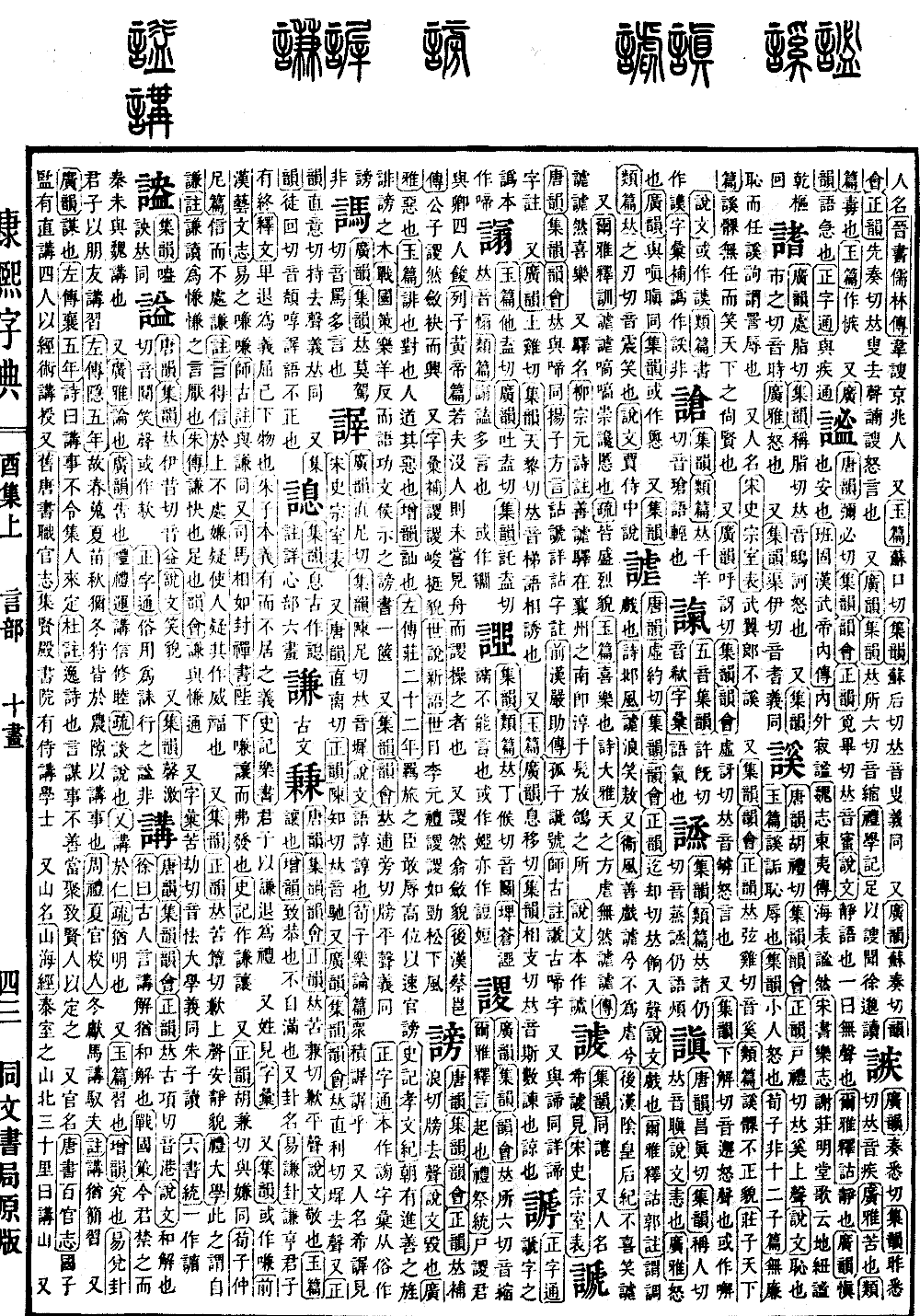
You Collection, Upper Volume
Radical: Speech (yán)
17 strokes
Page 1175, Entry 01
Pronounced bang (falling tone). According to Tang Rhymes (Tangyun), Collected Rhymes (Jiyun), Rhyme Compendium (Yunhui), and Correct Rhymes (Zhengyun), it is pronounced like the character bang (falling tone).
Shuowen Jiezi states the meaning is to slander.
Guangya states the meaning is evil.
Yupian states the meaning is to libel or reproach, referring to when people criticize the misdeeds of others.
Zengyun states the meaning is to satirize.
Zuo Zhuan (Zuozhuan), 22nd year of Duke Zhuang: A minister residing in another state, how dare he occupy a high position, such that he invites the slander of officials.
Records of the Grand Historian (Shiji), Annals of Emperor Xiaowen: The imperial court established banners for offering good advice and wooden plaques for people to write criticisms.
Strategies of the Warring States (Zhan Guo Ce): When Yue Yang returned to his state, he boasted of his military achievements, and Marquis Wen of Wei showed him a box of letters containing slanders against him.
Also, according to Collected Rhymes (Jiyun) and Rhyme Compendium (Yunhui), it is pronounced bang (level tone). The meaning is the same.
Zhengzitong states that the original form was written differently. The dictionary Zi Hui follows the popular simplified form, which is incorrect.