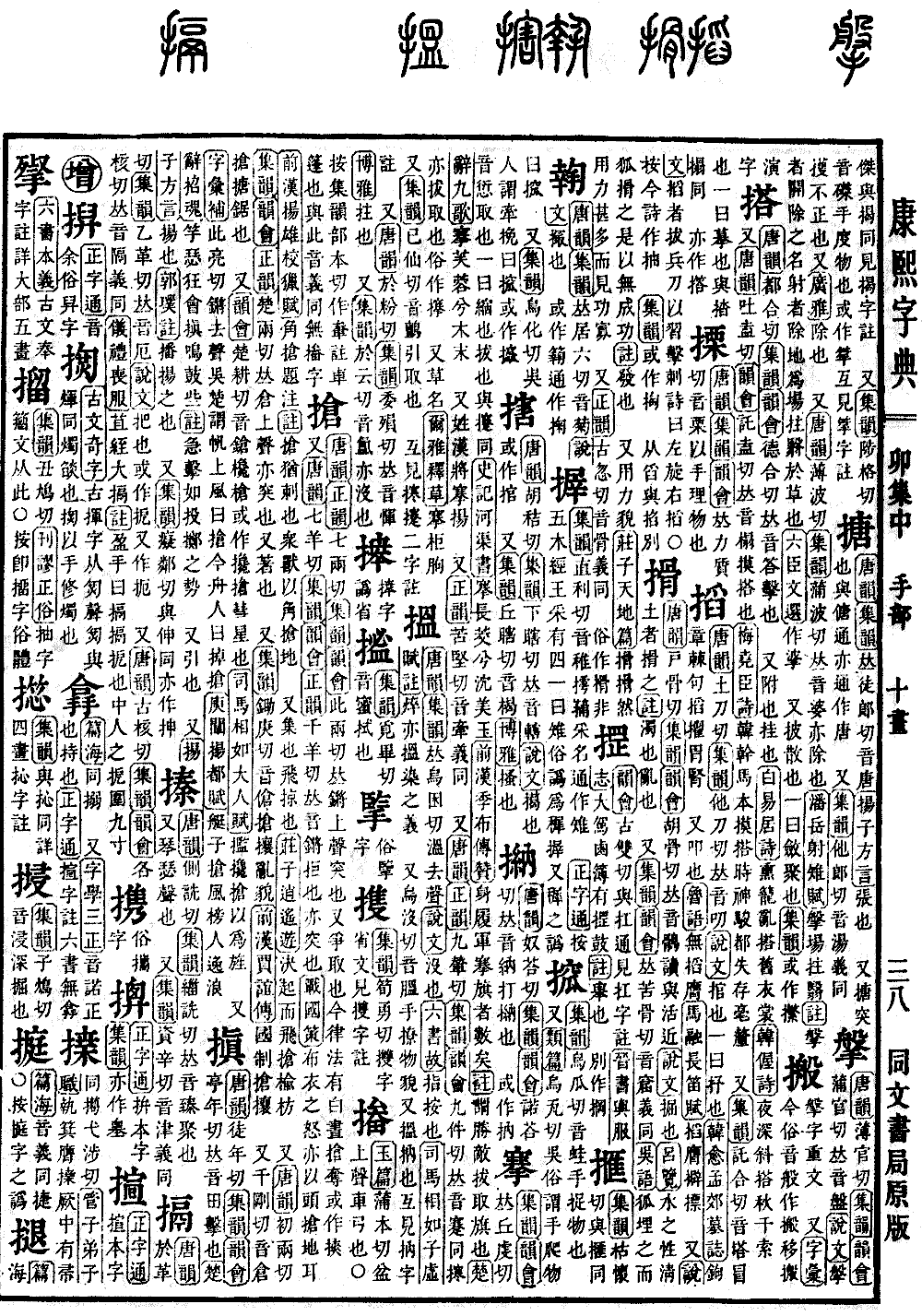
Mao Collection, Middle Volume
Radical: Hand (shǒu)
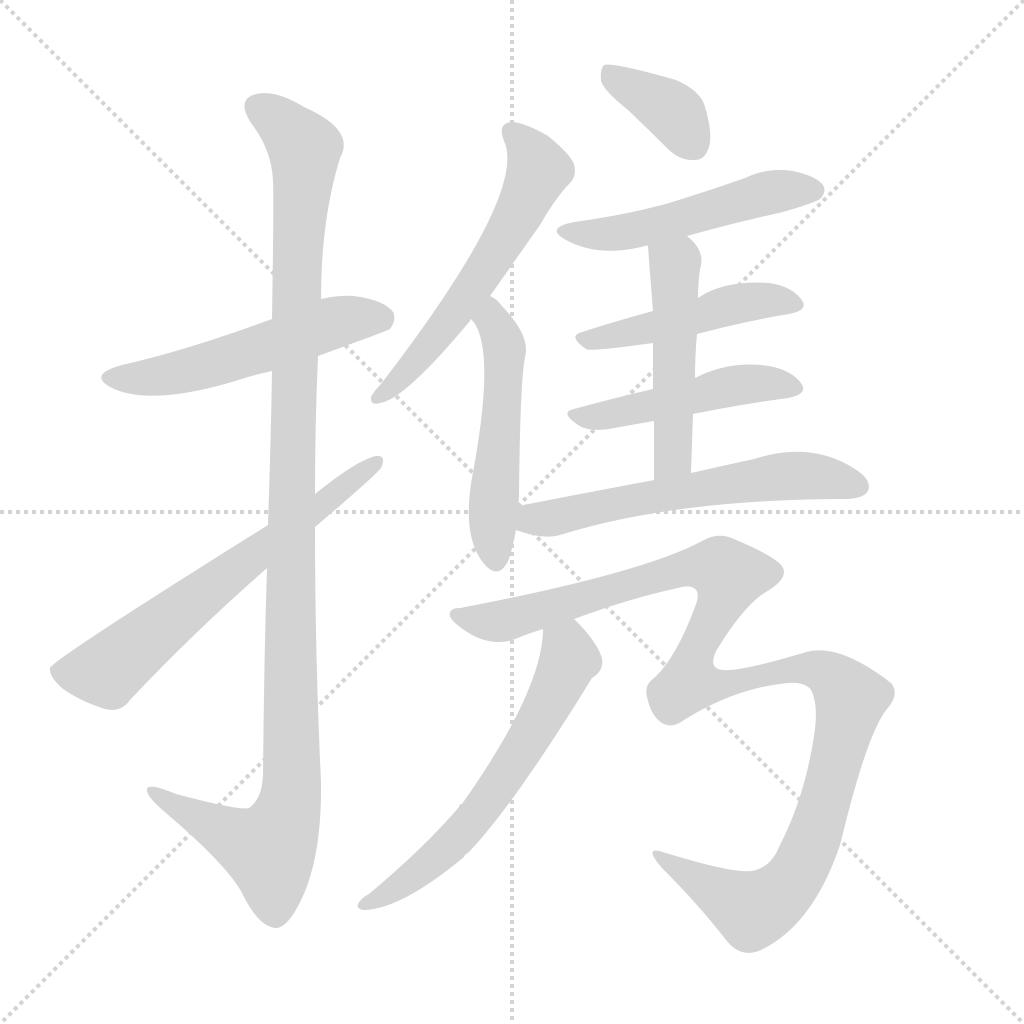
携
Kangxi strokes: 22
Page 448, Entry 26
This is the common variant form of the character for carry (xié). It is pronounced xié. According to the Analytical Dictionary of Chinese Characters (Shuowen Jiezi), it means to lift. According to the Six Categories of Writing Explained (Liushu Gu), it means to hold in a suspended manner. In the Book of Documents (Shujing), specifically the chapter Establishment of Government (Lizheng), it appears in the phrase "attendants and carried servants." The commentary explains this as those who are held or led by the attendant. In the Book of Odes (Shijing), specifically the Greater Odes (Daya), it is written "as if taking, as if carrying." The sub-commentary explains this as lifting or taking items from the ground by hand. In the Book of Rites (Liji), specifically the chapter Summary of the Rules of Propriety (Quli), it says "if a senior gives a hand to be led, then use both hands to support the senior's hand." The commentary explains "leading by the hand" as walking together while holding hands. It also carries the meaning of to separate. In the Zuo Tradition (Zuo Zhuan), seventh year of Duke Xi, it says "summon those who have separated with propriety." In the Discourses of the States (Guoyu), it says "the measures and standards do not fall apart." It also carries the meaning of to connect. In the History of the Former Han Dynasty (Qian Hanshu), Treatises on Astronomy, it says "the handle of the dipper connects to the dragon's horn." The commentary explains "handle" as the handle of the ladle. It is also a surname, as seen in the Surnames Garden (Xingyuan). Sometimes it is simplified as an abbreviated form. The common variant forms such as xié or xié are considered incorrect.