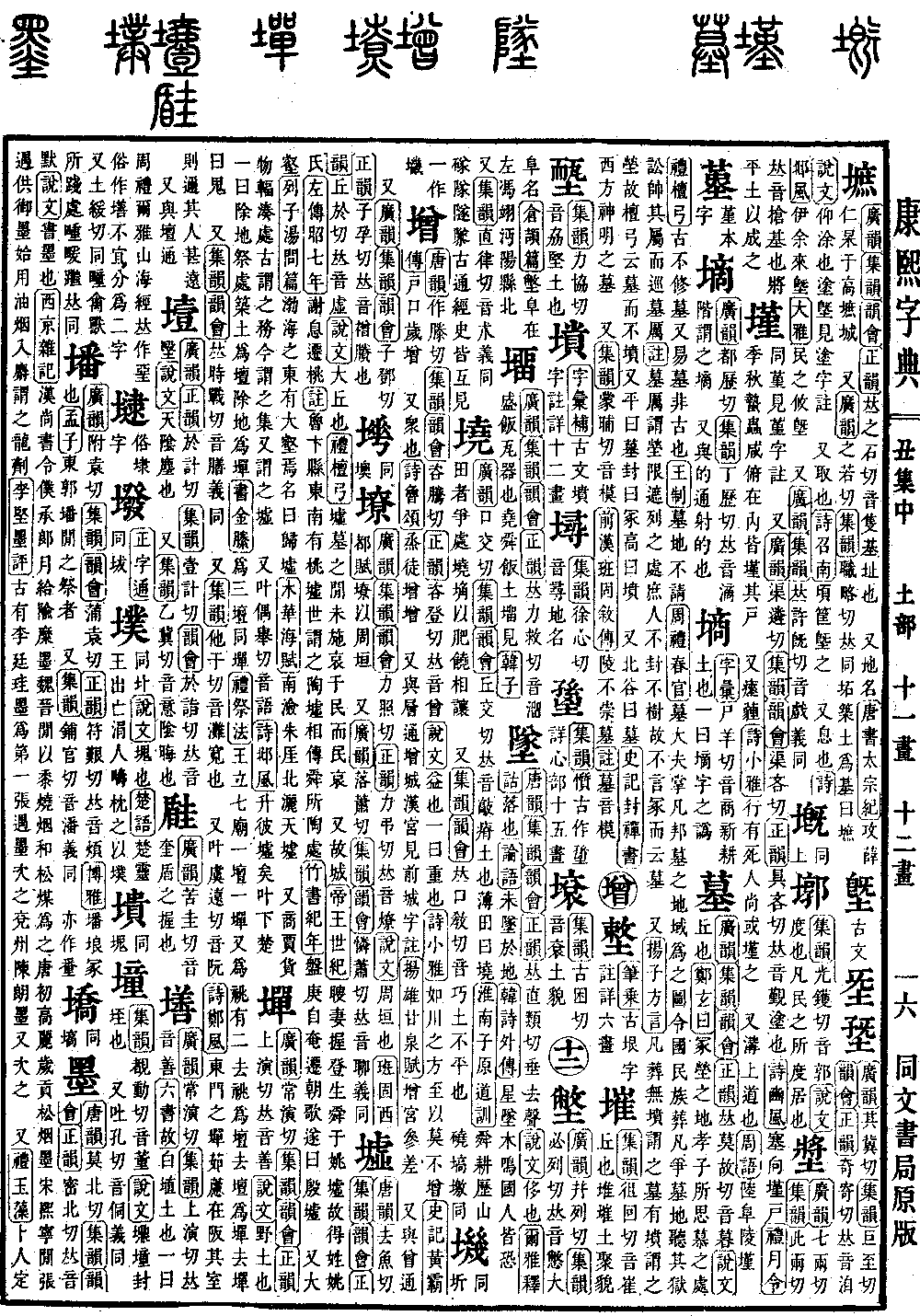
Chou Collection, Middle Volume
Radical: Earth (tǔ)
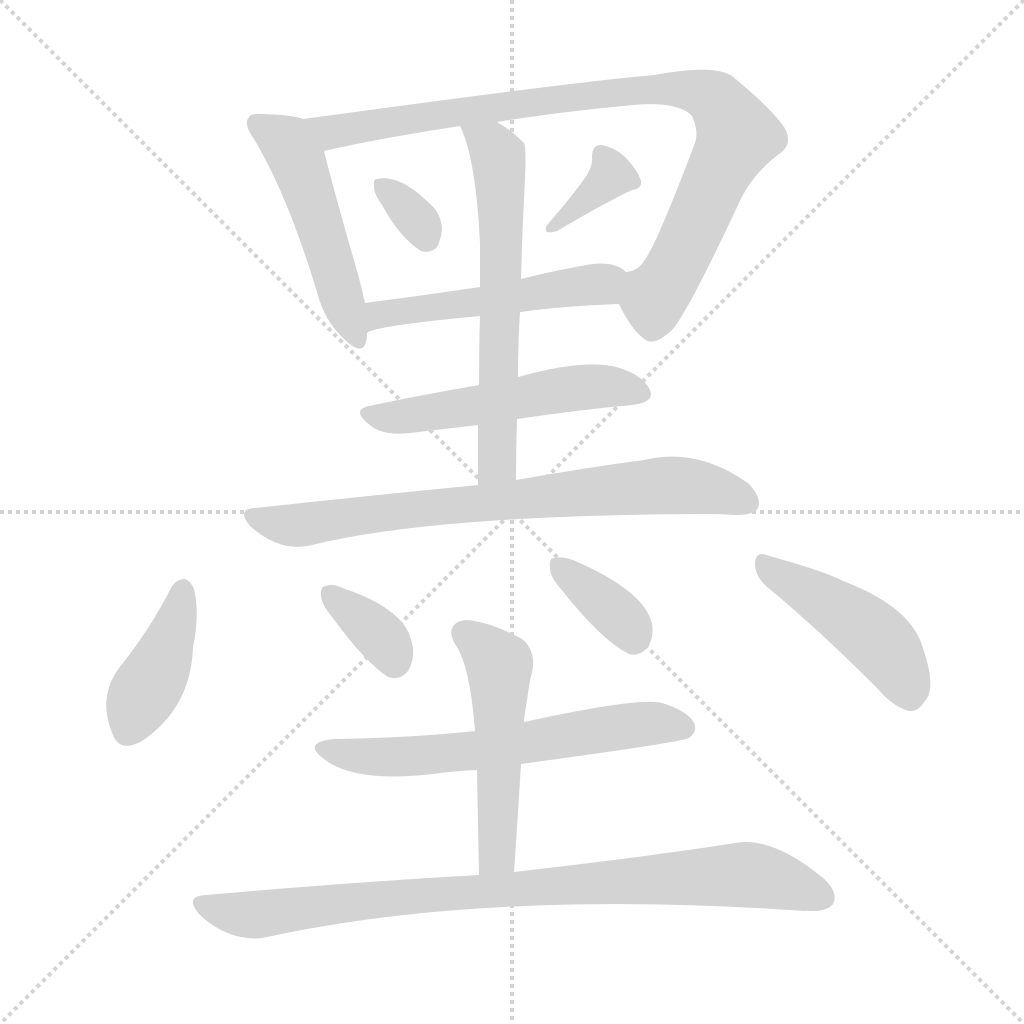
Ink (mò)
Kangxi Strokes: 15
Page 238, Entry 40
Pronounced mò. According to the Shuowen Jiezi, ink used for writing.
Records of the Western Capital (Xijing Zaji): During the Han dynasty, the Imperial Secretariat and court officials were issued Yumi ink monthly. During the Wei and Jin dynasties, soot from burning millet was mixed with pine soot ash to produce ink. In the early Tang dynasty, the state of Goryeo presented pine soot ink as tribute annually. During the Xining era of the Song dynasty, Zhang Yu presented ink for imperial use, which began incorporating lampblack and musk, known as dragon agent.
Li Jian's Ink Commentary (Li Jian Mo Ping): In antiquity, Li Tinggui’s ink was considered the best, followed by Zhang Yu’s ink, then the ink from Yanzhou.
Also, in the Book of Rites (Liji): A diviner selects the tortoise shell, and the scribe determines the ink markings. Commentary: All divinations must use ink to mark the shell, which is then drilled and scorched to observe the cracks to determine good or bad fortune.
Also, a unit of length. In the Small Erya (Xiao Erya): Five feet equal one mo, two mo equal one zhang. In the Discourses of the States (Zhouyu): Not exceeding one zhang to one zhang and six feet.
Also, one of the five ancient punishments, involving tattooing characters on the forehead and filling them with ink. In the Book of Documents (Shujing): If subordinates do not correct the faults of their sovereign.
Also, a sorrowful complexion. In the Mencius: When drinking congee, the face appears dark.
Also, a murky or gloomy complexion. In the Zuo Tradition (Zuo Zhuan): Duke Ding of Jin and King Fuchai of Wu formed an alliance at Huangchi. Sima Yin said: Those who occupy high positions should not have a murky complexion.
Also, murky and unclear. In the New Preface (Xinxu) by Liu Xiang: Shi Kuang replied to Duke Ping of Jin, saying: The state has become murky. There has never been a state that became murky and did not perish.
Also, ink ash. In the Records of the Western Capital: When Emperor Wu of Han excavated the Kunming Pond, all that was dug up was grey-black soil, with no solid earth. People of the Western Regions said: When a great kalpa (aeon) is about to end, kalpa fires will burn. The grey-black soil is the residue of the kalpa fire.
Also, interchangeable with silent (mò). In the Records of the Grand Historian (Shiji): King Wu flourished because his ministers were direct and dared to remonstrate, while King Zhou perished because of his silence and stupidity. In the History of the Former Han (Qianhan Shu): Dou Ying was silent and frustrated.
Also, the Grand Historian’s assessment of the six schools of thought: The Mohist school is frugal and difficult to follow, but their advocacy of strengthening the foundation and economizing on expenses cannot be discarded. The six schools are: Yin-Yang, Confucian, Mohist, Logicians, Legalist, and Daoist.
Also, a place name. Jimo, a location in the old state of Qi. In the Records of the Grand Historian: When Le Yi conquered seventy cities of Qi, only Jimo remained unconquered. The current Jimo is the Buqi county of the Han dynasty.
Also, Mo Mountain, located northeast of Jimo, where the Mo River originates. In the History of the Former Han: The Emperor followed the advice of fangshi (esoteric practitioners) to perform sacrifices at Mount Taishi in Jimo; this refers to that mountain. Another location is northwest of Weihui County. In the Records of the Nine Provinces (Jiuzhou Yaoji): Mozi lived on Mo Mountain, gathered and consumed poria, and lived for five hundred years without dying.
Also, Gumo, the name of a state. It bordered Yutian to the south. Additionally, there was a Fumo City in the Kangju state. See the History of the Former Han.
Also, a surname. Mo Ru, the teacher of the Great Yu. See Wang Fu’s Discourses of a Recluse (Qianfu Lun). In the Zhou dynasty, there was Mo Di; in the Ming dynasty, there was Mo Lin. In the Surname Compilation (Xingzhuan): The Mo clan is the same as the Motai clan, descendants of the Lord of Guzhu.
Also, an object found in the belly of an old horse called mo, similar to a gallstone found in a dog. See the Compendium of Materia Medica (Bencao Gangmu).
Also, pronounced méi. Mo chi, describes a silent and deceptive appearance. Also describes a weak appearance.
Also, pronounced mèi. In the system of posthumous titles, one who ruins his office through greed and ruins his virtues through slander is called mo.