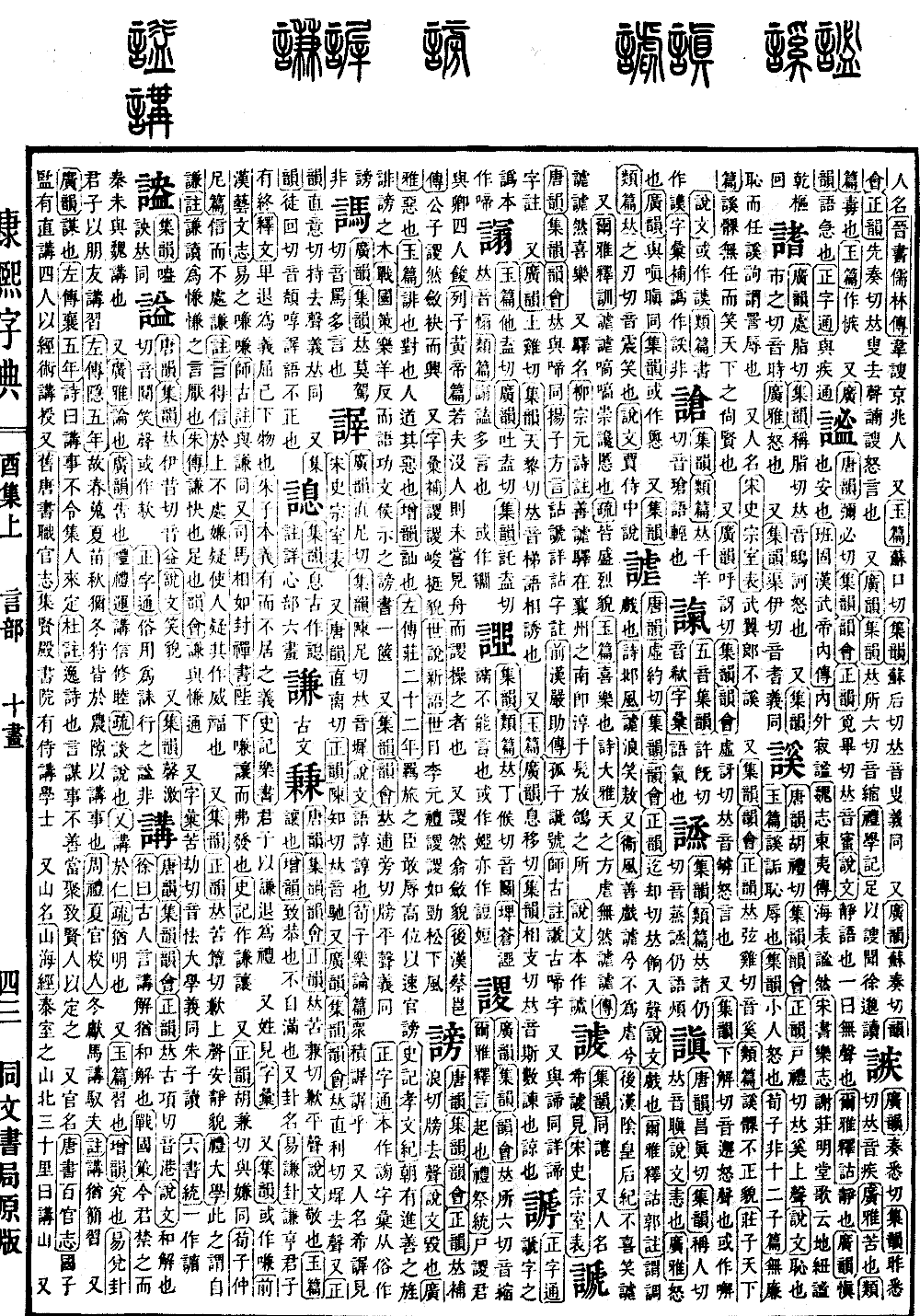
You Collection, Upper Volume
Radical: Speech (yán)
17 strokes
Page 1175, Entry 16
Tang Rhyme (Tangyun), Collection Rhyme (Jiyun), Rhyme Assembly (Yunhui), and Correct Rhymes (Zhengyun) define this as pronounced bang (falling tone).
Shuowen Jiezi says this means to destroy.
Guangya says this means to be evil.
Yupian says this means to slander or to confront. It is when people speak of someone else's evil.
Zengyun says this means to ridicule.
Zuo Tradition (Zuozhuan), Year 22 of Duke Zhuang: A guest official, how dare I hold such a high position and thereby invite public criticism of the government.
Records of the Grand Historian (Shiji), Annals of Emperor Wen: At court, there were markers for those presenting virtuous advice and wooden pillars for those submitting criticisms.
Strategies of the Warring States (Zhanguo Ce): When Yue Yang returned and spoke of his merits, Marquis Wen showed him a whole chest of books containing criticisms of him.
Also, according to Collection Rhyme (Jiyun) and Rhyme Assembly (Yunhui), it is pronounced bang (level tone), with the same meaning.
Correction of Characters (Zhengzitong) states that the original form was written differently. The Dictionary of Characters (Zihui) follows common usage in writing it as this character, which is incorrect.