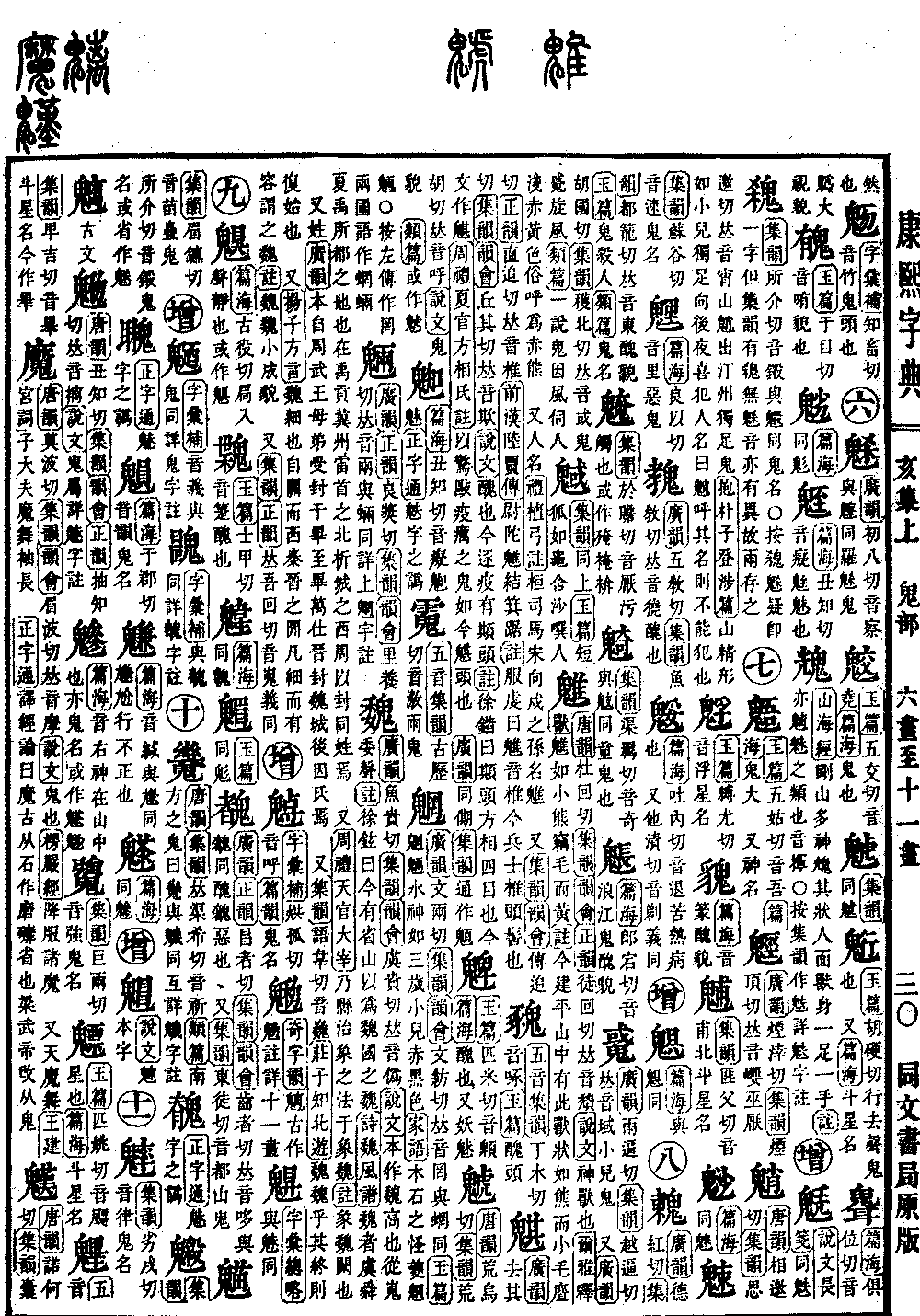
Hai Collection, Upper Volume
Radical: Ghost (guǐ)
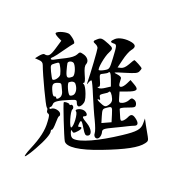
Character: Tui
Kangxi Stroke Count: 18
Page 1462, Entry 31
Tang Rhyme (Tangyun) states: Pronounced tui.
Collection Rhyme (Jiyun), Rhyme Compilation (Yunhui), and Orthodox Rhymes (Zhengyun) state: Pronounced tui, reading is the same as tui.
Explanation of Characters (Shuowen) states: A type of mythical beast.
Approaching Elegance (Erya), Explanation of Beasts section, records: The tui resembles a small bear, with light yellow fur.
Commentary states: Nowadays, these beasts are found in the Jianping mountains; they are shaped like bears but are smaller in size, with coarse fur that is a light reddish-yellow color, commonly known as the red bear.
Also used as a personal name.
Commentary on the Book of Rites (Liji), Tan Gong section, states: The grandson of the Huan Sima of Song, Xiang Shu, was named Tui.
Also, Collection Rhyme (Jiyun) and Rhyme Compilation (Yunhui) state: Pronounced zhui; Orthodox Rhymes (Zhengyun) states: Pronounced zhui, reading is the same as zhui.
Former Han History (Qianhan Shu), Biography of Lu Jia, states: Zhao Tuo wore a topknot and sat with legs splayed.
Commentary states: Fu Qian says: Tui is pronounced the same as zhui, referring to the cone-shaped hairstyle worn by soldiers at that time.