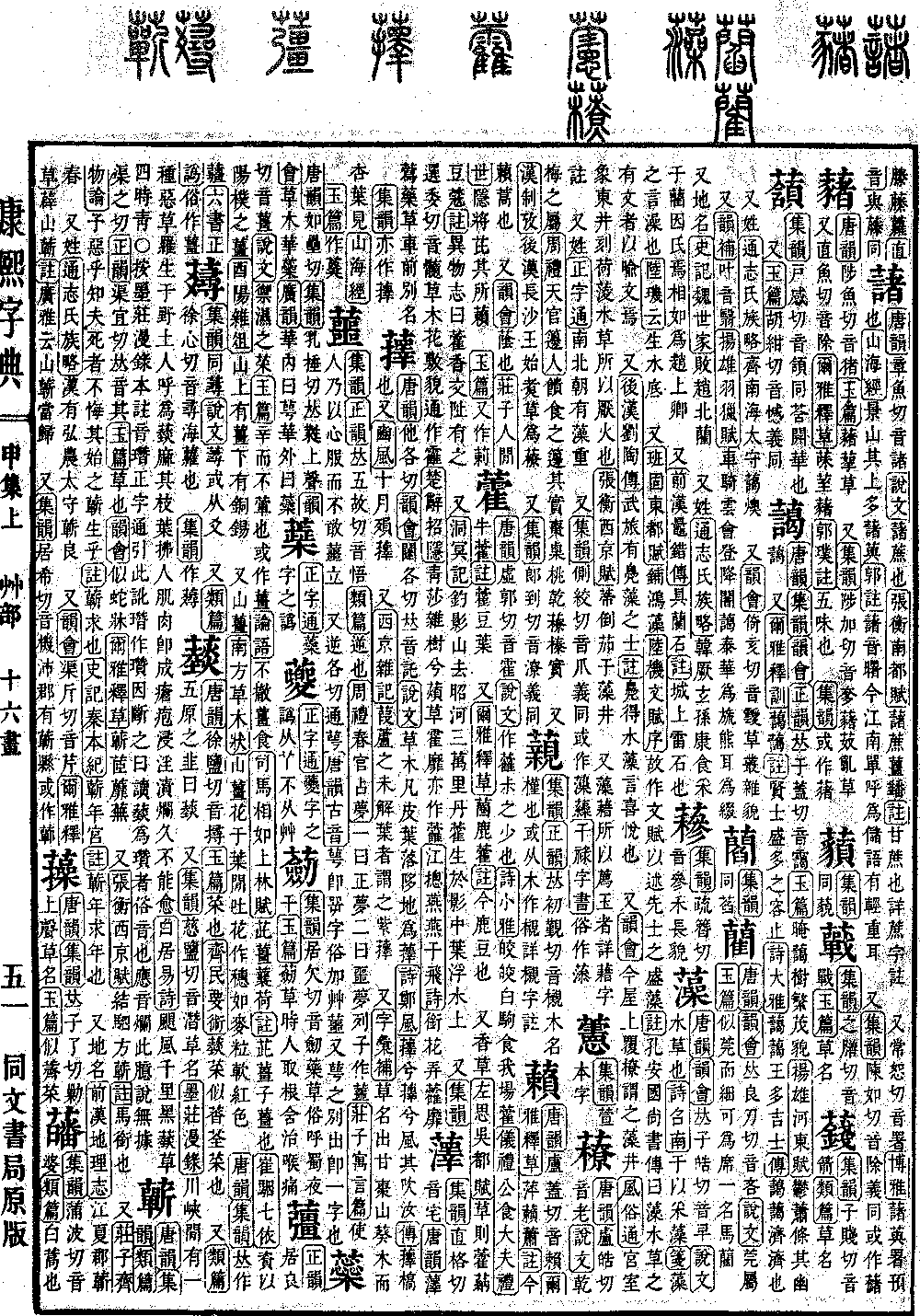
Shen Collection, Upper Volume
Radical: Grass (cǎo)
Kangxi Strokes: 22
Page 1067, Entry 16
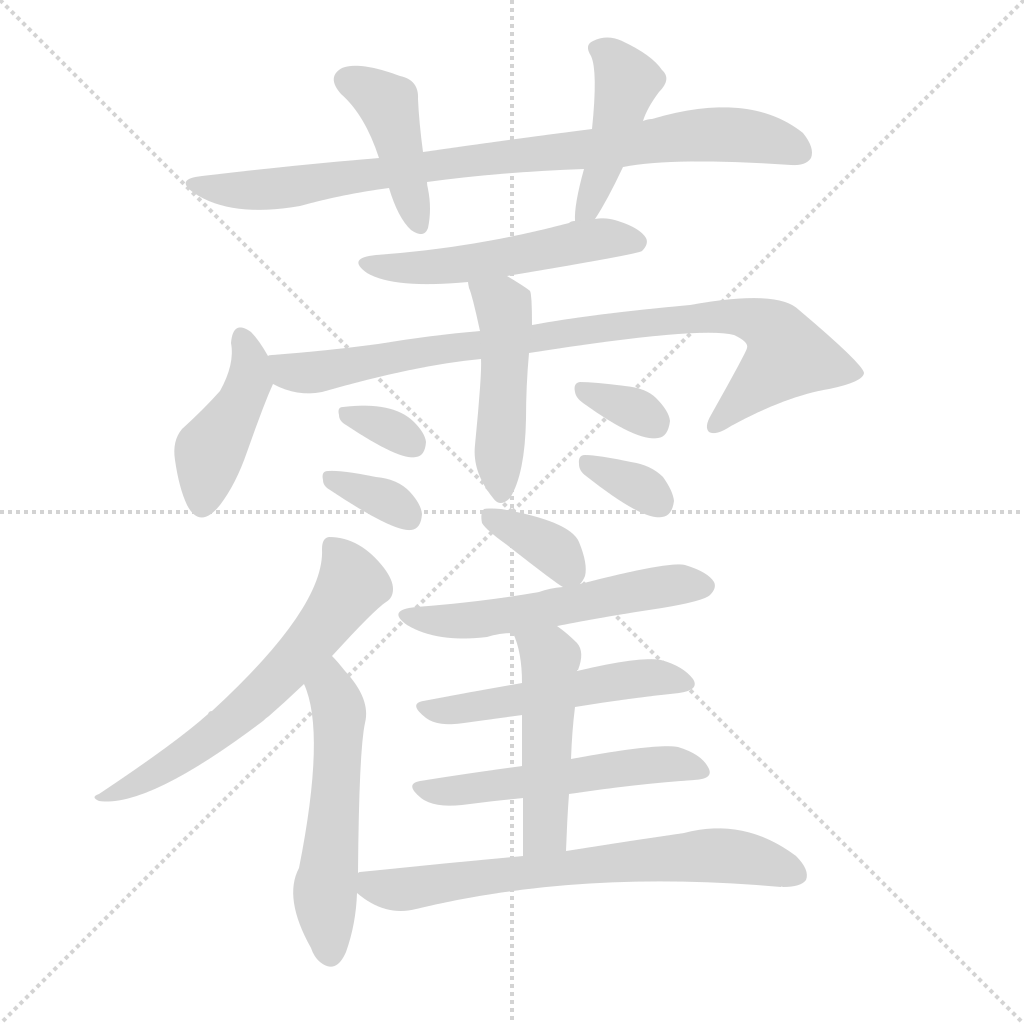
Pronounced huo.
According to the Shuo Wen Jiezi (Shuo wen), it is written in a variant form and refers to the tender leaves of the bean plant.
In the Book of Odes (Shijing), it is written: White, white is the white colt, feeding on the bean leaves in my courtyard.
In the Book of Etiquette and Ceremonial (Yili), it is mentioned as cow bean leaves. The commentary states: Bean leaves.
According to the Erya (Er ya), the term lu huo refers to what is now known as the deer bean.
It also refers to a fragrant herb. In the Rhapsody on the Capital of Wu (Wu du fu), it is written: The plants include the fragrant herb and cardamom. The commentary states: Records of Strange Things (Yi wu zhi) says: Fragrant herb (huoxiang) is produced in the Jiaozhi region.
According to the Records of the Penetrating Mystery (Dong ming ji), at Diaoying Mountain, thirty thousand li from the Zhao River, grows the vermilion fragrant herb, which flourishes amidst light and shadow, with leaves floating upon the water.
Pronounced sui. Describes the appearance of plants and flowers in full bloom. Commonly written in the variant form (huo).
In the Songs of Chu (Chu ci), it is written: Green sedge and mixed trees, the fragrant grass bows and bends. Also written in a variant form.
In the poem燕燕于飞 by Jiang Zong, it is written: Carrying flowers and swaying gracefully.