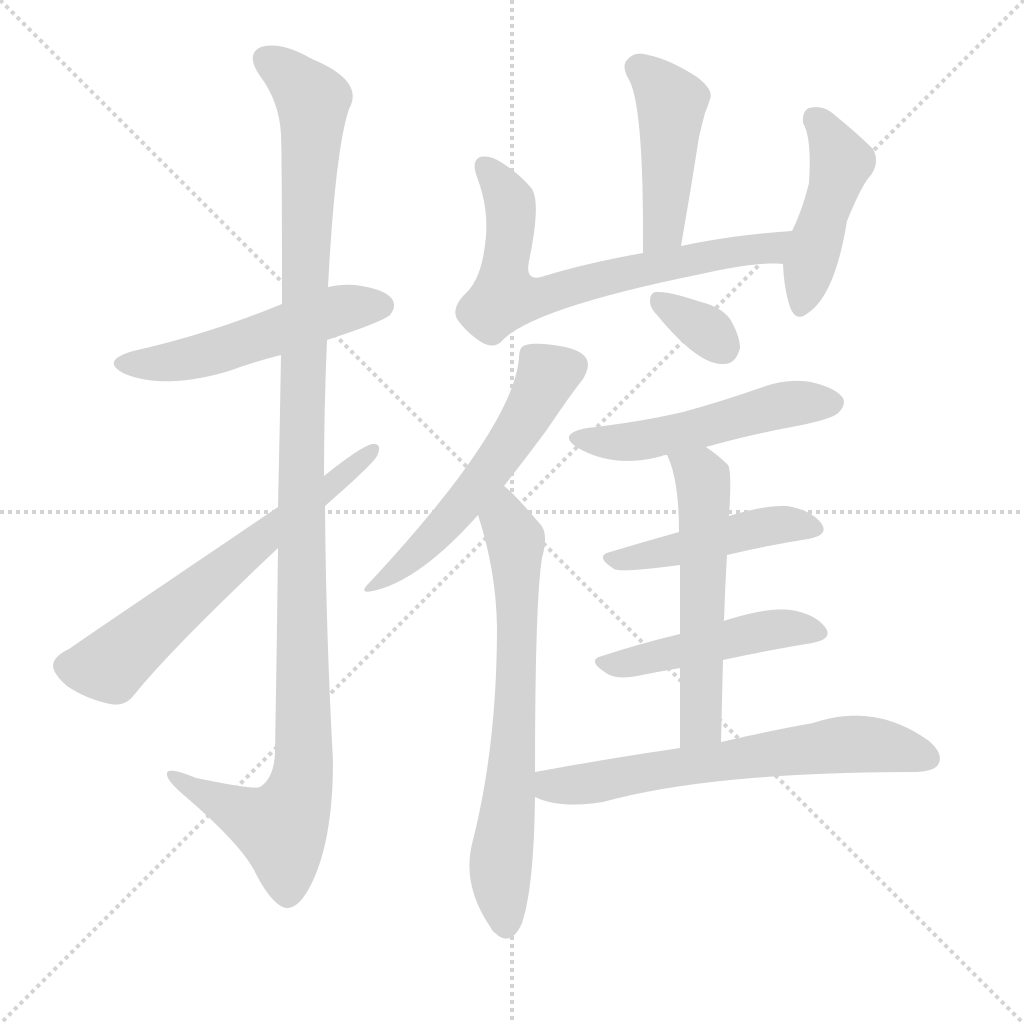
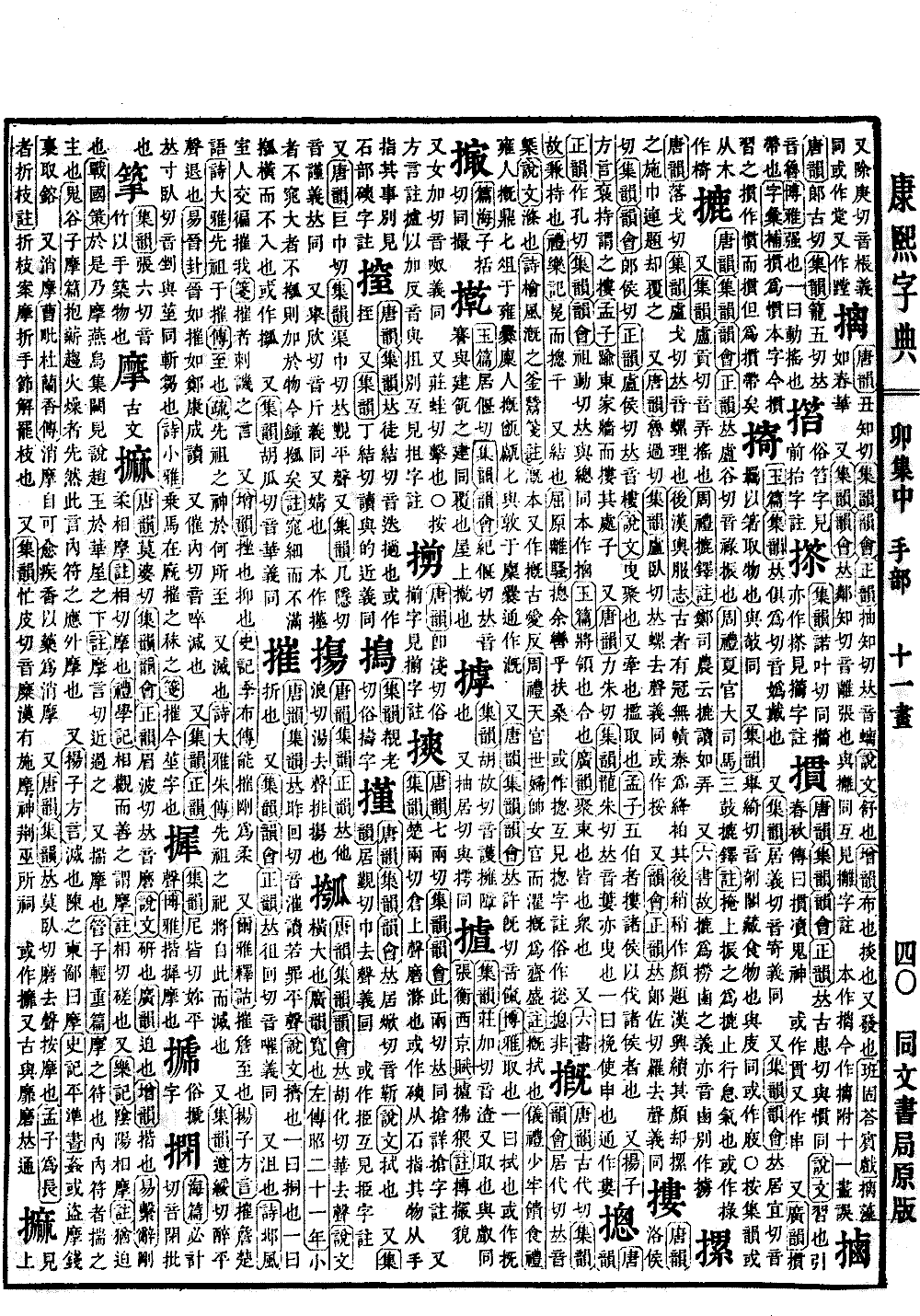
Mao Collection, Middle Volume
Radical: Hand (shǒu)
Kangxi stroke count: 15
Page 450, Entry 23
Pronounced cui. Read as zui (level tone).
Shuowen Jiezi (Dictionary of Character Etymology): To squeeze. Also defined as to stir. Also defined as to break.
Also defined as to frustrate.
Book of Odes (Shijing), Odes of Bei: The members of the household all together berate me. Mao Commentary: To berate is a word for censure and mockery.
Zengyun (Additional Rhymes): To defeat, to suppress.
Records of the Grand Historian (Shiji), Biography of Ji Bu: Able to temper the hard into the soft.
Erya (Approximation of Terms): To reach.
Yang Xiong, Fangyan (Regional Dialects): To reach; this is the language of Chu.
Book of Odes (Shijing), Greater Odes: The ancestral spirits have arrived. Commentary: To arrive. Sub-commentary: Where have the ancestral spirits arrived?
Also, to extinguish. Book of Odes (Shijing), Greater Odes, Commentary by Zhu Xi: The ancestral sacrifices will from this point be extinguished.
Pronounced zui (level tone). To retreat. Book of Changes (Yijing), Hexagram Jin: Advancing like retreating. Zheng Kangcheng reading.
Pronounced cui. To diminish.
Pronounced cuo. Equivalent to the character cuo. To chop straw for fodder. Book of Odes (Shijing), Lesser Odes: The team of horses is in the stable, chop their fodder and feed them. Commentary: The character used here is the modern version of the character for chopping fodder.