Wu Collection, Middle Volume
Radical: Eye (mù)
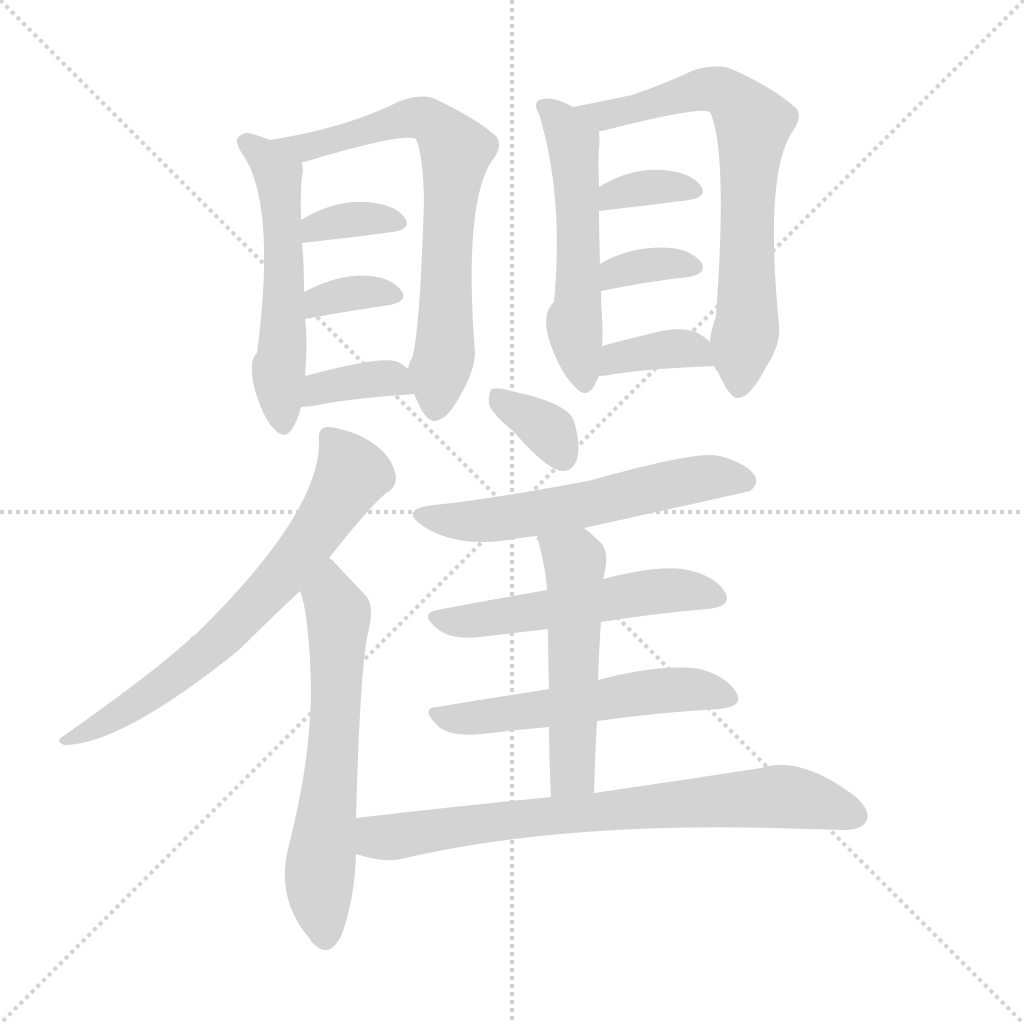
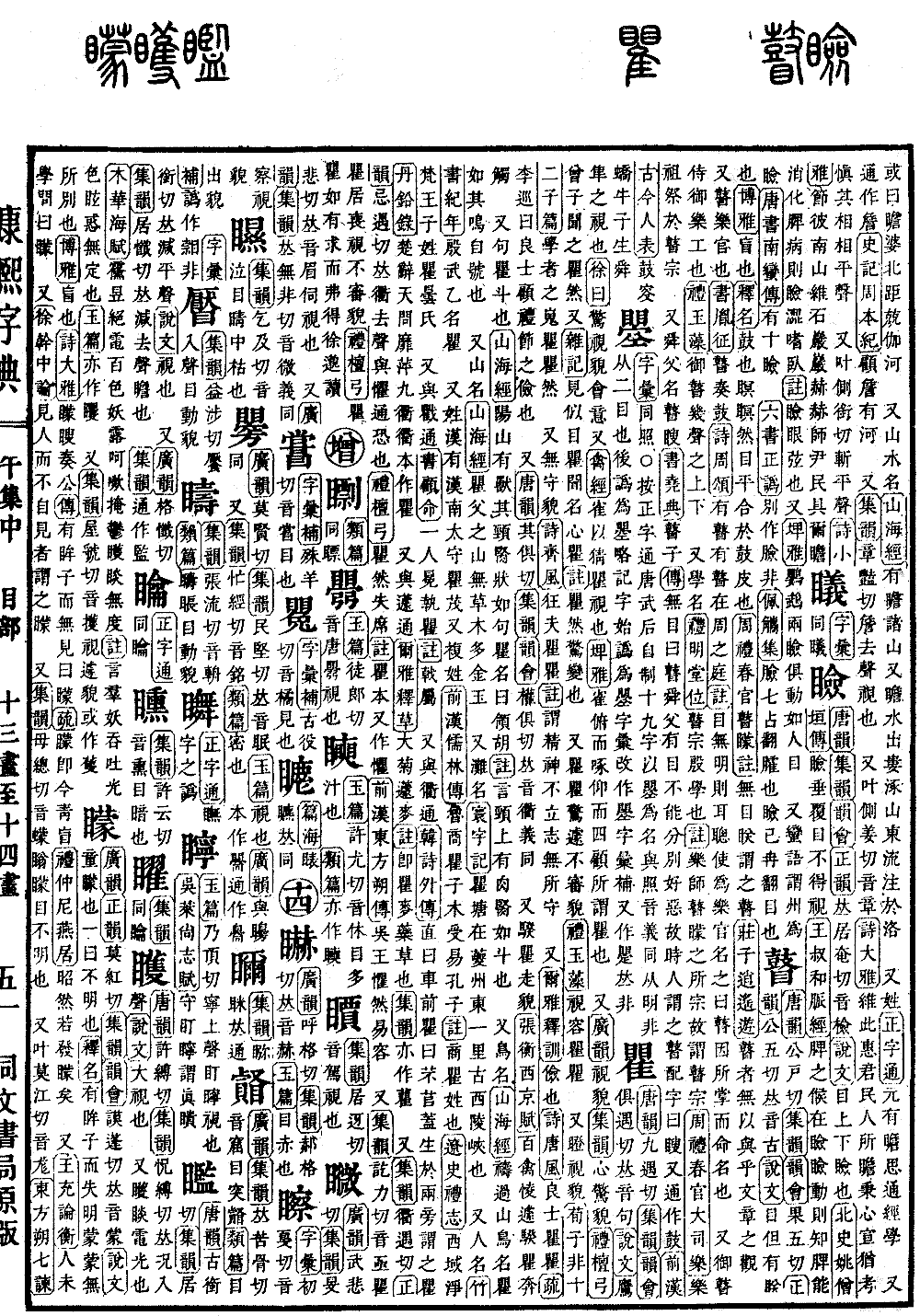
瞿
Kangxi strokes: 18
Page 819, Entry 05
Tang Rhymes (Tangyun): Pronounced ju
Collected Rhymes (Jiyun), Rhyme Compendium (Yunhui): Pronounced ju. Meaning: ju.
Shuowen Jiezi: The gaze of a hawk or falcon.
Xu states: A startled appearance, a compound ideograph.
Also, Bird Classic (Qin Jing): The sparrow looks around with suspicion.
Piya: When a sparrow bows to peck, it looks up and glances all around; this is what is called ju.
Also, Guangyun: A look.
Jiyun: A startled heart.
Book of Rites (Liji): Zengzi heard this and was startled (ju-ran).
Also, Miscellaneous Records (Zaji): Seeing his face, he appeared startled (ju); hearing his name, his heart was startled (ju).
Commentary: Startled and changed in demeanor.
Also, ju-ju: A startled, hurried, and unclear appearance.
Book of Rites (Liji): The appearance of the gaze is startled (ju-ju).
Also, a staring appearance.
Xunzi, Chapter on Denouncing the Twelve Philosophers: The lofty scholars are staring blankly (ju-ju).
Also, a lack of steadfastness.
Book of Odes (Shijing): The mad man is unsettled (ju-ju).
Commentary: This means his spirit is not established, and his will has nowhere to settle.
Also, Erya: Parsimonious.
Book of Odes (Shijing): The good man is cautious (ju-ju).
Commentary: Li Xun states: The good man is cautious regarding ritual and propriety.
Also, Tang Rhymes (Tangyun): Pronounced qu.
Jiyun, Rhyme Compendium (Yunhui): Pronounced qu. Meaning is the same.
Also, kui-ju: The appearance of running.
Zhang Heng, Western Capital Rhapsody (Xijing Fu): The hundred birds were startled, running swiftly (kui-ju) and colliding.
Also, gou-ju: A struggle.
Classic of Mountains and Seas (Shanhai Jing): On Yang Mountain there is a beast whose neck is shaped like a gou-ju; it is called linghu.
Commentary: It means there is flesh on the neck shaped like a bucket.
Also, the name of a bird.
Classic of Mountains and Seas (Shanhai Jing): On Daoguo Mountain, there is a bird called ju, which is named after its cry.
Also, a mountain name.
Classic of Mountains and Seas (Shanhai Jing): Jufu Mountain has no grass or trees, but is rich in gold and jade.
Also, a rapid name.
Universal Record (Huanyu Ji): Qutang is one mile east of the prefecture; it is the ancient Xiling Gorge.
Also, a personal name.
Bamboo Annals (Zhushu Jinian): Emperor Wu Yi of the Shang dynasty was named Ju.
Also, a surname. In the Han dynasty, there was a Han-nan governor named Ju Mao.
Also, a double-character surname.
History of the Former Han Dynasty (Qianhan Shu), Biographies of Confucian Scholars: Shang Ju, styled Zimu, of Lu received the Book of Changes (Yijing) from Confucius.
Commentary: Shang Ju is a surname.
History of Liao (Liaoshi), Treatise on Rituals: The Prince of the Pure Brahma from the Western Regions had the surname Gautama (Qutan).
Also, used interchangeably with qi (a type of halberd).
Book of Documents (Shujing), Testamentary Charge (Guming): One person wearing a crown held a halberd (ju).
Commentary: A type of halberd.
Also, used interchangeably with qu (a thoroughfare).
Han Shi Wai Zhuan: Straight is called carriage-front; qu (the plant name) is called plantain (fuyi), because it grows on both sides, it is called qu.
Danqian Lu: In the Chuci, Heavens Questions (Tianwen), there is mention of nine thoroughfares (jiu qu). Qu was originally written as ju.
Also, used interchangeably with qu (in qu-mai).
Erya: Great chrysanthemum is qu-mai.
Commentary: This is the medicinal herb Dianthus chinensis (qu-mai).
Jiyun: Also written as the same character.
Also, Jiyun: Pronounced ju (falling tone).
Zheng Yun: Pronounced ju (falling tone).
Used interchangeably with ju (to fear). Fear.
Book of Rites (Liji): He started (ju-ran) and left his seat.
Commentary: Ju was originally also written as the character for fear.
History of the Former Han Dynasty (Qianhan Shu), Biography of Dongfang Shuo: The King of Wu looked fearful (ju-ran) and his expression changed.
Also, Jiyun: Pronounced ji.
Ju-ju: An appearance of not seeing clearly while in mourning.
Book of Rites (Liji): Gazing blankly (ju-ju) as if seeking something and failing to find it. Xu Miao reads it thus.