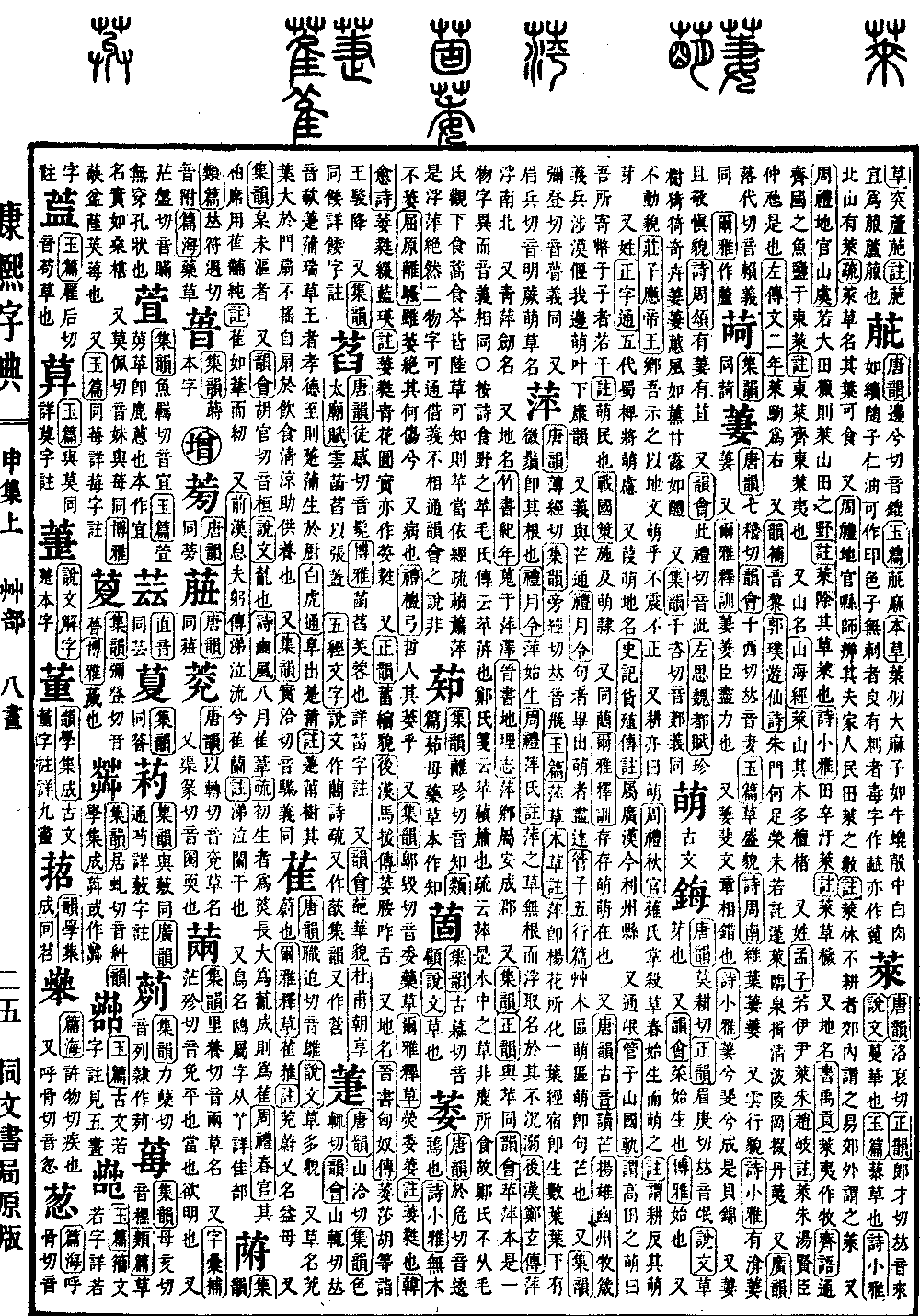
Shen Collection, Upper Volume
Radical: Grass (cǎo)
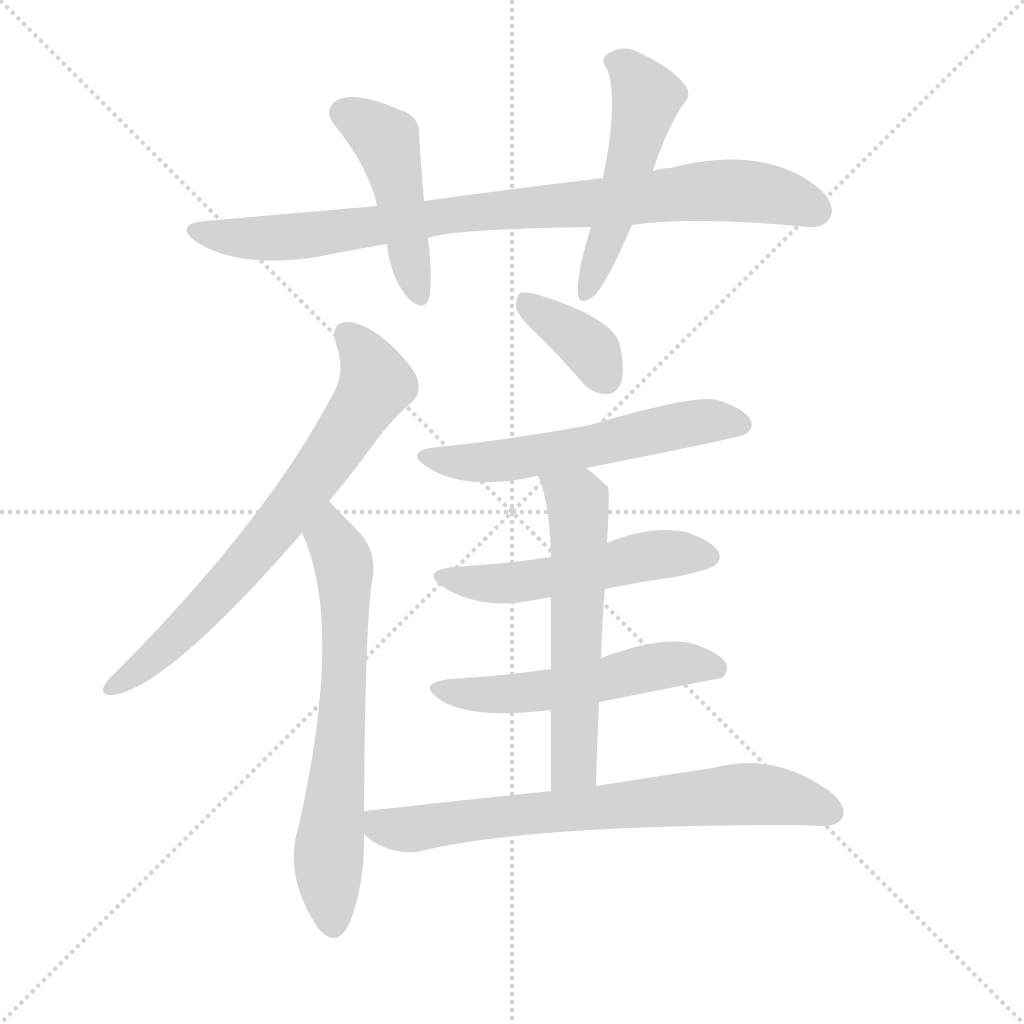
萑
Kangxi stroke count: 14
Page 1041, Entry 13
According to the Tang Dynasty Rhymes (Tangyun), the pronunciation is zhui (level tone), phonetically identical to zhui.
The Explanation of Script and Elucidation of Characters (Shuowen Jiezi) defines it as the appearance of lush, overgrown grass. It also refers to a type of plant, namely motherwort (chongwei).
In the Er Ya, Explanation of Plants (Er Ya Shicao), it is referred to as huantui. The commentary notes that motherwort is also called yimu (mother-benefiting herb).
According to the Collection of Rhymes (Jiyun), it refers to hemp that has not yet been retted.
According to the Compendium of Rhymes (Yunhui), the pronunciation is huan, phonetically identical to huan.
The Explanation of Script and Elucidation of Characters (Shuowen Jiezi) defines it as a type of reed (wan).
The Book of Odes (Shijing), Odes of Bin (Binfeng) mentions the eighth-month reed (huanwei). The commentary explains that when first growing it is called tan, when taller it is called wan, and when fully grown it is called huan.
The Rites of Zhou (Zhouli), Offices of Spring (Chunguan) records the use of reed mats with black-and-white patterned silk borders. The commentary notes that huan resembles a reed but is more flexible.
The Book of Han (Qianhanshu), Biography of Xifu Gong mentions tears flowing like huanlan. The commentary explains this as the appearance of tears streaming down the face.
It also refers to a type of bird in the owl family.
The character is formed with the Grass radical. See the entry under the Bird (zhui) radical for further details.