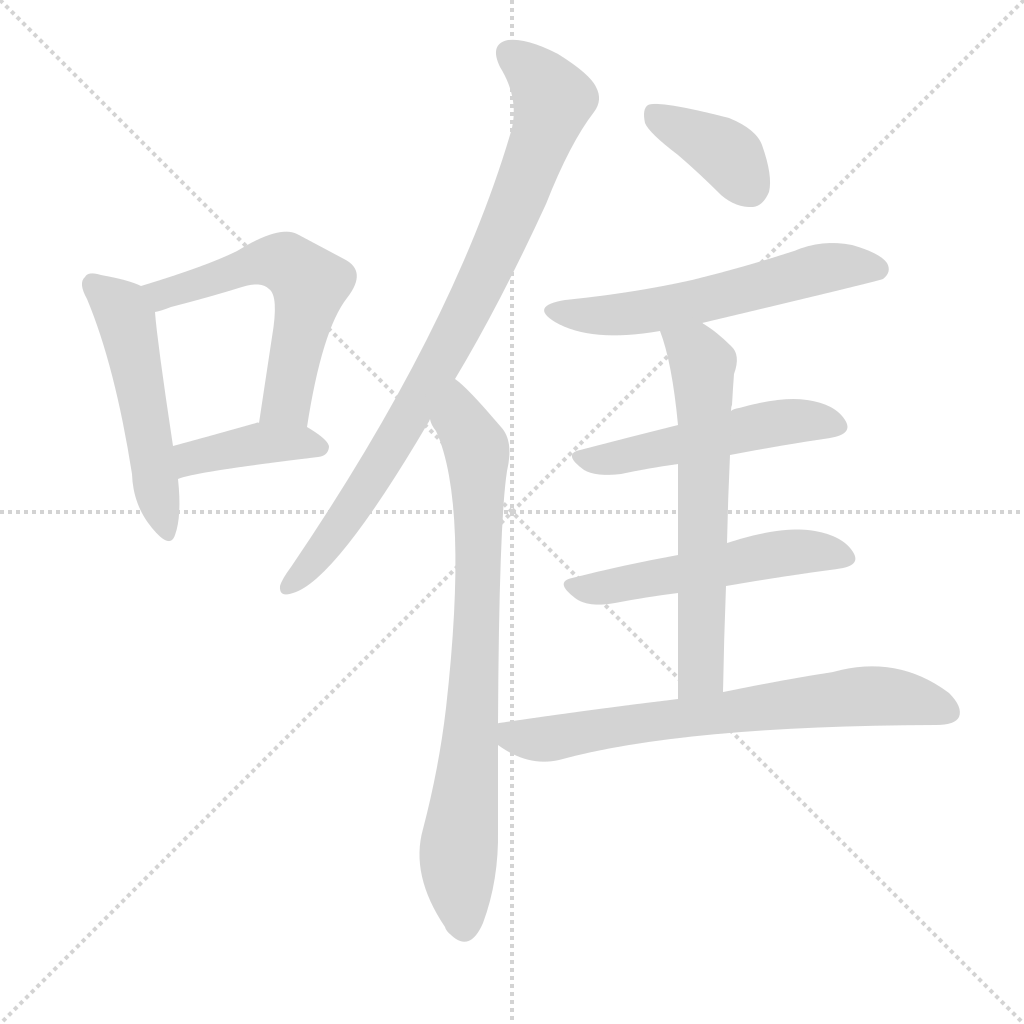
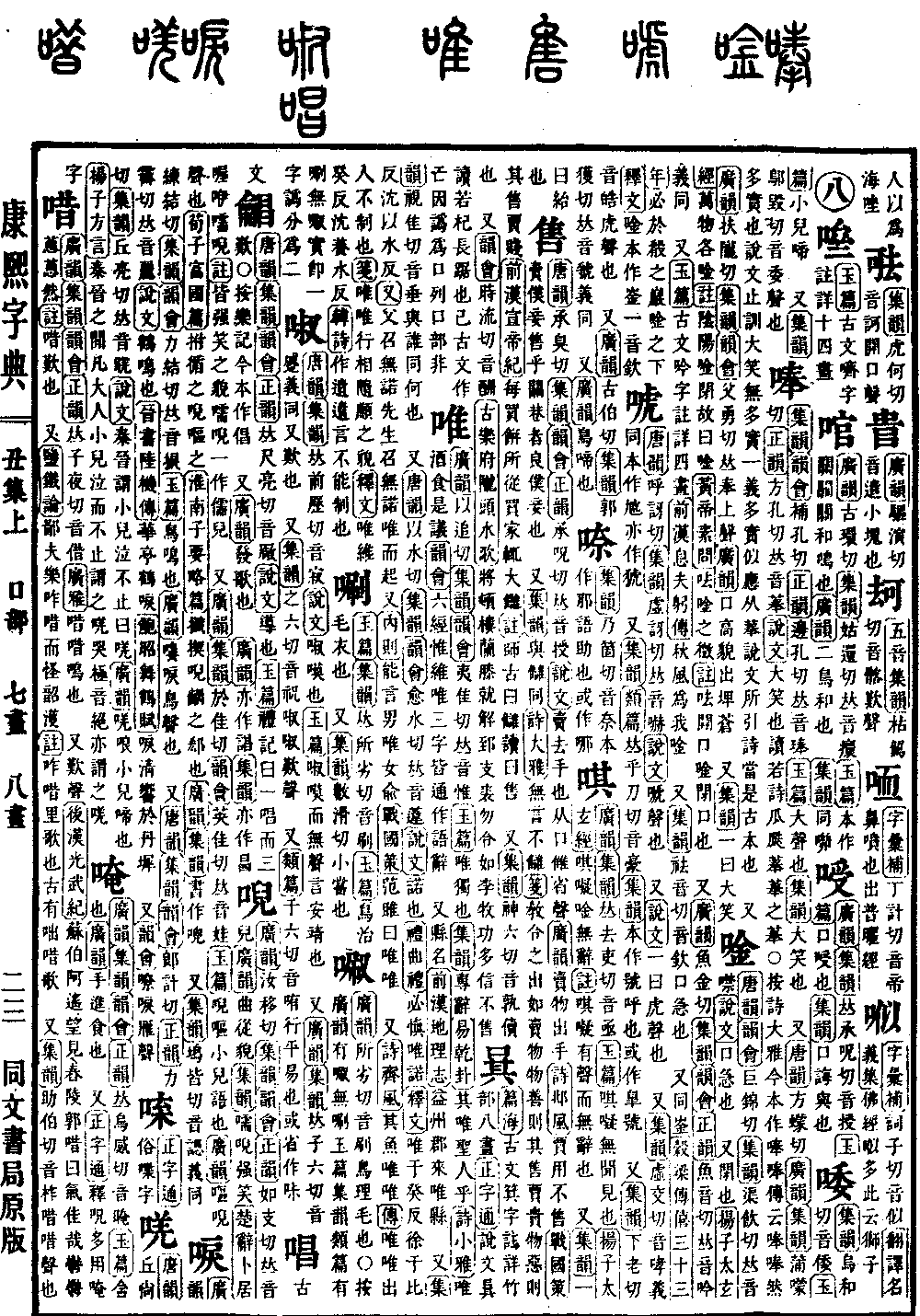
Chou Collection, Upper Volume
Radical: Mouth (kǒu)
Kangxi Strokes: 11
Page 193, Entry 17
Pronounced wei.
Jade Chapter (Yupian): Means singular, only.
Collected Rhymes (Jiyun): A word denoting single-mindedness.
Book of Changes (Yijing), Qian Hexagram: Perhaps it is only the sage.
Book of Odes (Shijing), Lesser Odes (Xiao Ya): Only considering the matters of food and wine.
Rhyme Anthology (Yunhui): In the Six Classics, the three characters meaning wei are all interchangeable and serve as modal particles.
Also the name of a county.
History of the Former Han Dynasty (Qian Han Shu), Treatise on Geography: There is Laiwei County in Yizhou Commandery.
Also pronounced chui. Same meaning as who. Represents the meaning of what.
Also pronounced sui.
Explanation of Simple and Compound Characters (Shuowen Jiezi): The sound of a response.
Book of Rites (Liji), Summary of the Rules of Propriety (Qu Li): One must respond with caution.
Classic of Explanations (Shiwen): Wei, read as yu gui. Xu Miao reads it as yu bi. Shen Chong reads it as yi shui.
Also: When a father calls, do not merely respond with nuo; when a teacher calls, do not merely respond with nuo; one must respond with wei and stand up.
Record of Internal Rules (Neize): When children learn to speak, boys respond with wei and girls respond with yu.
Strategies of the Warring States (Zhanguo Ce): Fan Sui repeatedly responded with wei wei.
Also: Book of Odes (Shijing), Odes of Qi (Qi Feng): Those fish swim freely.
Commentary (Zhuan): Wei wei, the appearance of moving in and out without restraint.
箋 (Jian): Wei wei, the appearance of following and conforming to one another.
Classic of Explanations (Shiwen): Wei, read as wei gui. Shen Chong reads it as yang shui.
Han Poetry (Han Shi): Written as yi yi, meaning unable to control.