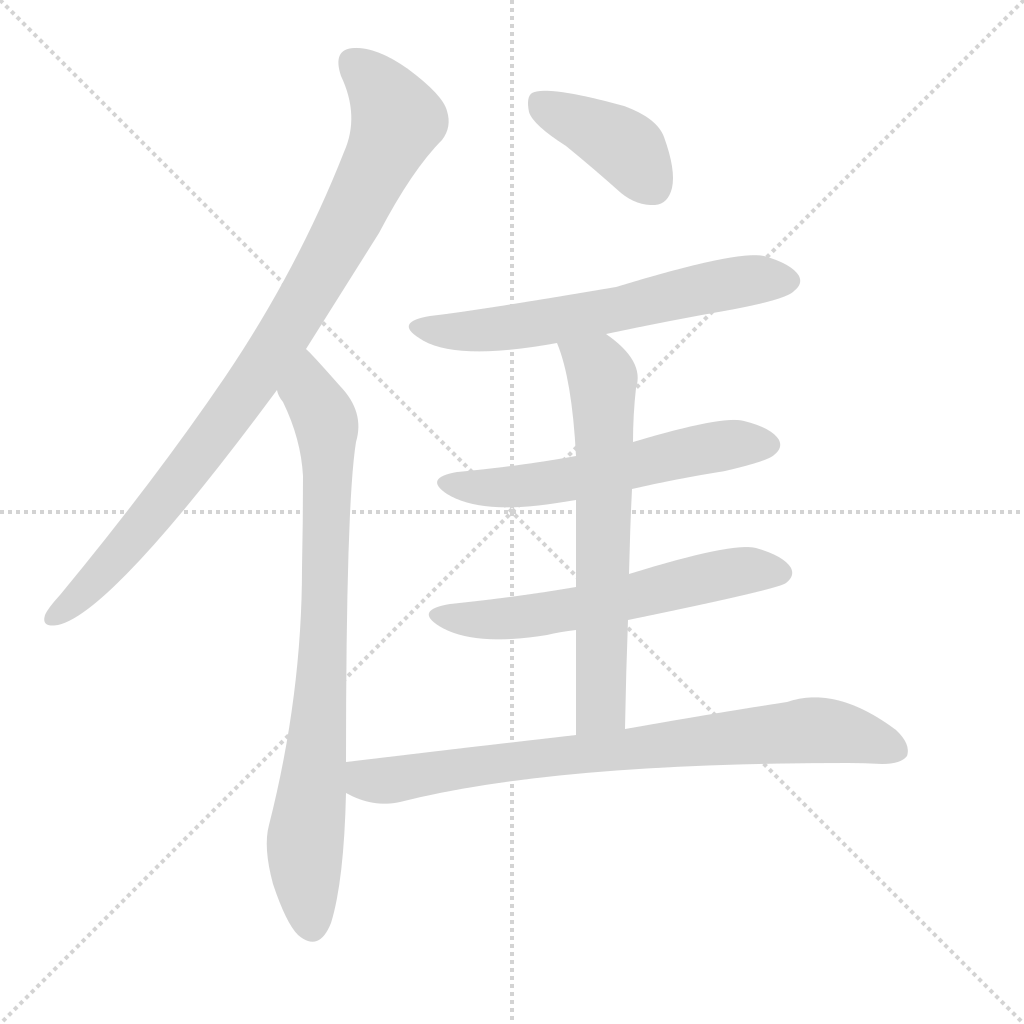
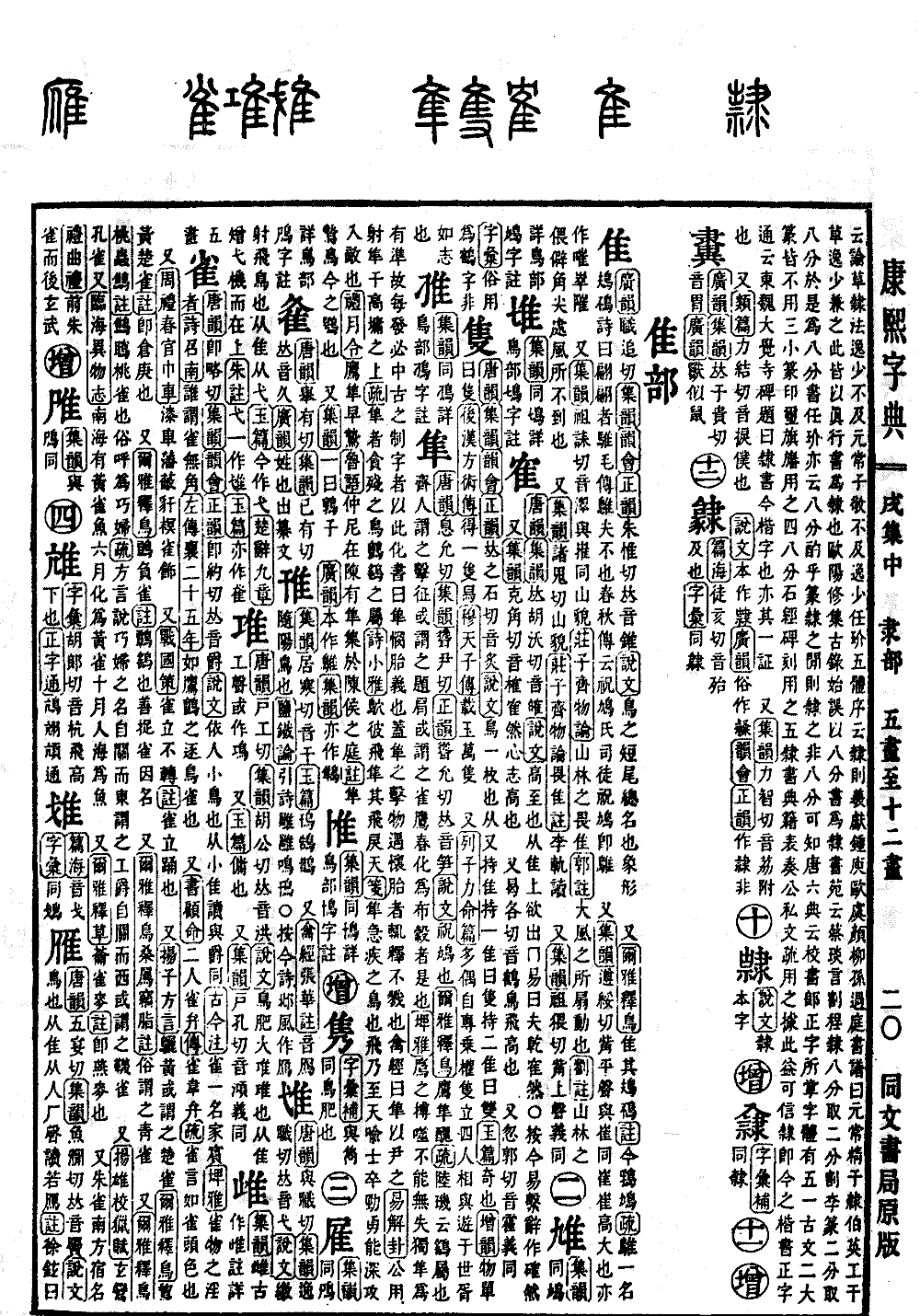
Xu Collection, Middle Volume
Radical: Short-tailed Bird (zhuī)
Kangxi Strokes: 8
Page 1364, Entry 05
Pronounced zhui. In Comprehensive Rhymes (Guangyun), it is pronounced zhui. In Collected Rhymes (Jiyun), Rhyme Meetings (Yunhui), and Orthodox Rhymes (Zhengyun), it is pronounced zhui. The pronunciation is the same as the character for awl.
According to Explaining Graphs and Analyzing Characters (Shuowen Jiezi), it is a general term for short-tailed birds. This is a pictographic character.
Also, in Literary Expositor (Erya), it mentions that the zhui bird is the gufu bird. The commentary notes that this is the pigeon of today. The sub-commentary explains that the zhui is also called the gufu.
The Book of Odes (Shijing) states: The fluttering zhui bird. The Mao commentary explains that the zhui is the fu-bu bird. The Spring and Autumn Annals (Chunqiu Zhuan) states: The zhu-jiu species is the administrator of the masses. The zhu-jiu is the zhui bird.
Also, in Collected Rhymes (Jiyun), it is pronounced zui (level tone). It is the same as the character for high or precipitous. It describes the appearance of being high and great. It is also written as zui or zui.
Also, in Collected Rhymes (Jiyun), it is pronounced zui. It is the same as the character for jagged mountains. It describes the appearance of mountains. Zhuangzi, in the chapter On the Equality of Things (Qiwulun), mentions the fearful zhui of the mountains and forests. The Guo commentary explains this as being moved by strong winds. The Liu commentary explains this as a secluded corner of the mountains and forests where the wind does not reach.
Also, in Collected Rhymes (Jiyun), it is pronounced zhui. It describes the appearance of mountains. Li Gui reads it this way in his commentary on the fearful zhui in the chapter On the Equality of Things.
Also, in Collected Rhymes (Jiyun), it is pronounced zui (rising tone). The meaning is the same.