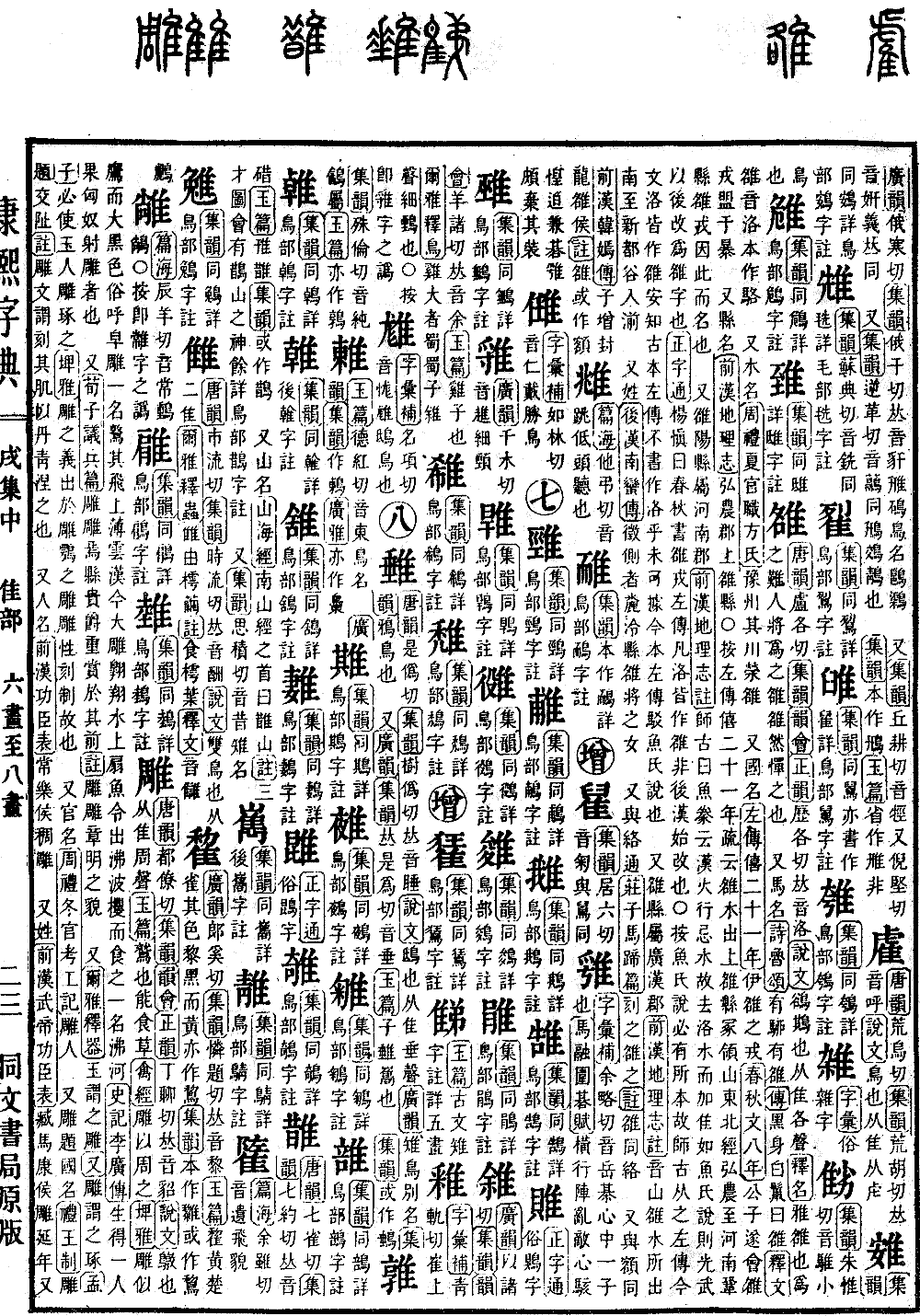
Xu Collection, Middle Volume
Radical: Short-tailed bird (zhuī)
Kangxi Strokes: 14
Page 1367, Entry 11
Pronounced luò. According to the Analytical Dictionary of Characters (Shuowen), it refers to a species of myna bird. The character is formed from the Short-tailed bird (zhuī) radical, with the component meaning each (gè) acting as the phonetic. According to the Explaining Names (Shiming), the term is synonymous with elegant; because a task may be difficult to accomplish, one experiences a sense of luò, meaning to feel apprehensive or afraid. It also refers to a type of horse. According to the Book of Odes (Shijing), in the Hymns of Lu, it mentions chestnut horses and black-maned white horses. The Commentary notes that a horse with a black body and a white mane is called luò. The Explanation of the Text states that the pronunciation is luò, and it was originally written as the character with the water radical. It also refers to a river name. According to the Rites of Zhou (Zhouli), in the Summer Offices, the rivers of Yu Province include the Xing River and the Luo River. It also refers to a state or ethnic group. According to the Zuo Commentary (Zuozhuan), it refers to the Rong tribes in the region of the Yi and Luo rivers. According to the Spring and Autumn Annals (Chunqiu), Gongzi Sui formed an alliance with the Luo Rong at the location of Bao. It also refers to a county name. According to the History of the Former Han (Qianhanshu), Hongnong Commandery includes Shangluo County. The commentary on the Zuo Commentary states that the Luo River originates in the northeast of Mount Zhongling in Shangluo County and flows through Hongnong to Gong County in Henan; the Luo Rong take their name from this river. There is also Luoyang County, which belongs to Henan Commandery. According to the commentary in the History of the Former Han, Yan Shigu cites Yu Huan, who believed that the Han dynasty operated under the virtue of fire and thus avoided the water radical, so the water radical was removed from the character luò and replaced with the short-tailed bird radical. According to Yu Huan, this change occurred only after Emperor Guangwu. The Correction of Characters states that Yang Shen argued that the Spring and Autumn Annals record the Luo Rong, and that throughout the Zuo Commentary, every instance of the character is written as luò, suggesting it was not changed during the Eastern Han. Note: Yu Huan’s assertion must have had a basis, which is why Yan Shigu adopted it. Current versions of the Zuo Commentary all use this form; one cannot know if ancient versions did not use the version with the water radical, so one cannot refute Yu Huan’s claim based on modern versions. There is also Luo County, belonging to Guanghan Commandery. According to the commentary in the History of the Former Han, the pronunciation is shan, which is the place where the Luo River originates, flowing south into the Jian River at Xindu Valley. It also refers to a surname. According to the History of the Later Han (Houhanshu), the biography of the Southern Barbarians, Zheng Ce was the daughter of a Luo general in Miling County. It is also interchangeable with the character meaning to bind or net (luò). According to the Zhuangzi, it refers to the carving and binding of objects. The commentary notes that this is the same as the character for net. It is also interchangeable with the character for forehead. According to the History of the Former Han, the biography of Han Yan, his son Han Zeng was enfeoffed as the Marquis of Longluo. The commentary notes that some versions write this character as the one meaning forehead.