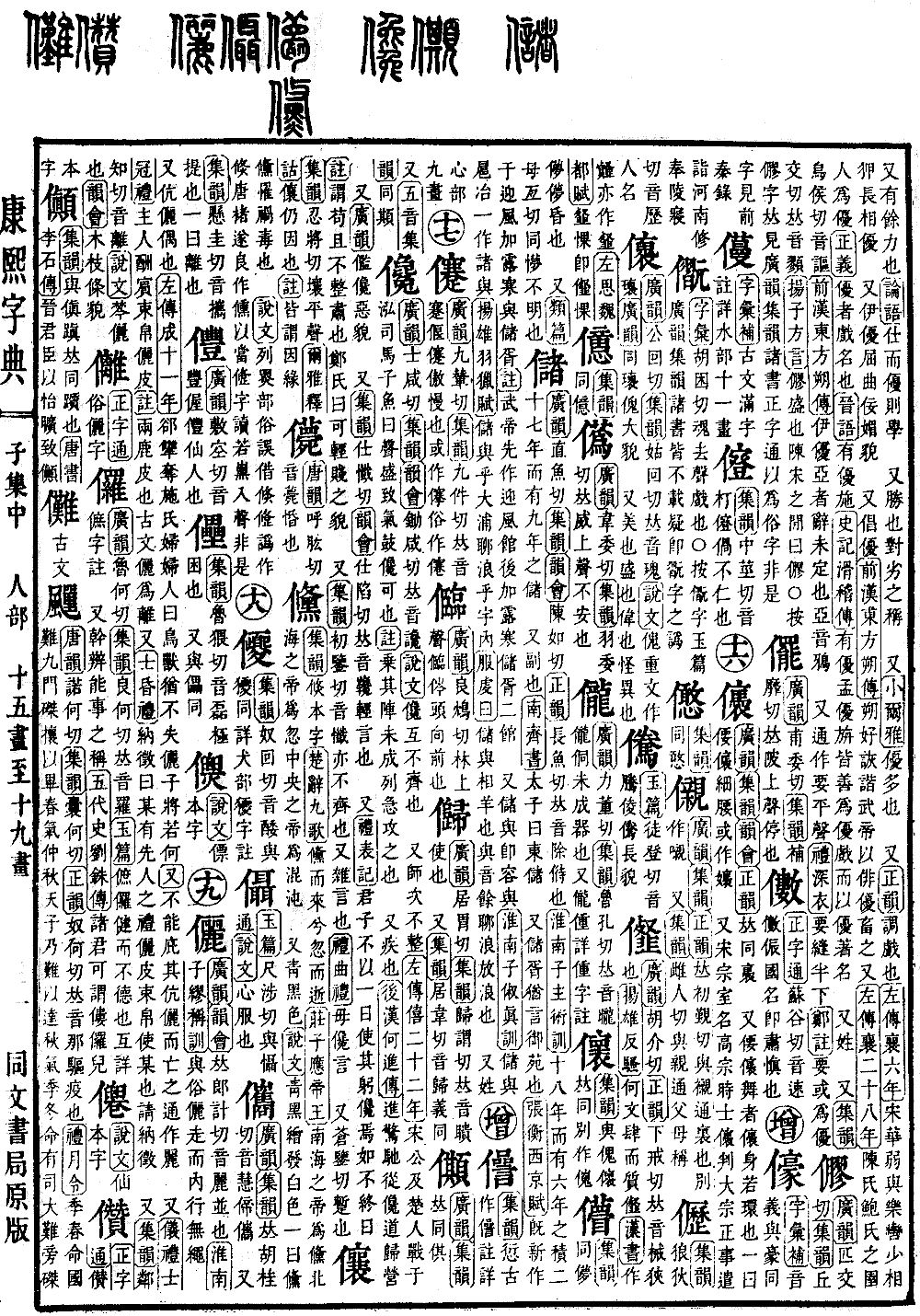
Zi Collection, Middle Volume
Radical: Person (rén)
Character: Nuan
Kangxi Stroke Count: 21
Page 121, Entry 04
Ancient form. Pronounced nuo. Meaning: To expel plagues.
Book of Rites (Liji), Monthly Ordinances (Yueling) records: In the third month of spring, the state performs a rite to expel pestilence, splitting sacrificial animals at the nine city gates to dispel disaster, thereby bringing the breath of spring to a close. In the second month of autumn, the Son of Heaven personally performs the rite to expel pestilence to clear the breath of autumn. In the third month of winter, officials are ordered to perform a grand rite to expel pestilence, splitting animals in the four directions and creating earthen oxen to send away the cold. Note: Here, the character is used interchangeably with nuan (expelling ghosts).
Account of Wonders (Bowuzhi), citing old Han dynasty annals, records that during the expulsion of pestilence, items such as peach-wood figures, reed ropes, cocklebur, and tiger figures are set up.
General Refinements (Tongya) explains: Jian’er is the same as cocklebur. Furthermore, there are twelve deities of pestilence expulsion, all dispatched to pursue malignant spirits. For detailed records, refer to History of the Later Han (Hou Hanshu), Treatise on Rituals (Liyizhi).
Also, the term yi-nuan describes a soft and yielding appearance. Book of Odes (Shijing), Odes of Gui (Guifeng) states: In the low-lying marshes grow actinidia, their branches are soft and beautiful. Book of Odes (Shijing), Lesser Odes (Xiaoya) also states: The mulberry trees in the marshes are so beautiful, their leaves are so lush. Note: Here it describes a lush appearance.
Additionally, according to Collection of Rhymes (Jiyun), it is pronounced na. Book of Odes (Shijing), Odes of Wei (Weifeng) states: The jade pendants sway with a rhythm while walking. Note: Nuan refers to a graceful and orderly manner of walking.
Examination of Ancient Sounds in the Mao Odes (Maoshi Guyinkao) verifies: Yi-nuan is pronounced like e-na. It is also used interchangeably with the characters ni, na, and na.
Songs of Chu (Chuci), Nine Arguments (Jiubian) contains the line: Drifting gracefully through the palace chambers. Song Yu’s Rhapsody on Gaotang (Gaotangfu) contains the description: Graceful and abundant. Zhang Heng’s Rhapsody on the Southern Capital (Nandufu) contains the description: Soft and luxuriant. Cao Zhi’s Rhapsody on the Goddess of the Luo River (Luoshenfu) contains the description: Beautiful and graceful. All have the same pronunciation and meaning.