Si Collection, Upper Volume
Radical: Water (shuǐ)
Kangxi Strokes: 22
Page 662, Entry 35
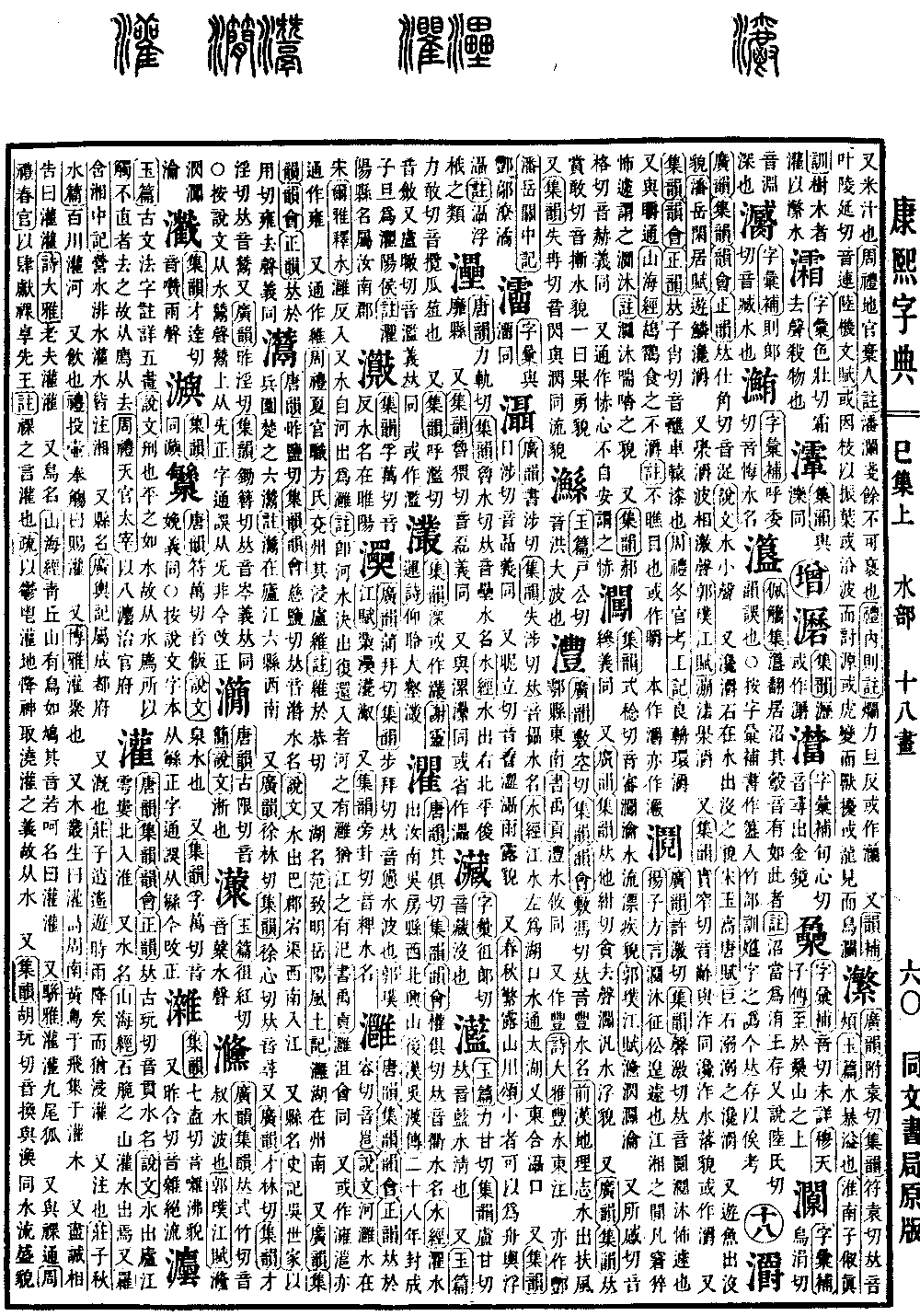
Pronounced guan. Name of a river. According to the Shuowen (Explanation of Words and Phrases), the river originates in Yulou, Lujiang, and flows north into the Huai River. Also a river name. In the Classic of Mountains and Seas (Shanhaijing), it is written that on Mount Shicui, the Guan River originates. Also, according to the Xiangzhong Ji (Records of Central Xiang) by Luo Han, the Ying River, the Fei River, and the Guan River all flow into the Xiang River. Also the name of a county. According to the Guangyu Ji (Comprehensive Geographic Records), it belongs to the Chengdu Prefecture. Also means to irrigate. In the Zhuangzi (Zhuangzi), it is written that when the seasonal rain falls, one still practices irrigation. Also means to pour into. In the Zhuangzi (Autumn Floods chapter), it is written that a hundred rivers pour into the Yellow River. Also means to drink. In the Book of Rites (Liji), specifically the Throwing Pot chapter, it is written that when presenting a cup, one says to pour. Also, according to the Boya (Wide Elegant), guan means to gather. Also, trees growing in thickets are called guan. In the Book of Odes (Shijing), it is written that yellow birds fly and gather in the thickets. Also, to tell someone something with complete sincerity is called guanguan. In the Book of Odes (Shijing), it is written that this old man is sincere. Also, the name of a bird. In the Classic of Mountains and Seas (Shanhaijing), it is written that on Mount Qingqiu there is a bird resembling a turtledove, whose sound is like a reprimand, known as guanguan. Also, according to the Pianya (Categorized Elegant), guanguan is a nine-tailed fox. Also interchangeable with the term for libation (luo). In the Rites of Zhou (Zhouli), it is written that the Spring Office uses offerings to perform libations to ancestral kings. The commentary states that the word luo means to pour. The sub-commentary explains that using fragrant wine to pour onto the ground to invite the descent of spirits takes the meaning of pouring, hence the character is derived from water. Also, pronounced huan. Interchangeable with huan. Describes a state of overflowing water. Also, pronounced guan. Interchangeable with the term for washing (guan). Refers to washing the hands.